JHS1 Mathematics · Term 3, Week 12
Chance or Probability
Lesson notes
Learning Objectives
Indicator: B7.4.2.1.2 - Classify the likelihood of a single outcome occurring in a probability experiment as impossible, possible, or certain
By the end of the lesson, learners can:
- Classify the likelihood of a single outcome in a probability experiment as impossible, possible, or certain, with accurate justification for each classification.
- Apply the words impossible, possible, and certain correctly to outcomes of throwing a single die and two dice.
- Justify their classifications using the sample space (the set of all possible outcomes) of the experiment.
- Work in pairs or small groups to discuss and agree on the classification of outcomes, communicating their reasoning clearly to peers.
- Distinguish between outcomes that are impossible, possible, or certain in both mathematical experiments and everyday Ghanaian situations.
Sign in with your phone number to read the full note and download the GES plan - free.
Sign in with phone numberCurriculum details
- Strand
- Handling Data (Strand 4)
- Sub-strand
- Chance or Probability (4.2)
- Content standard
- B7.4.2.1 - Identify the sample space for a probability experiment involving single events and express the probabilities of given events as fractions, decimals, percentages and/or ratios to solve problems
- Indicator
- B7.4.2.1.2 - Classify the likelihood of a single outcome occurring in a probability experiment as impossible, possible, or certain
- Suggested placement
-
Term 3, Week 12
(Week 36 of the year)
Our suggestion, laid out in curriculum order across three terms of twelve weeks. NaCCA does not fix the week, so follow your school's scheme of learning.
- Curriculum reference
-
Mathematics, Common Core Programme (JHS1-JHS3), 2023, p. 87
Transcribed from the official NaCCA publication. Check this page against the source.
Exemplars (from the NaCCA curriculum)

E.g. 1 Discuss the following outcomes of throwing a die using words like impossible, possible, or certain. A. Obtaining the number 1 B. Obtaining the number 7 C. Obtaining the number 4
E.g. 2 Discuss the following outcomes of throwing two
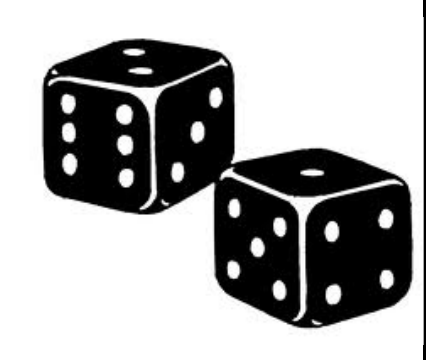
dice using words like impossible, possible, or certain. A. Obtaining a total of 12 B. Obtaining a total of 2 C. Obtaining a total of 13