SHS1 Mathematics · Semester 1, Week 11
Applications of Expressions, Equations and Inequalities
Lesson notes
Learning Objectives
Indicator: 1.2.1.LI.3 - Recognise perfect squares and apply the idea to solve problems, including the difference of two squares of binomials.
By the end of the lesson, learners can:
- Identify perfect squares by observing the pattern that each square number is the sum of consecutive odd numbers (for example, 0 + 1 = 1, 1 + 3 = 4, 4 + 5 = 9).
- Recognise a binomial as a difference of two squares when both terms are perfect squares separated by a minus sign (for example, x² - 4, 9y² - 25).
- Factorise expressions of the form a² - b² into (a + b)(a - b) correctly.
- Apply the difference of two squares technique to solve problems involving numbers and simple algebraic expressions.
- Use the difference of two squares pattern to evaluate numerical products mentally, such as 102 × 98, without a calculator.
Sign in with your phone number to read the full note and download the GES plan - free.
Sign in with phone numberCurriculum details
- Strand
- Algebraic Reasoning (Strand 2)
- Sub-strand
- Applications of Expressions, Equations and Inequalities (2.1)
- Content standard
- 1.2.1.CS.1 - Demonstrate knowledge and understanding of algebraic expressions and solve real-life problems on them. 1.2.1.LO.1 Formulate algebraic expressions using patterns to create models and solve real life problems (e.g., linear and quadratic models).
- Indicator
- 1.2.1.LI.3 - Recognise perfect squares and apply the idea to solve problems, including the difference of two squares of binomials.
- Suggested placement
-
Semester 1, Week 11
(Week 11 of the year)
Our suggestion, laid out in curriculum order across three terms of twelve weeks. NaCCA does not fix the week, so follow your school's scheme of learning.
- Curriculum reference
- NaCCA curriculum document, p. 58
Exemplars (from the NaCCA curriculum)
Group Work/Collaborative Learning, Problem-based Learning and self-paced learning.
In convenient groups, learners explore the concept of perfect squares using whole numbers.
Example: 0+1=1, 1+3=4, 4+5=9, etc. Working collaboratively, learners brainstorm the meaning of perfect squares, identify differences of two squares, and use problem-solving strategies to apply the concepts of perfect squares. Employ differentiated assessment and ensure values such as tolerance, truth, honesty, respect for others' views, etc., among learners.
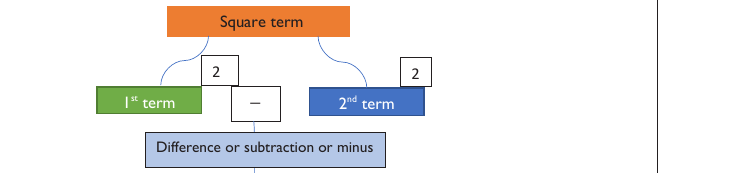
 Square term
1 st term − 2 nd term
Difference or subtraction or minus
For example, 𝑥 2 − 4, 𝑦 2 − 1
Note that whenever you have a binomial with each term being squared (i.e. having an exponent of 2) and subtraction as the middle sign, then you are guaranteed to have the case of difference of two squares.
Teaching and Learning Resources:
- Algebraic tiles
- Patterns
- calculator
- technology tools such as
- computer
- mobile phone
- YouTube videos, etc.
- Paper grids
- Maths posters
- YouTube videos
- Whiteboard
- Pan balance
- Videos
- mini whiteboards or laminated white paper
- Dry-erase markers and erasers
Assessment (1.2.1.AS.3). The document marks no depth-of-knowledge level for this indicator.