JHS3 Mathematics · Term 2, Week 7
Algebraic Expressions
Lesson notes
Learning Objectives
Indicator: B9.2.2.1.4 - Use the knowledge of simplifying and factorising expressions to solve real world problems.
By the end of the lesson, learners can:
- Identify which algebraic skill (simplifying, substituting, or factorising) is needed to solve a given real world problem.
- Formulate algebraic expressions from word problems involving quantities such as money, measurements, and quantities of items.
- Apply simplification and substitution to evaluate expressions that model practical situations and state the answer with appropriate units.
- Apply factorisation to solve problems involving products, such as finding unknown dimensions when the area is given.
- Use a step by step approach to check whether their algebraic solution answers the original question asked in the problem.
Sign in with your phone number to read the full note and download the GES plan - free.
Sign in with phone numberCurriculum details
- Strand
- Algebra (Strand 2)
- Sub-strand
- Algebraic Expressions (2.2)
- Content standard
- B9.2.2.1 - Demonstrate an understanding of (i) change of subject (ii) substituting values to evaluate expressions, and (iii) factorize expressions that have simple binomial as a factor.
- Indicator
- B9.2.2.1.4 - Use the knowledge of simplifying and factorising expressions to solve real world problems.
- Suggested placement
-
Term 2, Week 7
(Week 19 of the year)
Our suggestion, laid out in curriculum order across three terms of twelve weeks. NaCCA does not fix the week, so follow your school's scheme of learning.
- Curriculum reference
-
Mathematics, Common Core Programme (JHS1-JHS3), 2023, p. 187
Transcribed from the official NaCCA publication. Check this page against the source.
Exemplars (from the NaCCA curriculum)
E.g.1 You purchased 10 items from a shopping plaza, and now you need plastic bags to carry them home. If each bag can hold only 3 items, how many plastic bags will you need to accommodate the10 items?
Solution: We use simple algebraic formula x to calculate the number of bags. y
x = Number of items purchased = 10 y = Capacity of 1 bag = 3
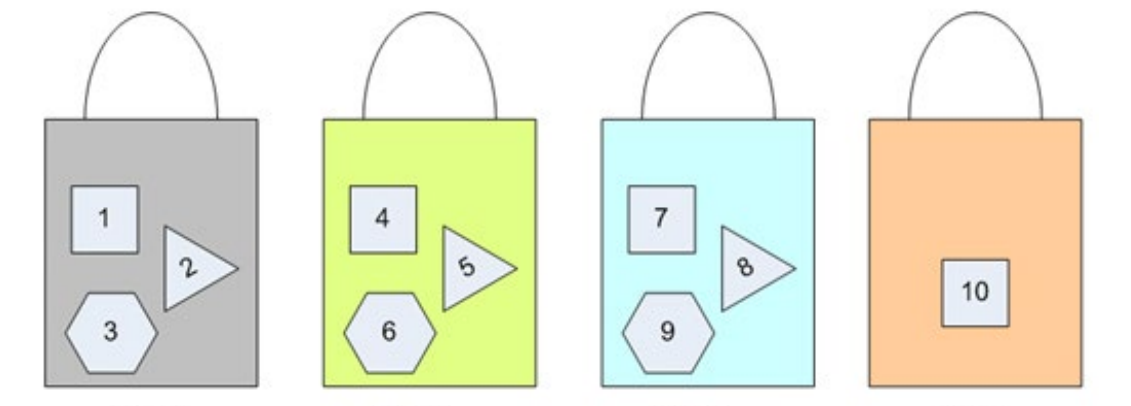
Hence, 10 = 3.333 bags 3 = 4 bags
So, we need 4 shopping bags to carry 10 items.
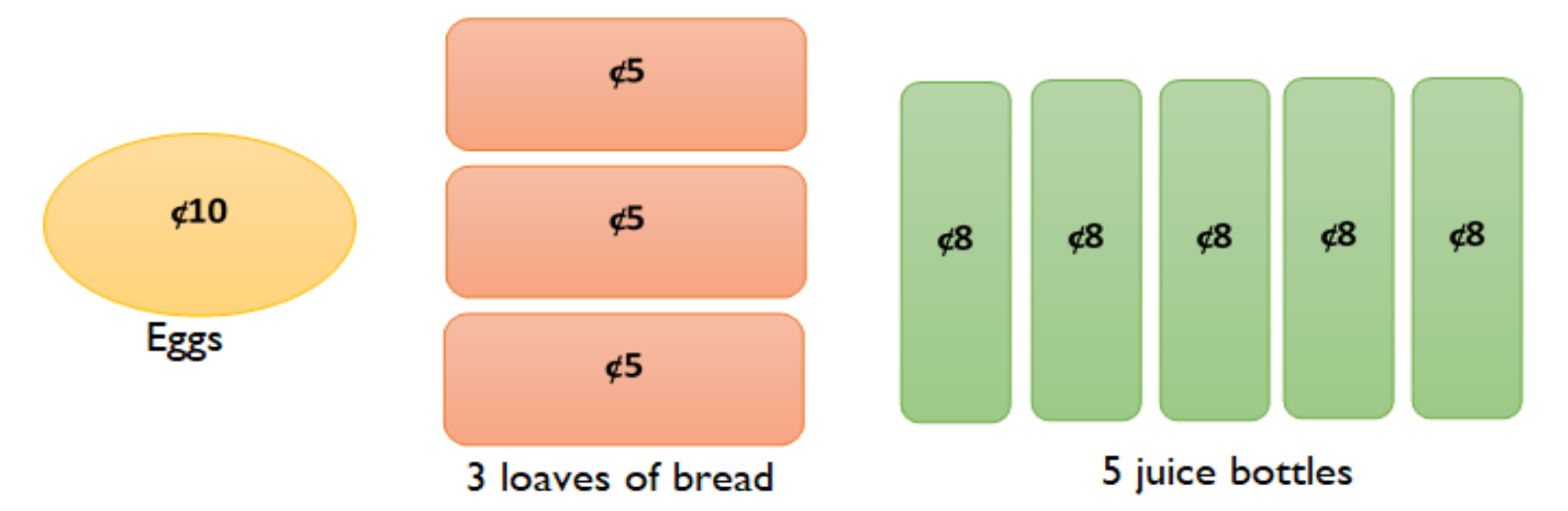
E.g.2 You have to buy two dozen of eggs priced at GH₵10, three loaves breads (each bread is GH₵5), and five bottles of juice (each bottle is GH₵8). How much money you will need to take to the grocery store? The prices are a = Price of two dozen eggs = GH₵10 b = Price of one bread = GH₵5 c = Price of one bottle of juice = GH₵8 => Money needed = a + 3b + 5c => Money needed = GH₵10 + 3(GH₵5) + 5(GH₵8) = GH₵10 + GH₵15 + GH₵40 = GH₵65
E.g.3 The area of a rectangle is 72 cm 2 . The length is twice its width. What is the length and width of the rectangle? Let "x" be the width and "2x" be the length. Length × Width = Area x × (2x) = 2x 2 = Area 2x 2 = Area 2x 2 = 72 2x 2 72 =
2 2
x 2 = 36 x = 6 width = 6cm 2x = 2 x 6 = 12 So, the length is 12 cm