B4 Mathematics · Term 3, Week 2
2D and 3D Shapes
Lesson notes
Learning Objectives
Indicator: B4.3.1.1.2 - Identify the lines of symmetry of regular and irregular 2D shapes (triangles and quadrilateral)
By the end of the lesson, learners can:
- Define a line of symmetry as a line that divides a 2D shape into two identical halves that match exactly when folded.
- Identify and draw all lines of symmetry on regular triangles (equilateral) and irregular triangles (scalene and isosceles).
- Identify and draw all lines of symmetry on regular quadrilaterals (square) and irregular quadrilaterals (rectangle, rhombus, parallelogram, trapezium, kite).
- Sort 2D shapes into symmetrical and non-symmetrical groups and justify their sorting by showing the lines of symmetry.
- State the number of lines of symmetry for each type of triangle and quadrilateral studied, with precision.
Sign in with your phone number to read the full note and download the GES plan - free.
Sign in with phone numberCurriculum details
- Strand
- Geometry and Measurement (Strand 3)
- Sub-strand
- 2D and 3D Shapes (3.1)
- Content standard
- B4.3.1.1 - Identify the lines of symmetry of regular and irregular 2D shapes
- Indicator
- B4.3.1.1.2 - Identify the lines of symmetry of regular and irregular 2D shapes (triangles and quadrilateral)
- Suggested placement
-
Term 3, Week 2
(Week 26 of the year)
Our suggestion, laid out in curriculum order across three terms of twelve weeks. NaCCA does not fix the week, so follow your school's scheme of learning.
- Curriculum reference
-
Mathematics Curriculum for Primary Schools (Basic 4-6), 2019, p. 36
Transcribed from the official NaCCA publication. Check this page against the source.
Exemplars (from the NaCCA curriculum)
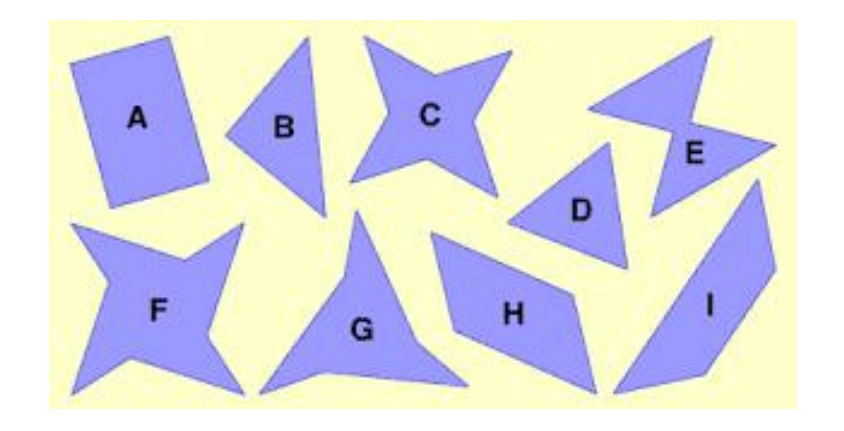
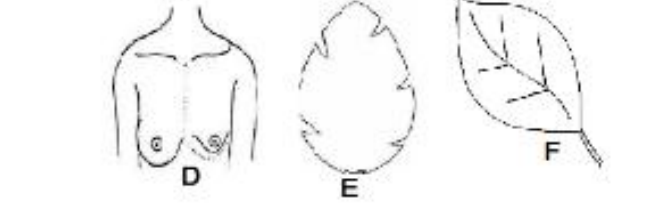
E.g. 1. Give learners photocopied worksheets with symmetrical and non-symmetrical objects to sort and explain why they are symmetrical or not showing the lines of symmetry
E.g. 2. Give learners photocopied worksheets with symmetrical and non-symmetrical 2D shapes to cut out and sort, and explain why they are symmetrical or not showing the lines of symmetry
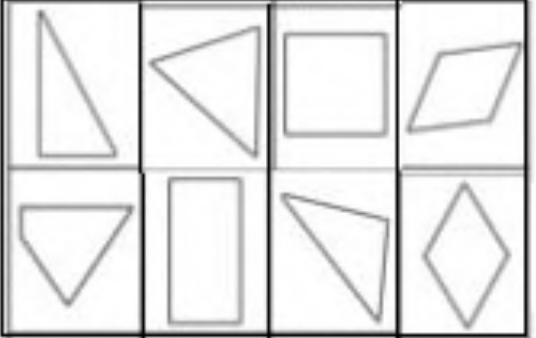
E.g. 3 Give learners cut-out 2D fold shapes to investigate the number of lines of symmetry
E.g. 4 Give learners 2-D shapes to copy and draw their lines of symmetry