B5 Mathematics · Term 2, Week 2
Ratios and Proportion
Lesson notes
Learning Objectives
Indicator: B5.1.4.1.1 - Describe and represent decimals (up to the thousandths) concretely, pictorially, and symbolically and relate them to fractions
By the end of the lesson, learners can:
- Read and write decimal fractions up to the thousandths place using a place value chart.
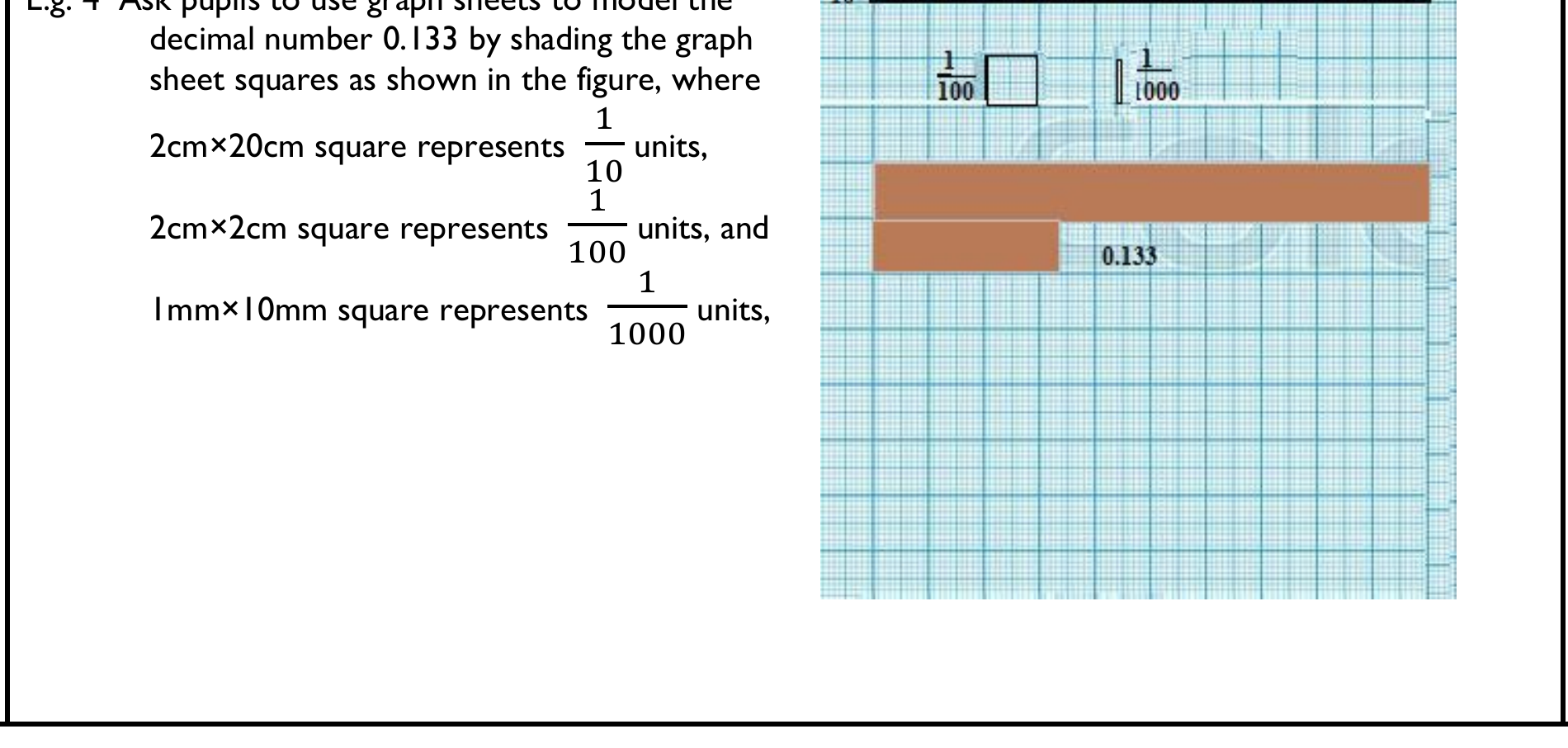
- Represent a given decimal such as 0.133 concretely by shading grid models and pictorially on number lines.
- Convert common fractions such as 3/8 and 1/4 into equivalent hundredths or thousandths and write them as decimals.
- Express decimals up to the thousandths symbolically as common fractions (e.g., write 0.45 as 45/100).
- Explain the meaning of the decimal point and why it separates the whole number part from the fractional part.
Sign in with your phone number to read the full note and download the GES plan - free.
Sign in with phone numberCurriculum details
- Strand
- Number (Strand 1)
- Sub-strand
- Ratios and Proportion (1.4)
- Content standard
- B5.1.4.1 - Demonstrate understanding of decimals fractions and strategies for comparing, adding and subtracting decimal fraction
- Indicator
- B5.1.4.1.1 - Describe and represent decimals (up to the thousandths) concretely, pictorially, and symbolically and relate them to fractions
- Suggested placement
-
Term 2, Week 2
(Week 14 of the year)
Our suggestion, laid out in curriculum order across three terms of twelve weeks. NaCCA does not fix the week, so follow your school's scheme of learning.
- Source document note
-
The official curriculum document has a fault in this entry, so the curriculum text above is transcribed exactly as printed:
- exemplars - p.77
- Curriculum reference
-
Mathematics Curriculum for Primary Schools (Basic 4-6), 2019, p. 76
Transcribed from the official NaCCA publication. Check this page against the source.
Exemplars (from the NaCCA curriculum)
E.g. 1 Use several pictorial representations or number line to introduce tenths and thousandths and ask pupils to identify the fractions (i.e. A, B, C, D, E, & F)

E.g. 2 Use the tenth to thousandth place value chart to illustrate how to write the fraction as a base ten number with the introduction of the decimal point "∙" after ones place in the place value chart
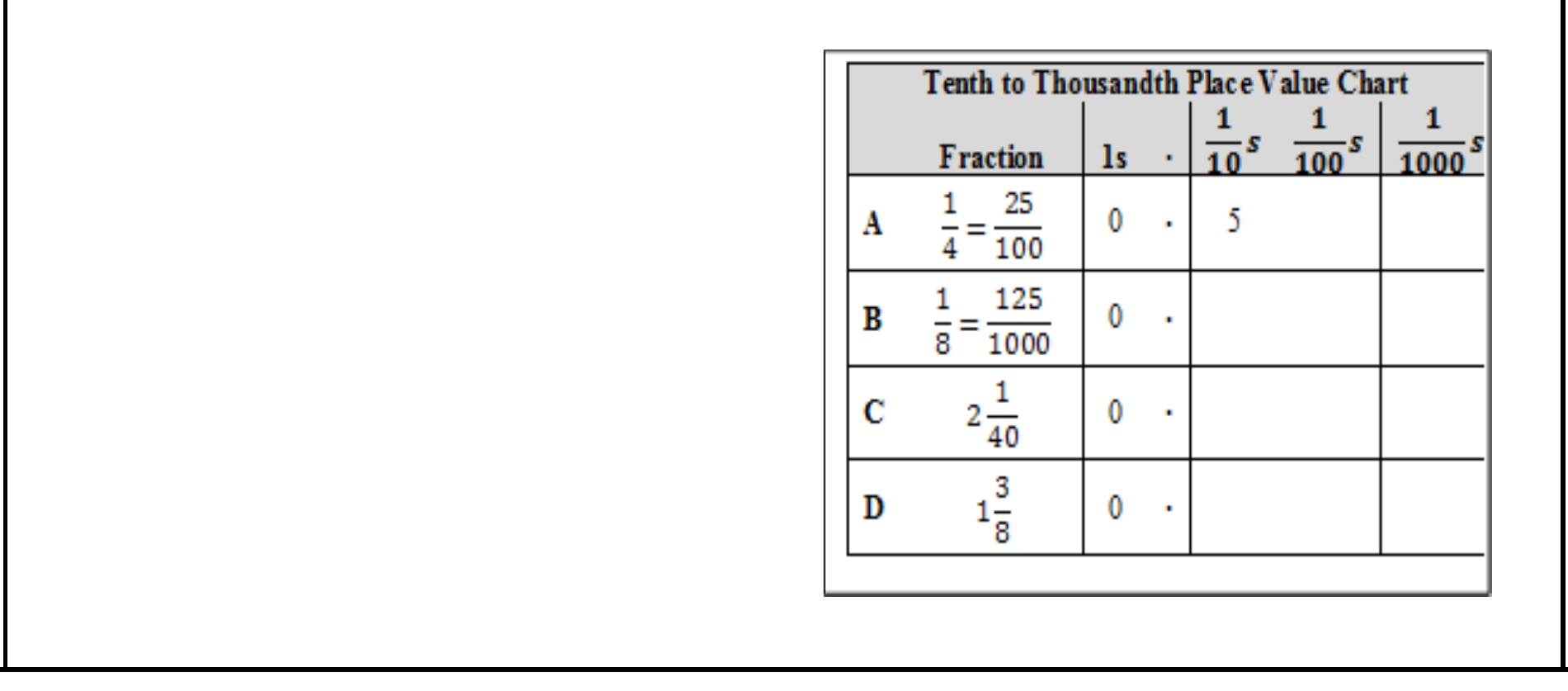
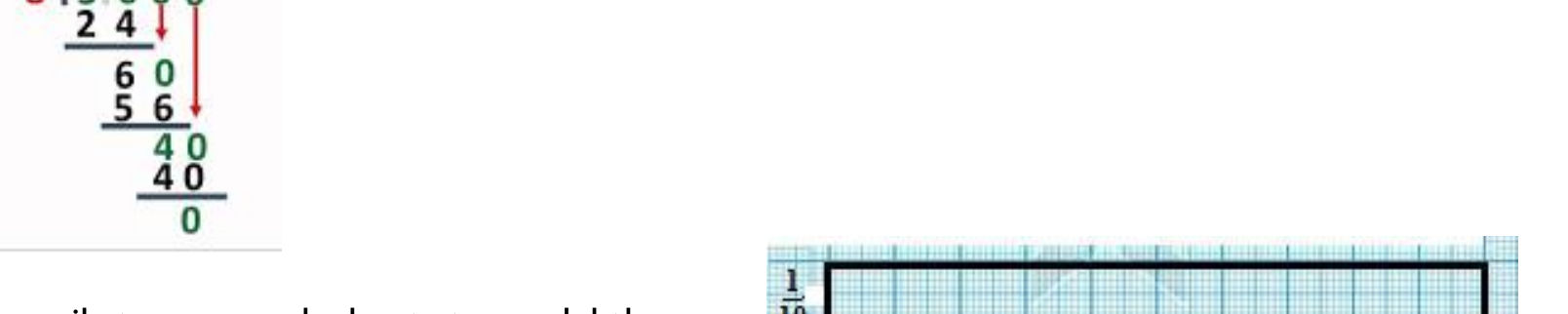
E.g. 3 Give pupils several common fractions (including improper fractions) to convert into hundredths and thousandths and write their decimal names; e.g. 3/8
E.g. 4 Ask pupils to use graph sheets to model the decimal number 0.133 by shading the graph sheet squares as shown in the figure, where 2cm x 20cm square represents 1/10 units, 2cm x 2cm square represents 1/100 units, and 1mm x 10mm square represents 1/1000 units
E.g. 3 and E.g. 4 are printed on p.77 under the heading "B5.1.2.1.1. Multiply multi-digit numbers by 2-digit numbers efficiently", which is a stray heading: the content standard cell on that page is B5.1.4.1 (decimals) CONT'D, the exemplars are about decimals, and B5.1.2.1.1 is a different indicator printed on p.65. They are transcribed here as the continuation of B5.1.4.1.1. The fractions are stacked and are written inline.