B5 Mathematics · Term 2, Week 2
Number: Fractions
Lesson notes
Learning Objectives
Indicator: B5.1.3.1.6 - Use models to explain the result of multiplying a fraction by whole number
By the end of the lesson, learners can:
- Use rectangular area models (shaded grids) to show that multiplying a fraction by a whole number means finding “of” that number of objects.
- Multiply a proper fraction by a whole number using models and record the product as an improper fraction and as a mixed number (e.g., 2/3 × 5 = 10/3 = 3 1/3).
- Convert a mixed number to an improper fraction and multiply it by a whole number, simplifying the result (e.g., 4 4/5 × 5 = 24).
- Explain their reasoning using the language “of” (e.g., “2/3 × 5 means 2/3 of 5”) and justify their answer with a drawn or shaded model.
- Solve a word problem involving multiplying a fraction by a whole number in a Ghanaian market or daily-life setting, showing the model and the computation.
Sign in with your phone number to read the full note and download the GES plan - free.
Sign in with phone numberCurriculum details
- Strand
- Number (Strand 1)
- Sub-strand
- Number: Fractions (1.3)
- Content standard
- B5.1.3.1 - Demonstrate understanding of strategies for comparing, adding, subtracting and multiplying fractions
- Indicator
- B5.1.3.1.6 - Use models to explain the result of multiplying a fraction by whole number
- Suggested placement
-
Term 2, Week 2
(Week 14 of the year)
Our suggestion, laid out in curriculum order across three terms of twelve weeks. NaCCA does not fix the week, so follow your school's scheme of learning.
- Source document note
-
The official curriculum document has a fault in this entry, so the curriculum text above is transcribed exactly as printed:
- exemplars - p.74
- Curriculum reference
-
Mathematics Curriculum for Primary Schools (Basic 4-6), 2019, p. 74
Transcribed from the official NaCCA publication. Check this page against the source.
Exemplars (from the NaCCA curriculum)
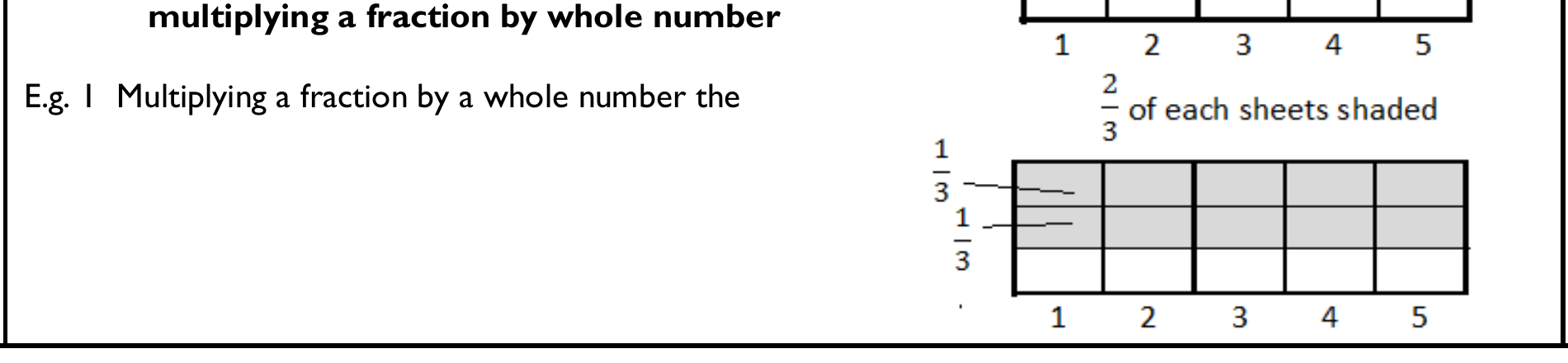
E.g. 1 Multiplying a fraction by a whole number the multiplication is interpreted as "of"; e.g. 2/3 x 5 means shade 2/3 of 5; i.e. finding two-thirds of each of five objects; i.e. 2/3 x 5 can be illustrated by shading 2/3 of 5 sheets of paper, which leads to the shading of 10 thirds, 2/3 x 5 = 2/3 of 5 = 10(1/3) = 10/3 = 3 1/3
E.g. 2 To multiply a mixed fraction by a whole number (e.g. 4 4/5 x 5) first change all into common fractions, then multiply the numerators separately and multiply the denominators separately and simplify; i.e. 4 4/5 x 5 = 24/5 x 5/1 = 120/5 = 24 Every fraction on this page is stacked and its parts interleave with the sentence in the text layer; they are written here inline. A reviewer should check each fraction against the page.