B5 Mathematics · Term 1, Week 9
Number Operations
Lesson notes
Learning Objectives
Indicator: B5.1.2.3.1 - Determine basic division fact up to 81
By the end of the lesson, learners can:
- State division facts up to 81 (dividing by 1 through 9) and give the quotient correctly.
- Apply divisibility tests for 2, 3, 4, 5, 6, and 9 to determine whether a number up to 81 is divisible by a given divisor.
- Use a multiplication chart to find quotients by locating the dividend and reading the corresponding divisor and quotient.
- Solve simple division word problems using basic division facts up to 81, showing working and the correct quotient.
- Justify their answers by explaining how they used multiplication to check a division fact.
Sign in with your phone number to read the full note and download the GES plan - free.
Sign in with phone numberCurriculum details
- Strand
- Number (Strand 1)
- Sub-strand
- Number Operations (1.2)
- Content standard
- B5.1.2.3 - Recall basic division fact up to 100
- Indicator
- B5.1.2.3.1 - Determine basic division fact up to 81
- Suggested placement
-
Term 1, Week 9
(Week 9 of the year)
Our suggestion, laid out in curriculum order across three terms of twelve weeks. NaCCA does not fix the week, so follow your school's scheme of learning.
- Curriculum reference
-
Mathematics Curriculum for Primary Schools (Basic 4-6), 2019, p. 69
Transcribed from the official NaCCA publication. Check this page against the source.
Exemplars (from the NaCCA curriculum)
E.g. 1. Investigate numbers that are multiples of 3,4, 6, 8 and 9. How do you know a number is divisible by 3, 4, 6, 9? (This is also known as the divisibility test).
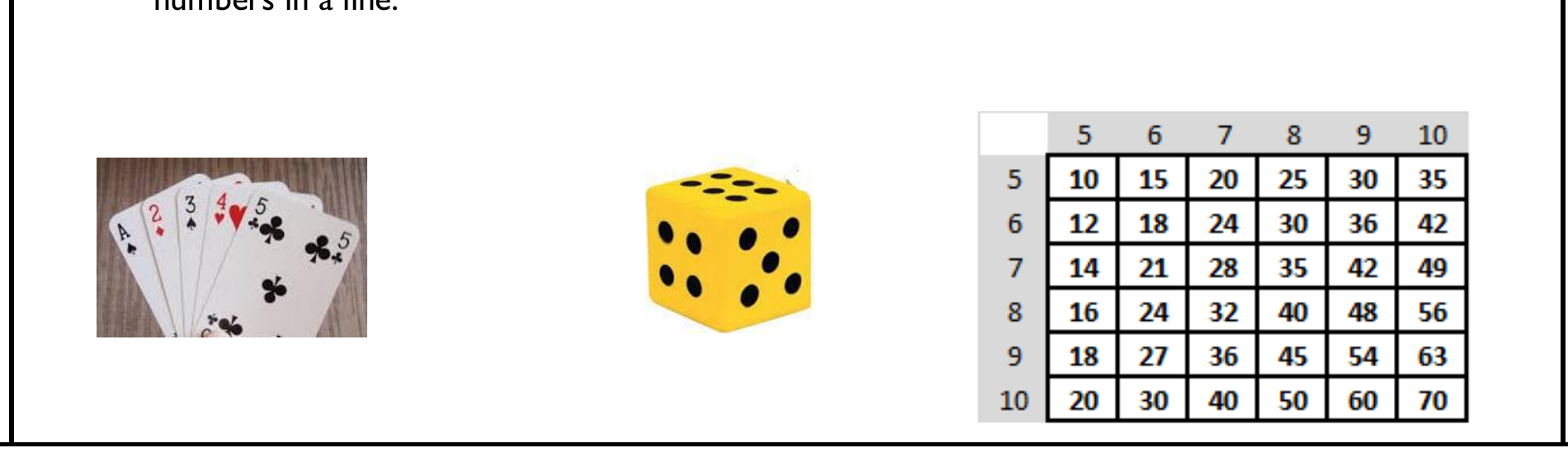
E.g. 2. Draw a 6 by 6 multiplication chart and use it as a game board to play the 3-in-a-line game with a pair of dice or playing cards. Players take turns in throwing a one dice and mark (or cover) a number that can be divided by the results (i.e. a quotient). The winner is the one who obtains three numbers in a line.