B5 Mathematics · Term 1, Week 6
Counting, Representation & Cardinality
Lesson notes
Learning Objectives
Indicator: B5.1.1.3.4 - Determine the highest common factor of any 2 or 3 numbers by prime factorisation
By the end of the lesson, learners can:
- Use the factor tree method to find the prime factors of any whole number from 1 to 100.
- Express composite numbers as products of their prime factors in index or expanded form (e.g., 36 = 2 × 2 × 3 × 3).
- Determine the highest common factor (HCF) of two numbers by identifying and multiplying their common prime factors.
- Determine the highest common factor (HCF) of three numbers using the prime factorisation table method.
- Solve simple word problems involving HCF in everyday situations.
Sign in with your phone number to read the full note and download the GES plan - free.
Sign in with phone numberCurriculum details
- Strand
- Number (Strand 1)
- Sub-strand
- Counting, Representation & Cardinality (1.1)
- Content standard
- B5.1.1.3 - Demonstrate an understanding of factors, multiples of numbers including composite, even, odd and prime numbers from 1 to 100
- Indicator
- B5.1.1.3.4 - Determine the highest common factor of any 2 or 3 numbers by prime factorisation
- Suggested placement
-
Term 1, Week 6
(Week 6 of the year)
Our suggestion, laid out in curriculum order across three terms of twelve weeks. NaCCA does not fix the week, so follow your school's scheme of learning.
- Curriculum reference
-
Mathematics Curriculum for Primary Schools (Basic 4-6), 2019, p. 63
Transcribed from the official NaCCA publication. Check this page against the source.
Exemplars (from the NaCCA curriculum)
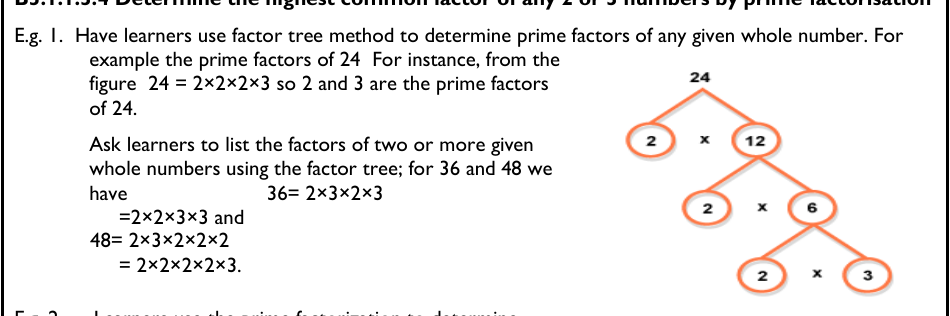
E.g. 1. Have learners use factor tree method to determine prime factors of any given whole number. For example the prime factors of 24 For instance, from the figure 24 = 2×2×2×3 so 2 and 3 are the prime factors of 24. Ask learners to list the factors of two or more given whole numbers using the factor tree; for 36 and 48 we have 36= 2×3×2×3 =2×2×3×3 and 48= 2×3×2×2×2 = 2×2×2×2×3.
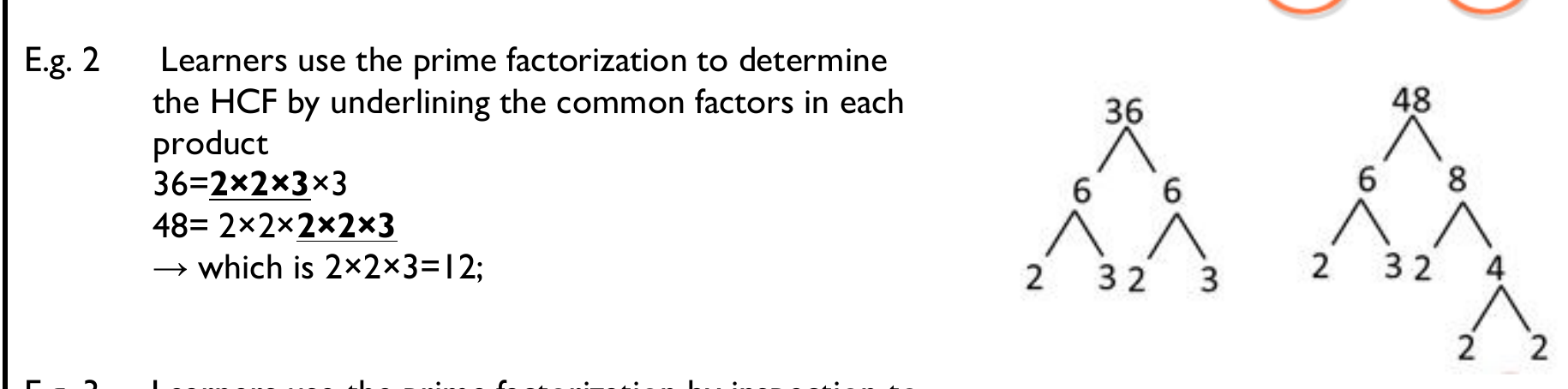
E.g. 2 Learners use the prime factorization to determine the HCF by underlining the common factors in each product 36=2×2×3×3 48= 2×2×2×2×3 → which is 2×2×3=12;
E.g. 3 Learners use the prime factorization by inspection to determine the LCM by underlining the largest number of factors in each product 36=2×2×3×3 48= 2×2×2×2×3 → which is 2×2×2×2×3×3=144
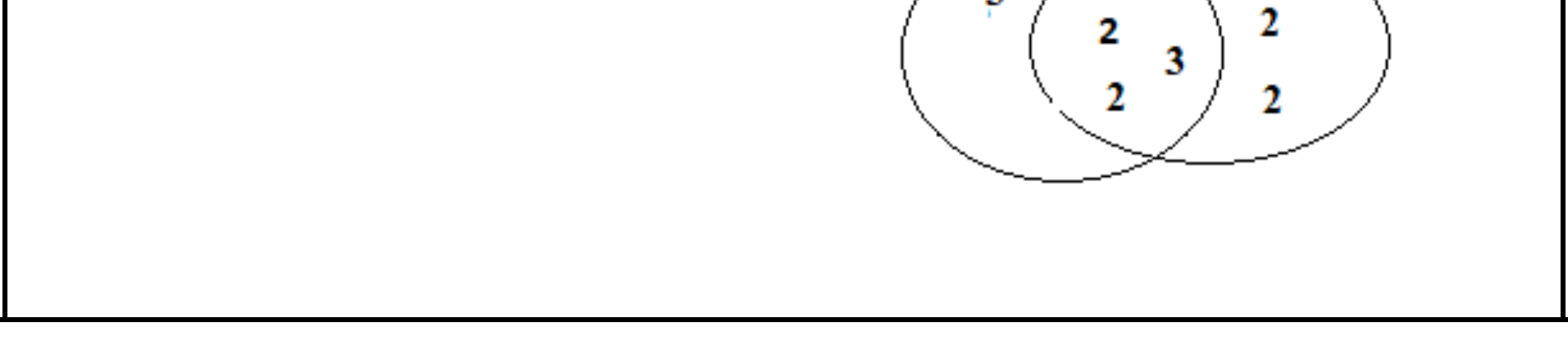
E.g. 4 Learners place factors in a Venn diagrams to find the HCF and LCM of 36 and 48. i.e. the HCF is product of factors in both circles →2×2×3=12; and the LCM is product of factors in the diagram →3×2×2×3×2×2 =144
E.g. 5 Learners use the prime factorization to determine the LCM and HCF of three numbers using (i) prime factorization using table and dividing through by prime factors. Example 1, find the LCM and HCF these sets of numbers: 12, 20 and 30. (see method in figure), i.e. HCF = 2, and LCM = 2×2×3×5 = 60.