B5 Mathematics · Term 1, Week 1
Counting, Representation & Cardinality
Lesson notes
Learning Objectives
Indicator: B5.1.1.1.2
By the end of the lesson, learners can:
- Read aloud 7-digit numbers up to 1,000,000 in figures correctly, using the correct place value names (millions, hundred-thousands, ten-thousands, etc.).
- Write numbers up to 1,000,000 in words, placing commas and spaces correctly (e.g., 462,318 as “four hundred and sixty-two thousand, three hundred and eighteen”).
- Convert numbers written in words into figures (e.g., “seven hundred and five thousand, two hundred and nine” becomes 705,209).
- Expand 7-digit numbers into their expanded form using place value, such as 2,524,513 = 2,000,000 + 500,000 + 20,000 + 4,000 + 500 + 10 + 3.
- Generate 7-digit numbers using a number wheel or similar game and state the number created from the place value rings.
Sign in with your phone number to read the full note and download the GES plan - free.
Sign in with phone numberCurriculum details
- Strand
- Number (Strand 1)
- Sub-strand
- Counting, Representation & Cardinality (1.1)
- Content standard
- B5.1.1.1 - Demonstrate an understanding of quantities and place value for multi-digit numerals up to 1000,000
- Indicator
- B5.1.1.1.2 - Read and write numbers in figures and in words up to 1000,000
- Suggested placement
-
Term 1, Week 1
(Week 1 of the year)
Our suggestion, laid out in curriculum order across three terms of twelve weeks. NaCCA does not fix the week, so follow your school's scheme of learning.
- Curriculum reference
-
Mathematics Curriculum for Primary Schools (Basic 4-6), 2019, p. 56
Transcribed from the official NaCCA publication. Check this page against the source.
Exemplars (from the NaCCA curriculum)
E.g. 1 Play the place value number wheel game: Use the million number wheel to generate 7-digit numbers and represent the number generated on a place value frame. Throw a number of pebbles (or stones) onto the number wheel, identify the number of pebbles landing in each place value ring, and state the number generated in the wheel (i.e. 2 landed in the ten-thousands' ring making the number twenty- thousand or 20,000)
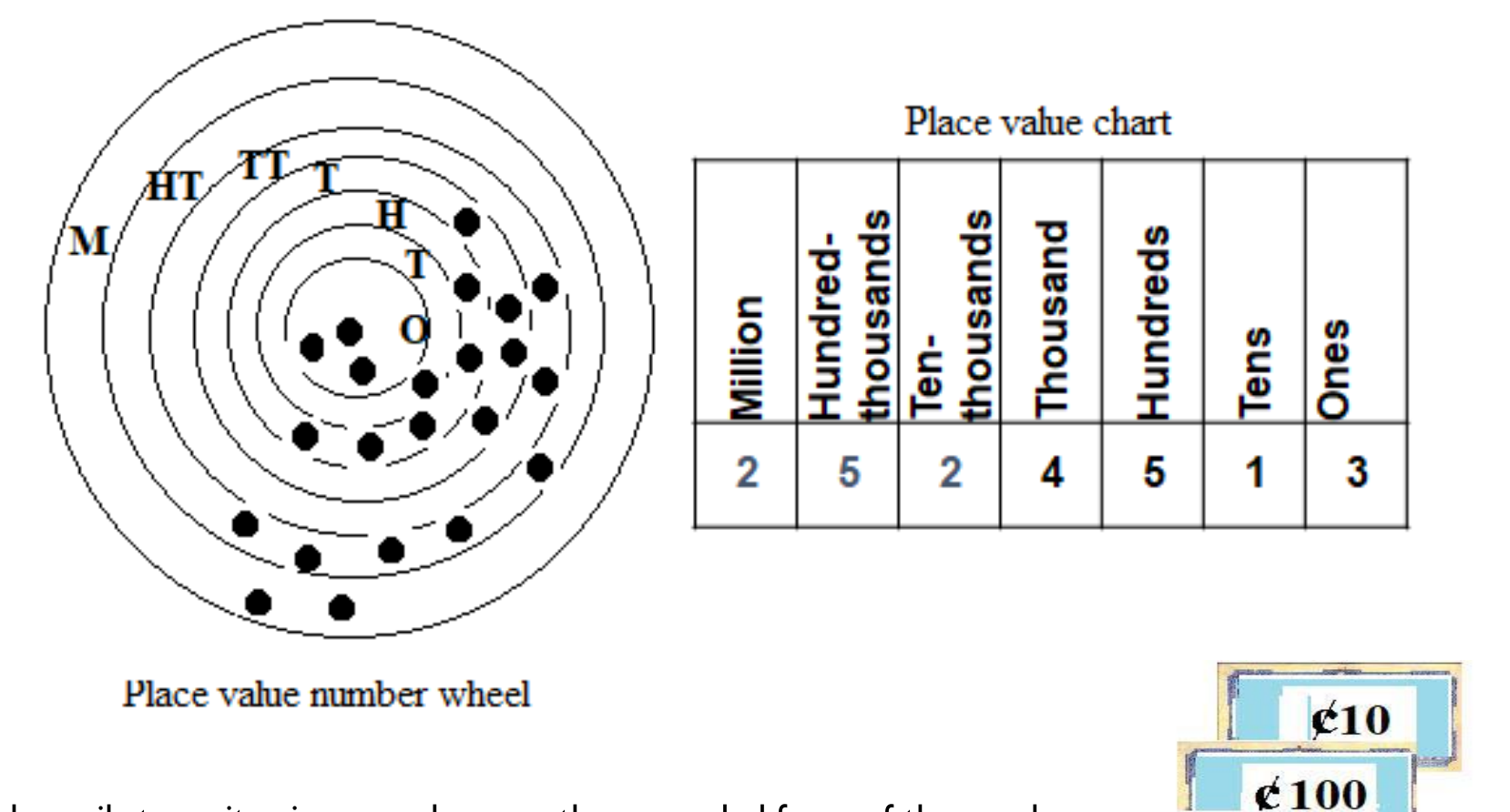
E.g. 2. Ask pupils to write given numbers on the expanded form of the number : 2,524,513=1000,000× 2 +100,000× 5 + 10,000 × 2+1000 × 4+ 100× 5 + 10× 1+ 1× 3 = 2,000,000 + 500,000 + 20,000 + 4,000 + 500 + 10 + 3