SHS1 Mathematics · Semester 2, Week 5
Measurement
Lesson notes
Learning Objectives
Indicator: 1.3.2.LI.1 - Investigate the three basic trigonometric ratios (tangent, sine and cosine) of an acute angle in degrees.
By the end of the lesson, learners can:
- Define the three primary trigonometric ratios (sine, cosine and tangent) in terms of the sides of a right-angled triangle.
- Identify the opposite side, adjacent side and hypotenuse of a right-angled triangle given a specified acute angle.
- Use a calculator correctly to find the sine, cosine and tangent of any acute angle in degrees, giving answers to a suitable degree of accuracy.
- Calculate the value of a missing side length in a right-angled triangle when one acute angle and one side length are known.
- Recognise that tangent, sine and cosine relate the measure of an acute angle to the ratios of two sides of a right-angled triangle.
Sign in with your phone number to read the full note and download the GES plan - free.
Sign in with phone numberCurriculum details
- Strand
- Geometry Around Us (Strand 3)
- Sub-strand
- Measurement (3.2)
- Content standard
- 1.3.2.CS.2 - Demonstrate a conceptual understanding of the primary trigonometric ratios and apply it to solve problems that involve right triangles. 1.3.2.LO.2 Investigate and determine the trigonometric functions of special angles and solve problems using the three primary trigonometric ratios.
- Indicator
- 1.3.2.LI.1 - Investigate the three basic trigonometric ratios (tangent, sine and cosine) of an acute angle in degrees.
- Suggested placement
-
Semester 2, Week 5
(Week 25 of the year)
Our suggestion, laid out in curriculum order across three terms of twelve weeks. NaCCA does not fix the week, so follow your school's scheme of learning.
- Curriculum reference
- NaCCA curriculum document, p. 114
Exemplars (from the NaCCA curriculum)
Using think-pair-share activities: Engage learners in a discussion to recall the pre-requisite concepts on trigonometry.
Example: Engage learners on the following pre-requisite concept:
- Recall learners' familiarity with Pythagoras' theorem.
- Review learners' basic knowledge of congruence and similarity of triangles.
- Knowledge of the basic properties of triangles, squares and rectangles.
- Familiarity with the use of a calculator.
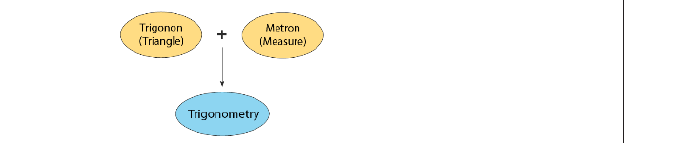
Using think-pair-share activities, task learners to discuss the meaning of the concept of trigonometry.
Example: i. Trigonometry is the study of the relation between the sides and angles of a right-angled triangle. It thus helps in finding the measure of unknown dimensions of a right-angled triangle using formulas and identities based on this relationship.
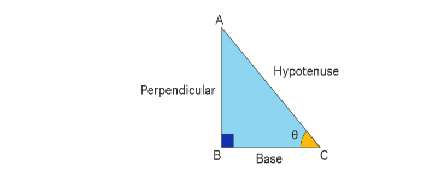
ii. Using ideas from the concept of Pythagoras' theorem, deduce the basic six ratios in trigonometry that help in establishing a relationship between the ratios of sides of a right triangle with the angle. Use geodot to explore the basic ratios.
Example: If θ is the angle in a right-angled triangle formed between the base and hypotenuse, then sin θ = Perpendicular/Hypotenuse cos θ = Base/Hypotenuse tan θ = Perpendicular/Base
The value of the other three functions, cot, sec, and cosec, depend on tan, cos and sin, respectively, as given below. cot θ = 1/tan θ = Base/Perpendicular sec θ = 1/cos θ = Hypotenuse/Base cosec θ = 1/sin θ = Hypotenuse/Perpendicular
Teaching and Learning Resources:
- * Mathematical sets.
- Technology tools such as computers, mobile phones, etc.
- * Computer software applications like GeoGebra
Assessment (1.3.2.AS.1). The document marks these depth-of-knowledge levels for this indicator: Level 2 Skills of conceptual understanding.
Skills of conceptual Understanding