SHS1 Mathematics · Semester 2, Week 2
Spatial Sense
Lesson notes
Learning Objectives
Indicator: 1.3.1.LI.5 - State and use the properties of quadrilaterals and calculate the sums of interior angles and exterior angles of a polygon.
By the end of the lesson, learners can:
- State the defining properties of the main quadrilaterals (square, rectangle, parallelogram, rhombus, trapezium and kite) from their earlier work on angles and parallel lines
- Derive and state the formula for the sum of interior angles of an n-sided polygon as 180(n - 2) degrees by dividing the polygon into triangles
- Calculate the sum of interior angles for any given polygon, such as a pentagon, hexagon or decagon
- Determine the measure of each interior angle of a regular polygon with n sides using the formula 180(n - 2) / n
- Apply the rule that the sum of exterior angles of any polygon is 360 degrees to solve problems involving unknown exterior or interior angles
Sign in with your phone number to read the full note and download the GES plan - free.
Sign in with phone numberCurriculum details
- Strand
- Geometry Around Us (Strand 3)
- Sub-strand
- Spatial Sense (3.1)
- Content standard
- 1.3.1.CS.1 - Demonstrate a conceptual understanding of spatial sense with respect to angles, parallel lines, transversal and polygons, and apply their properties to solve everyday life problems. 1.3.1.LO.1 Draw and describe angles of various measures; solve problems on the Pythagorean theorem, parallel lines, perpendicular lines and transversal; use the exterior angle theorem of a triangle and calculate the sums of interior and exterior angles of polygons.
- Indicator
- 1.3.1.LI.5 - State and use the properties of quadrilaterals and calculate the sums of interior angles and exterior angles of a polygon.
- Suggested placement
-
Semester 2, Week 2
(Week 22 of the year)
Our suggestion, laid out in curriculum order across three terms of twelve weeks. NaCCA does not fix the week, so follow your school's scheme of learning.
- Source document note
-
The official curriculum document has a fault in this entry, so the curriculum text above is transcribed exactly as printed:
- exemplars - p.100: this exemplar sets a two-dimensional construct - a stacked fraction, an index or a column vector - which the text layer flattens into separate lines, so the parts are present but their vertical arrangement is lost; read the page
- Curriculum reference
- NaCCA curriculum document, p. 99
Exemplars (from the NaCCA curriculum)
Experiential Learning: In small groups, learners discuss with models to come out with a generalisation/formula for determining the sum of the interior angles of polygons.
Example: Determine the sum of the interior angle of a pentagon.
Solution: Calculating the angle sum of pentagon ABCDE we have;
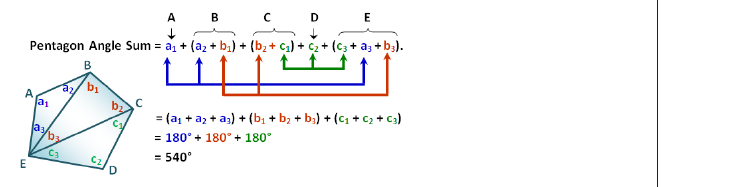
Explanation: Realise that the angle measures in the first line of our equation are just a rearrangement of the measures of the interior angles of the three triangles. Hence, the sum of the interior angles of the pentagon is equal to the angle sum of the three triangles. Therefore, we can conclude that the sum of the interior angles of a polygon is equal to the angle sum of the number of triangles that can be formed by dividing it using the method described above.
Using this conclusion, we will now relate the number of sides of a polygon, the number of triangles that can be formed by drawing diagonals and the polygon's angle sum.
Polygon Number Number Sum of of of Angles Vertices triangles (mº) (n) Triangle 3 1 1(180)=180 Quadrilateral 4 2 2(180)=360 Pentagon 5 3 3(180)=540 Hexagon 6 4 4(180)=720 Heptagon 7 5 5(180)=900 ... ... ... ... Decagon 10 8 8(180)=1440 100-gon 100 ? ? n-gon n n-2 (n-2)180
From the table, we observe that the number of triangles formed is 2 less than the number of sides of the polygon. This is true because n - 2 triangles can be formed by drawing diagonals from one of the vertices to n - 3 non-adjacent vertices. Therefore, the angle sum 𝑚 of a polygon with 𝑛 sides is given by the formula 𝑚 = 180(𝑛 − 2).
Teaching and Learning Resources:
- * Mathematical sets. * Technology tools such as computers, mobile phones, etc.
- * Computer software applications like GeoGebra. * Tape measure, carpenters square, compass, clock face, etc.
Assessment (1.3.1.AS.5). The document marks these depth-of-knowledge levels for this indicator: Level 2 Skills of conceptual understanding; Level 3 Strategic reasoning.