SHS1 Mathematics · Semester 1, Week 17
Patterns and Relations
Lesson notes
Learning Objectives
Indicator: 1.2.2.LI.2 - Recognise and interpret two points on a straight line and use it to find the distance between them.
By the end of the lesson, learners can:
- Identify the coordinates of two points on a straight line from a graph or a written pair and correctly label them as (x₁, y₁) and (x₂, y₂).
- Derive the distance formula from the Pythagorean theorem using the horizontal and vertical differences between two points.
- Calculate the distance between two given points by substituting coordinates into the formula PQ = √[(x₂ − x₁)² + (y₂ − y₁)²].
- Interpret the distance between two points as the length or magnitude of the line segment joining them, expressing answers in the correct units.
- Apply the distance formula to solve real-life problems involving lengths and distances, such as finding how far two locations are from each other on a coordinate map.
Sign in with your phone number to read the full note and download the GES plan - free.
Sign in with phone numberCurriculum details
- Strand
- Algebraic Reasoning (Strand 2)
- Sub-strand
- Patterns and Relations (2.2)
- Content standard
- 1.2.2.CS.2 - Demonstrate understanding of the gradient and equation of a straight line, the magnitude of a line segment, and its applications in real-life situations. 1.2.2.LO.2 Determine the gradient and equation of a straight line and find the distance between two points on a straight line.
- Indicator
- 1.2.2.LI.2 - Recognise and interpret two points on a straight line and use it to find the distance between them.
- Suggested placement
-
Semester 1, Week 17
(Week 17 of the year)
Our suggestion, laid out in curriculum order across three terms of twelve weeks. NaCCA does not fix the week, so follow your school's scheme of learning.
- Curriculum reference
- NaCCA curriculum document, p. 81
Exemplars (from the NaCCA curriculum)
In groups, task learners to investigate between parallel and perpendicular lines and establish their relationships through problem-solving.
Example 1: i. Are the lines L 1 through (2, 3) and (4, 6) and L 2 through (-4, 2) and (0, 8) parallel, or do they intersect? Explain.
ii. Show that the following pairs of lines are parallel. (a) 3y = 6x + 9 and 2y + 12 = 4x (b) 5y + 3x = 2 and 15y = -9x - 12
iii. Examine the equation of the line which passes through the point (2, 3) and parallel to the line 2y - x = 3
iv. Show that the graphs of 3 x + 4 y = 4 and − 4 x + 3 y = 12 are perpendicular lines.
v. Are lines L 1 , through points (-2, 3) and (1, 7) and L 2 through points (2, 4) and (6, 1) perpendicular? Explain.
vi. Determine the equation of the line perpendicular to 2y+3x= 6 through the point (5, 2) and explain your result.
Example 2: Deduce, through discussions, the magnitude of a line segment and determine the distance between two points using everyday activity.
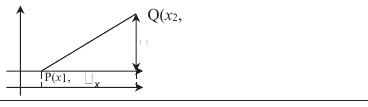
 Q(x 2 , E.g.
P(x 1,
The magnitude of a line, also known as "length", "distance", or "modulus" of a line, describes how long a line links to two points. Relating the length of objects discussed from activities, if P and Q have coordinates (x 1 , y 1 ) and (x 2 , y 2 ) from the above figure, Δ x = x 2 − x 1 Δ x = x 2 − x 1
Δ y = y 2 − y 1
Where Δ means a change By Pythagoras theorem, PQ = Δ x 2 + Δ y 2 2
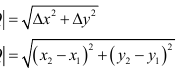
 PQ = Δ x 2 + Δ y 2
PQ = ( x 2 − x 1 ) + ( y 2 − y 1 ) 2 2
So, if P(x 1 , y 1 ) and Q(x 2 , y 2 ) are two points in the oxy plane, then the distance between P and Q is
PQ = ( x 2 − x 1 ) 2 + ( y 2 − y 1 ) 2
Note: The symbol ( ) called delta, as used here, implies a change in x 2 , x 1, y 2 , and y 1 or the differences in their values.
Example 3: Determine the distance between the points. (a) P(2, 1) and Q(5, 5) (b) A(7, -3) and B(-1, 5) (c) D(4, 1) and E(-3, -5)
Solution
( x 2 − x 1 ) 2 + ( y 2 − y 1 ) 2 The distance between two points is given by
(a) P(2, 1) and Q(5, 5)

 PQ = (5 − 2) 2 + (5 − 1) 2 = 3 2 + 4 2
⇒ PQ = 25 = 5units.
(b) A(7, -3) and B(-1, 5)
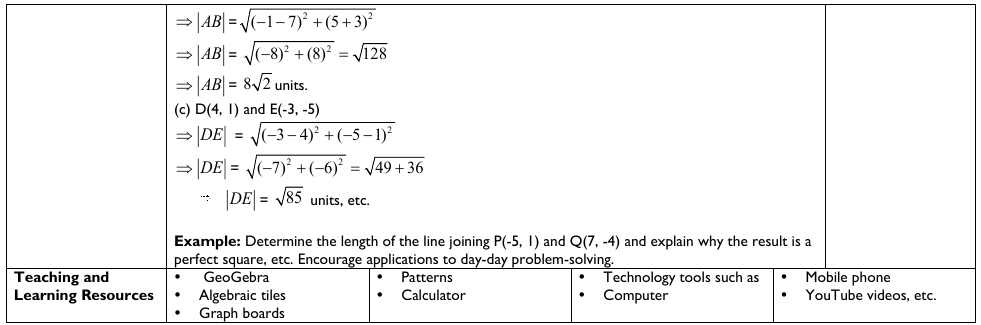
 ⇒ AB = ( − 1 − 7) 2 + (5 + 3) 2
⇒ AB = ( − 8) 2 + (8) 2 = 128
⇒ AB = 8 2 units.
(c) D(4, 1) and E(-3, -5) ⇒ DE = ( − 3 − 4) 2 + ( − 5 − 1) 2
⇒ DE = ( − 7) 2 + ( − 6) = 2 49 + 36
DE = 85 units, etc.
Example: Determine the length of the line joining P(-5, 1) and Q(7, -4) and explain why the result is a perfect square, etc. Encourage applications to day-day problem-solving.
Teaching and Learning Resources:
- * GeoGebra * Algebraic tiles * Graph boards
- * Patterns * Calculator
- * Technology tools such as * Mobile phone * Computer
- * YouTube videos, etc.
Assessment (?):
Level 1 Recall
Level 2 Skills of conceptual understanding
Level 3 Strategic reasoning
Level 4 Extended critical thinking and reasoning