SHS1 Mathematics · Semester 1, Week 14
Applications of Expressions, Equations and Inequalities
Lesson notes
Learning Objectives
Indicator: 1.2.1.LI.2 - Solve linear equations and inequalities in one variable for a given problem and relate it to real life situations.
By the end of the lesson, learners can:
- Identify a linear equation in one variable as an equation of the form ax + b = c, where a, b and c are real numbers and a ≠ 0, and state that it has exactly one solution.
- Solve linear equations in one variable, including those involving brackets, using algebraic manipulation with complete, justified steps.
- Represent the solution set of a linear inequality on a number line, using open and closed circles correctly.
- Translate real-life word problems involving linear equations and inequalities into mathematical statements and solve them.
- Verify solutions to equations and inequalities by substituting values back into the original statement.
Sign in with your phone number to read the full note and download the GES plan - free.
Sign in with phone numberCurriculum details
- Strand
- Algebraic Reasoning (Strand 2)
- Sub-strand
- Applications of Expressions, Equations and Inequalities (2.1)
- Content standard
- 1.2.1.CS.2 - Demonstrate knowledge and understanding of equations and inequalities in one variable and apply it in solving real-life problems. 1.2.1.LO.2 Model and solve linear equations and inequalities in one variable, including problems in real life.
- Indicator
- 1.2.1.LI.2 - Solve linear equations and inequalities in one variable for a given problem and relate it to real life situations.
- Suggested placement
-
Semester 1, Week 14
(Week 14 of the year)
Our suggestion, laid out in curriculum order across three terms of twelve weeks. NaCCA does not fix the week, so follow your school's scheme of learning.
- Source document note
-
The official curriculum document has a fault in this entry, so the curriculum text above is transcribed exactly as printed:
- exemplars - p.63: this exemplar sets a two-dimensional construct - a stacked fraction, an index or a column vector - which the text layer flattens into separate lines, so the parts are present but their vertical arrangement is lost; read the page
- exemplars - p.63: a tall brace here is drawn as three stacked pieces in a font with no /ToUnicode map; the opening and closing pieces are transcribed as { and } and the middle pieces dropped, so the brace may not sit exactly where the page prints it
- Curriculum reference
- NaCCA curriculum document, p. 63
Exemplars (from the NaCCA curriculum)
Group/Collaborative Learning, initiating Talk for Learning, Problem-based Learning.
Using the think-pair-share activities, learners discuss and explain a linear equation in one unknown (variable) as an equation of the form ax+b=c, where a, b and c are real numbers and a≠0 has exactly one solution.
Example 1: Solve for the variable indicated in the following equations:
3 x − 12 = 21 i. ii. 7( x − 6) = 3( x + 9)
Solution i. To solve 3 x − 12 = 21 , add 12 to both sides of the equation, 3 x = 33
then divide both sides of the equation by 3 to make x the subject 33 = x = 11 3
ii. To solve the equation 7( x − 6) = 3( x + 9) ,
First, multiply the brackets on both sides of the equation, 7 x − 42 = 3 x + 27 Then subtract 3x from both sides 4 x − 42 = 27
Then, add 42 to both sides of the equation. 4 x = 69
Divide both sides of the equation by 4. 69 = 17 1 x = 4 4
In mixed-ability groups, learners extend the idea of linear equation to explain linear inequality, including real life activities to enable conceptual understanding.
Example: Learners establish that a linear equation is of the form 𝑎𝑥 + 𝑏 < 𝑐, 𝑎𝑥 + 𝑏 ≤ 𝑐, 𝑎𝑥 + 𝑏 > 𝑐, 𝑎𝑥 + 𝑏 ≥ 𝑐.
They also establish that folding the human right arm resembles the idea of a greater than (>) symbol, and that of the left arm also resembles the idea of a less than (<) symbol and gives expressions that involve these signs. i.e. 4 < 5 (4 is less than 5) 6 > 4 (6 is greater than 4) x ≤ 4 (Depending on the values of x, which is an unknown variable)
Suppose we are given an inequality of the form x > -5; the solution set for an inequality (as it is for an equation) is the set of all values for the variable that make the inequality a true statement.
An appropriate way to picture the solution set is by a graph on a number line or the use of a geodot to generate conjectures.
Discuss graphs of inequalities and graph the set; {x: x < 4}
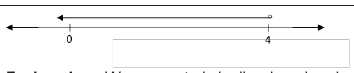
Explanations: We want to include all real numbers less than 4, that is, to the left of 4 on the number line. The open circle is used to indicate that the point corresponding to 4 is not included in the graph. It is called an open half line; it extends to the left and does not include 4. Two other symbols, as shown in the introduction, ≤ and ≥ , are also used in writing inequalities. In each
case, they combine the inequality symbols for less than or greater than with the symbol for equality.
The following explains the use of these symbols. The expression a ≤ b is read as "a is less than or
equal to b."
Note that this combines the symbols '< 'and '=' and means that either a < b or a = b. Similarly, a ≥ b reads "a is greater than or equal to b". Implying either a > b or a = b. etc.
Example 1: Find the solution set of the following: Solve for the truth set of 1 2 x − 1 3 ( x + 4 ) > 4x + 3 2
− 12 Dividing both sides by 23 yields x < 23 Hence, the truth set is { x : x < − 12 } . 23
Using think-pair-share in mixed-ability groups, learners discuss word problems involving linear equations and inequalities and translate them into mathematics statements and solve.
Example 1: If Kofi's age now is 30 years, what will be his age in 5 years' time? Explore: What facts are you given?
- The fact already given is 30 years
- The fact yet to be found is 5 years' time What fact do you need to find?
- Thus, how many years together would Kofi be in the coming 5 years (future)? Plan: Write an equation
Let m be Kofi's age now His age in 5 years time ⇒ m = 30 + 5 ⇒ m = 35 years.
Example 2: If Ama is 40 years old now, what was her age 4 years ago? Let n be her age now = 40 years. (given fact) Her age 4 years ago (past years) ⇒ ( n − 4) ⇒ 40 − 4 = 36 years
Teaching and Learning Resources:
- * Algebraic tiles * Patterns * calculator * technology tools such as
- computer
- mobile phone
- YouTube videos, etc.
- Paper grids
- Maths posters
- YouTube videos
- Whiteboard
- Pan balance
- Videos
- mini whiteboards or laminated white paper
- Dry-erase markers and erasers
Assessment (1.2.1.AS.2). The document marks these depth-of-knowledge levels for this indicator: Level 3 Strategic reasoning.