SHS1 Mathematics · Semester 1, Week 10
Applications of Expressions, Equations and Inequalities
Lesson notes
Learning Objectives
Indicator: 1.2.1.LI.2 - Factorise algebraic expressions involving quadratic trinomials.
By the end of the lesson, learners can:
- Identify the standard form of a quadratic trinomial as ax² + bx + c and name the coefficients a, b, and c for a given expression.
- Factorise a quadratic trinomial of the form x² + bx + c by finding two integers whose product is c and whose sum is b.
- Factorise a quadratic trinomial of the form ax² + bx + c where a ≠ 1 by using the grouping method (sometimes called the “split the middle” method).
- Use algebraic tiles or a paper-grid model to represent and factorise quadratic trinomials, connecting the visual model to the algebraic method.
- Apply factorisation to solve a real-life problem involving area or dimensions of a rectangle set in a Ghanaian context.
Sign in with your phone number to read the full note and download the GES plan - free.
Sign in with phone numberCurriculum details
- Strand
- Algebraic Reasoning (Strand 2)
- Sub-strand
- Applications of Expressions, Equations and Inequalities (2.1)
- Content standard
- 1.2.1.CS.1 - Demonstrate knowledge and understanding of algebraic expressions and solve real-life problems on them. 1.2.1.LO.1 Formulate algebraic expressions using patterns to create models and solve real life problems (e.g., linear and quadratic models).
- Indicator
- 1.2.1.LI.2 - Factorise algebraic expressions involving quadratic trinomials.
- Suggested placement
-
Semester 1, Week 10
(Week 10 of the year)
Our suggestion, laid out in curriculum order across three terms of twelve weeks. NaCCA does not fix the week, so follow your school's scheme of learning.
- Source document note
-
The official curriculum document has a fault in this entry, so the curriculum text above is transcribed exactly as printed:
- exemplars - p.56: the equation text on this page is set in a CambriaMath subset whose /ToUnicode map doubles every letter and gets many of them wrong, and the glyph ids could not be lined up with the extraction to repair it, so any italic variable here may be doubled or be the wrong letter; read the page
- exemplars - p.57: this exemplar sets a two-dimensional construct - a stacked fraction, an index or a column vector - which the text layer flattens into separate lines, so the parts are present but their vertical arrangement is lost; read the page
- Curriculum reference
- NaCCA curriculum document, p. 56
Exemplars (from the NaCCA curriculum)
Group Work/Collaborative learning, initiating Talk for Learning and Problem-based Learning Using Collaborative Learning: Learners identify, expand and simplify two binomial expressions using algebraic tiles. Employ differentiated assessment and ensure values such as tolerance, truth, honesty, respect for others' views, etc., among learners.
Example: Identify binomial expressions and work in groups to expand and simplify the two binomial expressions using algebraic tiles. i.e., (𝑥 + 4)(𝑥 + 2).
Solution. Steps:
- The blue tile is +𝑥𝑥, the orange is 𝑥𝑥 2 and the yellow tile is 1. Along one side of the chart, fill in the expression 𝑥𝑥 + 4 using the algebraic tiles, and across the top, fill in the expression 𝑥𝑥 + 1
- The product is the result inside the chart when we multiply the terms outside. Now count the number of 𝑥𝑥 2 ,𝑥𝑥, and the 1 and sum them up to give the solution.
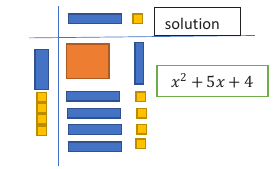
𝑥𝑥 2 + 5𝑥𝑥 + 4
Problem-based Learning: In mixed gender/ability groups, learners expand and simplify algebraic expressions.
Example: Expand and simplify the following expressions i. (𝑥𝑥 + 4)(𝑥𝑥 − 4) ii. (4𝑥𝑥 + 1) 2 iii. (𝑝𝑝 − 𝑞𝑞) 2 (𝑥𝑥 + 9) 2 iv.
Investigate, in mixed-ability/gender groups, the concept of factorisation and apply the idea to factorise expressions, including algebraic trinomials.
Example: Factorise 𝑎𝑎𝑎𝑎 + 𝑏𝑏𝑏𝑏 + 𝑎𝑎𝑎𝑎 + 𝑏𝑏𝑏𝑏
Solution: First, put the four expressions into two groups of two and find the common factors from each. i.e., (𝑎𝑎𝑎𝑎 + 𝑏𝑏𝑏𝑏)(𝑎𝑎𝑎𝑎 + 𝑏𝑏𝑏𝑏)
𝑐(𝑎 + 𝑏) + 𝑑(𝑎 + 𝑏), add the outside terms and take one of the common terms to be the final answer. (𝑐 +d)(a+b)
Using Talk for Learning in a whole class discussion, review with learners the concepts of finding the area of a rectangle and use the idea to factorise the trinomial expressions using algebraic tiles.
Example: Factorise 𝑥 2 + 7𝑥 + 12 using algebraic tiles.
Solution
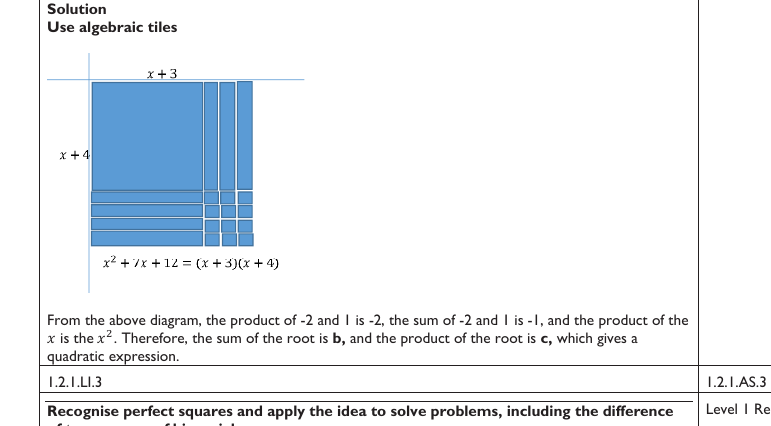
 Use algebraic tiles
From the above diagram, the product of -2 and 1 is -2, the sum of -2 and 1 is -1, and the product of the 𝑥 is the 𝑥 2 . Therefore, the sum of the root is b, and the product of the root is c, which gives a quadratic expression.
Teaching and Learning Resources:
- Algebraic tiles
- Patterns
- calculator
- technology tools such as
- computer
- mobile phone
- YouTube videos, etc.
- Paper grids
- Maths posters
- YouTube videos
- Whiteboard
- Pan balance
- Videos
- mini whiteboards or laminated white paper
- Dry-erase markers and erasers
Assessment (1.2.1.AS.2). The document marks these depth-of-knowledge levels for this indicator: Level 3 Strategic reasoning.