SHS1 Mathematics · Semester 1, Week 4
Real Number System
Lesson notes
Learning Objectives
Indicator: 1.1.1.LI.2
By the end of the lesson, learners can:
- Draw a three-set Venn diagram from given information and correctly label all eight regions of the universal set.
- Describe each region of a three-set Venn diagram using set notation for union, intersection, and complement.
- Solve real-world problems involving three sets by reading information from a completed Venn diagram.
- Conduct a simple mini survey in the school community, record the results, and present the findings using a three-set Venn diagram.
Sign in with your phone number to read the full note and download the GES plan - free.
Sign in with phone numberCurriculum details
- Strand
- Numbers for Everyday Life (Strand 1)
- Sub-strand
- Real Number System (1.1)
- Content standard
- 1.1.1.CS.2 - Demonstrate knowledge and understanding of real number systems with respect to the concepts and vocabulary of sets, establish their relationships and carry out simple surveys using the properties of sets. 1.1.1.LO.2 Analyse and solve real world problems involving union, intersection and complements of sets and apply these to three sets of problems using simple surveys.
- Indicator
- 1.1.1.LI.2 - Organise information visually to establish the relationship between and among sets of items (three sets) and apply these to conduct mini surveys in the school community and beyond.
- Suggested placement
-
Semester 1, Week 4
(Week 4 of the year)
Our suggestion, laid out in curriculum order across three terms of twelve weeks. NaCCA does not fix the week, so follow your school's scheme of learning.
- Curriculum reference
- NaCCA curriculum document, p. 34
Exemplars (from the NaCCA curriculum)
Diamond Nine; Group Work/Collaborative Learning. Apply the concept of the Venn diagram to solve three set problems using Group work/Collaborative Learning, ensuring balance in the differentiation of the various proficiency levels coupled with GESI.
Example: Create Venn diagrams for three sets (intersecting or non-intersecting) and identify the various sets or regions.
U
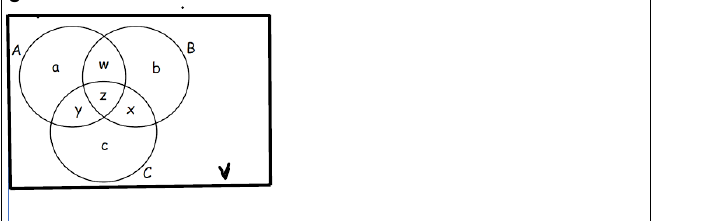
Figure: 4 From the Venn diagram, i. Region (z) represents elements that are common to sets A, B, and C:𝐴 ∩ 𝐵 ∩ 𝐶. ii. Region (w) represents elements that belong to sets A and B but not common to C: (𝐴 ∩ 𝐵) ∩ 𝐶 ' . iii. Region (y) represents elements that belong to sets A and C but not common to B: (𝐴 ∩ 𝐶) ∩ 𝐵 ' . iv. Region (x) represents elements that belong to sets B and C but not common to A: (𝐵 ∩ 𝐶) ∩ 𝐴 ' . v. Region (a) represents elements in set A that are neither in set B nor C:𝐴 ∩ (𝐵 ' ∩ 𝐶 ' ). vi. Region (b) represents elements in set B that are neither in set A nor C: 𝐵 ∩ (𝐴 ' ∩ 𝐶 ' ). vii. Region (c) represents elements in set C that are neither in set A nor B: 𝐶 ∩ (𝐵 ' ∩ 𝐴 ' ). viii. Region (v) represents elements in the universal set U that are not in sets A, B and C: (A ∪ 𝐵 ∪ 𝐶)'.
Teaching and Learning Resources:
- * GeoGebra (free software) * video clips * cardboards
- * models * SHS Mathematics curriculum * Fractional boards
- * square or grid paper * multi-base blocks * algebraic tiles
Assessment (1.1.1.AS.2). The document marks these depth-of-knowledge levels for this indicator: Level 4 Extended critical thinking and reasoning.