SHS1 Mathematics · Semester 1, Week 1
Real Number System
Lesson notes
Learning Objectives
Indicator: 1.1.1.LI.2 - Distinguish between rational and irrational numbers using the conversion of common fractions to decimals and solve related problems.
By the end of the lesson, learners can:
- Define rational and irrational numbers and state at least four examples of each subset of the real number system.
- Convert common fractions to terminating and recurring decimals by long division, and convert terminating and recurring decimals back to fractions.
- Determine whether a given decimal is terminating or recurring and use this to classify the original number as rational or irrational.
- Plot rational and irrational numbers on a number line and justify whether they occupy exact points or approximate positions.
- Solve word problems involving rational and irrational numbers in real-life contexts, presenting their reasoning clearly in groups.
Sign in with your phone number to read the full note and download the GES plan - free.
Sign in with phone numberCurriculum details
- Strand
- Numbers for Everyday Life (Strand 1)
- Sub-strand
- Real Number System (1.1)
- Content standard
- 1.1.1.CS.1 - Demonstrate knowledge and understanding of real number systems and the operations of the various subsets. 1.1.1.LO.1 Apply the relationships and differences between the set of rational and irrational numbers and use them to solve problems.
- Indicator
- 1.1.1.LI.2 - Distinguish between rational and irrational numbers using the conversion of common fractions to decimals and solve related problems.
- Suggested placement
-
Semester 1, Week 1
(Week 1 of the year)
Our suggestion, laid out in curriculum order across three terms of twelve weeks. NaCCA does not fix the week, so follow your school's scheme of learning.
- Source document note
-
The official curriculum document has a fault in this entry, so the curriculum text above is transcribed exactly as printed:
- exemplars - p.30: this exemplar sets a two-dimensional construct - a stacked fraction, an index or a column vector - which the text layer flattens into separate lines, so the parts are present but their vertical arrangement is lost; read the page
- Curriculum reference
- NaCCA curriculum document, p. 29
Exemplars (from the NaCCA curriculum)
Diamond Nine; Group Work/Collaborative Learning Using the Diamond Nine strategy, review subsets of real numbers, establish fractions that lead to recurring and non-recurring decimals, and investigate their applications to real life problems. Promote among learners tolerance, truth, honesty, respect for others' views, etc.
Example: Enumerate the subsets of rational and irrational numbers and establish their connections to the real number system.
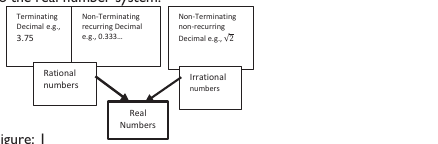
e.g., 0.333...
Figure: 1
Through collaborative group activity, use number lines, technology tools, the wheel of Theodorus, etc., to establish rational and irrational numbers. (i.e., √2, √3 , 𝜋, etc. ).
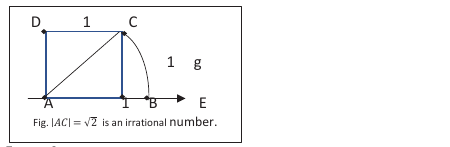
Figure: 2
i. Investigate which of the following real numbers √2, √3 and √4, 2.8, √6, can be plotted at exact points on a number line and classify such numbers. ii. Convert given decimals (recurring, non-recurring, fractions and percentages) to fractions and establish whether they are rational or irrational. 𝐶 22 iii. If the ratio = 𝜋, explain why the approximated value of 𝜋, " " is not an irrational number 𝑑 7 (As a group work to be presented in class).
Teaching and Learning Resources:
- Fractional boards
- square or grid paper
- multi-base blocks
- algebraic tiles
- video clips
- cardboards
- models
- SHS Mathematics curriculum
- Technology tools: computer, mobile phone, calculator, YouTube videos, etc.
- Number line
- Number track
- Wheel of Theodorus.
- Twine
- cylinders
- Tape measure or rule.
Assessment (1.1.1.AS.2). The document marks these depth-of-knowledge levels for this indicator: Level 3 Strategic reasoning.