KG1 Integrated Learning · Term 3, Week 2
Living Things - Animals (domestic and Wild)
Full lesson notes coming
Notes for this lesson are being prepared. The curriculum details below are complete and ready to use for your planning.
Curriculum details
- Strand
- All Around Us (Strand 6)
- Sub-strand
- Living Things - Animals (domestic and Wild) (6.2)
- Content standard
- K1.6.2.1 - Demonstrate understanding of domestic and wild animals.
- Indicator
- K1.6.2.1.1 - Sing and talk about different kinds of animals, what they eat, the sound they make and put them into groups.
- Suggested placement
-
Term 3, Week 2
(Week 26 of the year)
Term is the curriculum's own; the week within it is our suggestion, laid out in curriculum order. Follow your school's scheme of learning.
- Curriculum reference
-
Kindergarten Curriculum (KG1 and KG2), 2019, p. 70
Transcribed from the official NaCCA publication. Check this page against the source.
Exemplars (from the NaCCA curriculum)
In community circle time, leaners recite the poem "Fiddo is a dog" and have them discuss the poem. Use the discussion to explain domestic animal to the learners e.g. Animals in the home - cat, dog, goat, hen, etc.
Learners watch a video/conversational poster and talk about domestic animals regarding what they eat and their uses as well as the sound they make. E.g.
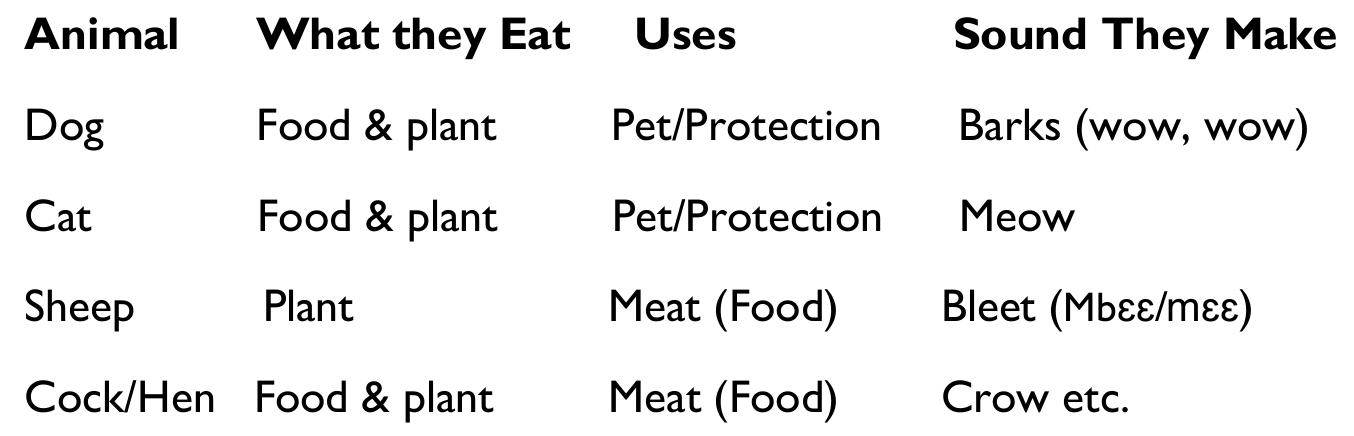
Animal What they Eat Uses Sound They Make
Dog Food & plant Pet/Protection Barks (wow, wow)
Cat Food & plant Pet/Protection Meow
Sheep Plant Meat (Food) Bleet (Mbɛɛ/mɛɛ)
Cock/Hen Food & plant Meat (Food) Crow etc.
Have learners sing "Old MacDonald has farm" to make the sounds of the domestic animals
Guide learners to discuss other living things around the home. Insects - ant, house fly, grass hopper, lizard, etc. and how to prevent them
Guide learners to sort and count the domestic animals discussed into those that are used for food and those for pet. Have learners use comparative word to describe the groups. Guide learners to create simple patterns using shapes, sounds or colours. Have learners draw their own patterns with a given pattern e.g. 3,2,2; 2,2,3,2, etc.