JHS2 Mathematics · Term 3, Week 1
Shapes and Space
Full lesson notes coming
Notes for this lesson are being prepared. The curriculum details below are complete and ready to use for your planning.
Curriculum details
- Strand
- Geometry and Measurement (Strand 3)
- Sub-strand
- Shapes and Space (3.1)
- Content standard
- B8.3.1.2 - Demonstrate the ability to perform geometric constructions of the angles (75˚, 105˚, 60˚, construct triangles and find locus of points under given conditions.
- Indicator
- B8.3.1.2.3 - Construct loci under given conditions including: (i) the locus of sets of points from a fixed point; (ii) the locus of points equidistant from two fixed points; (iii) the locus of points equidistant from two intersecting straight lines, (iv) the locus of points equidistant from two parallel lines.
- Suggested placement
-
Term 3, Week 1
(Week 25 of the year)
Our suggestion, laid out in curriculum order across three terms of twelve weeks. NaCCA does not fix the week, so follow your school's scheme of learning.
- Curriculum reference
-
Mathematics, Common Core Programme (JHS1-JHS3), 2023, p. 133
Transcribed from the official NaCCA publication. Check this page against the source.
Exemplars (from the NaCCA curriculum)
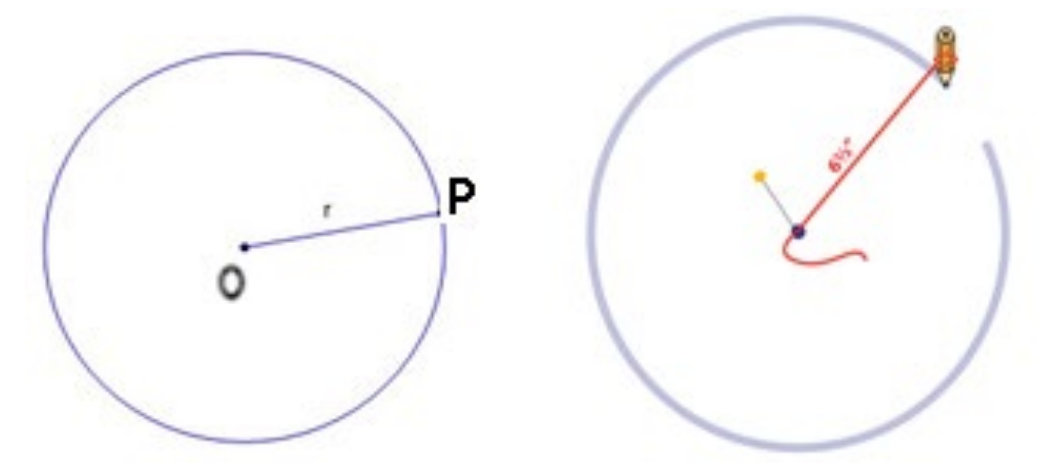
E.g.1: Describe the locus of a circle by tracing the path of a point P which moves in such a way that its distance from a fixed point, say O, is always the same to construct circles.
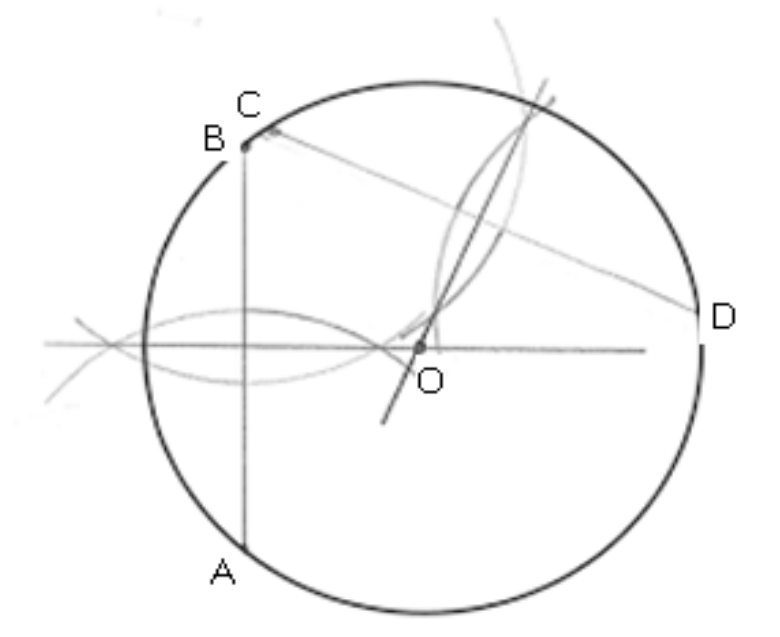
E.g.2: Perform geometric construction to locate the centre of a circle by locating the intersection of the perpendicular bisectors of any two chords on the circle.
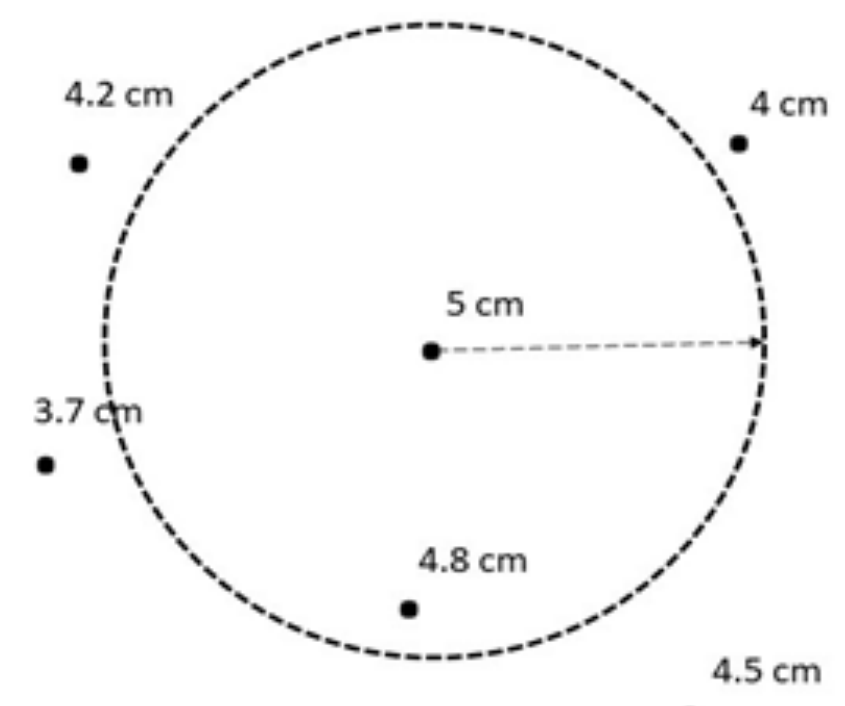
E.g.3: Draw circles of given radii at the points as centre and chord.
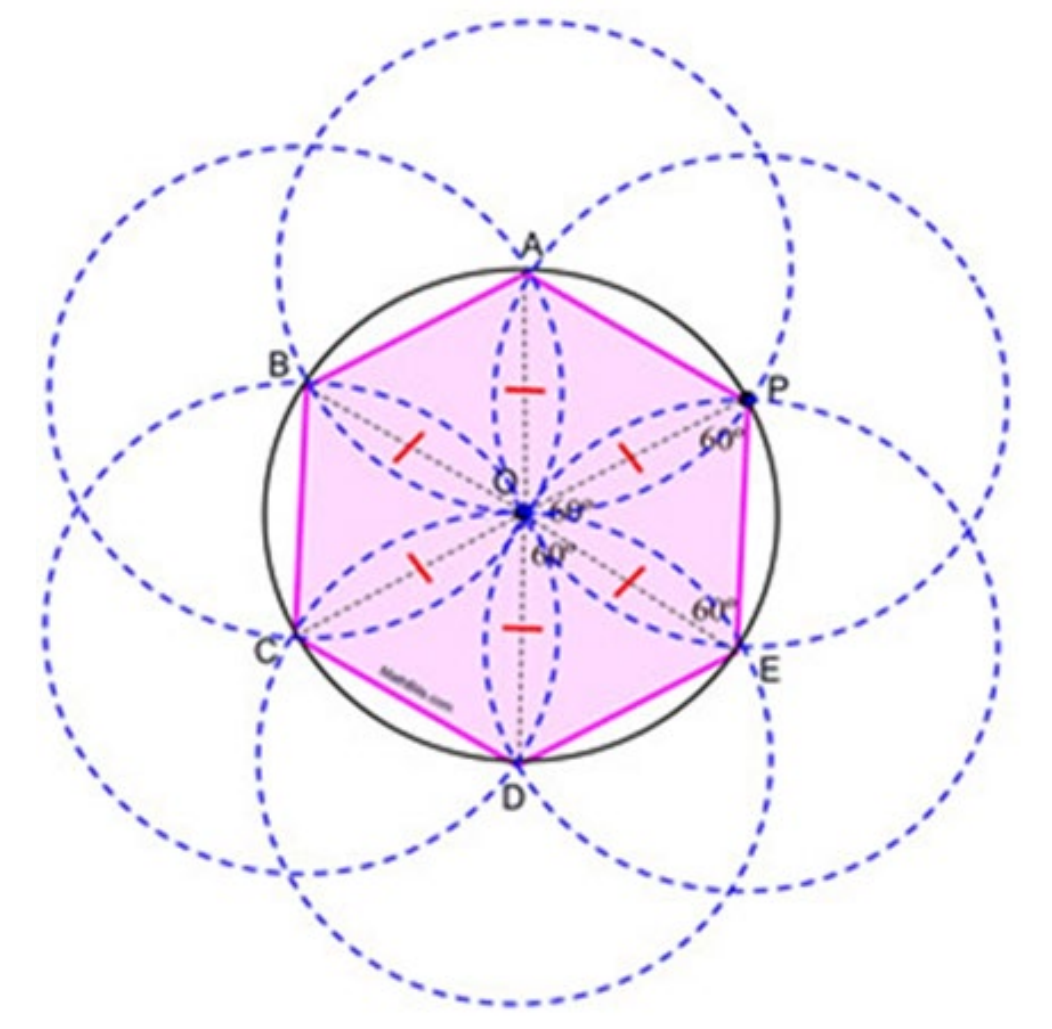
E.g.4: Construct a regular hexagon within a circle given the length of a side Use a pair of compasses and a ruler to construct a hexagon ABCDEF such that |AB| = 6cm. Find the measure of the angles AOB and compare to its value to ∠AFG, ∠DOE, ∠DOC, ∠EOF and ∠BOC. What is your observation?
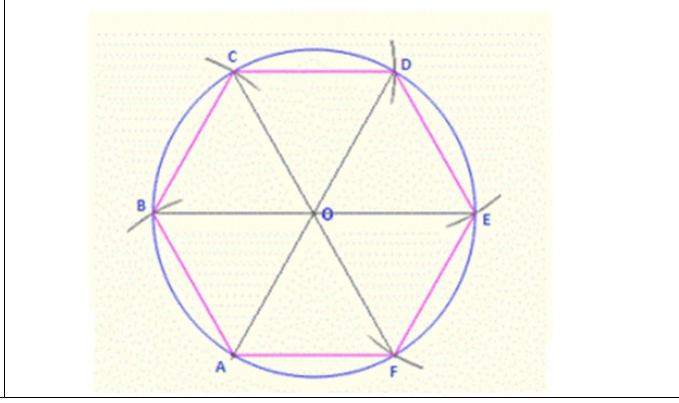
E.g.5 Use intersecting circles to construct a regular hexagon and measure it sides. Perform geometric construction of hexagon ABCDEF using the method of intersecting circles. Take |OA| = 5cm. Measure and compare the sides of the hexagon. Find the measure of the angles AOB and compare to its value to ∠AFG, ∠DOE, ∠DOC, EOF and ∠BOC. What is your observation?
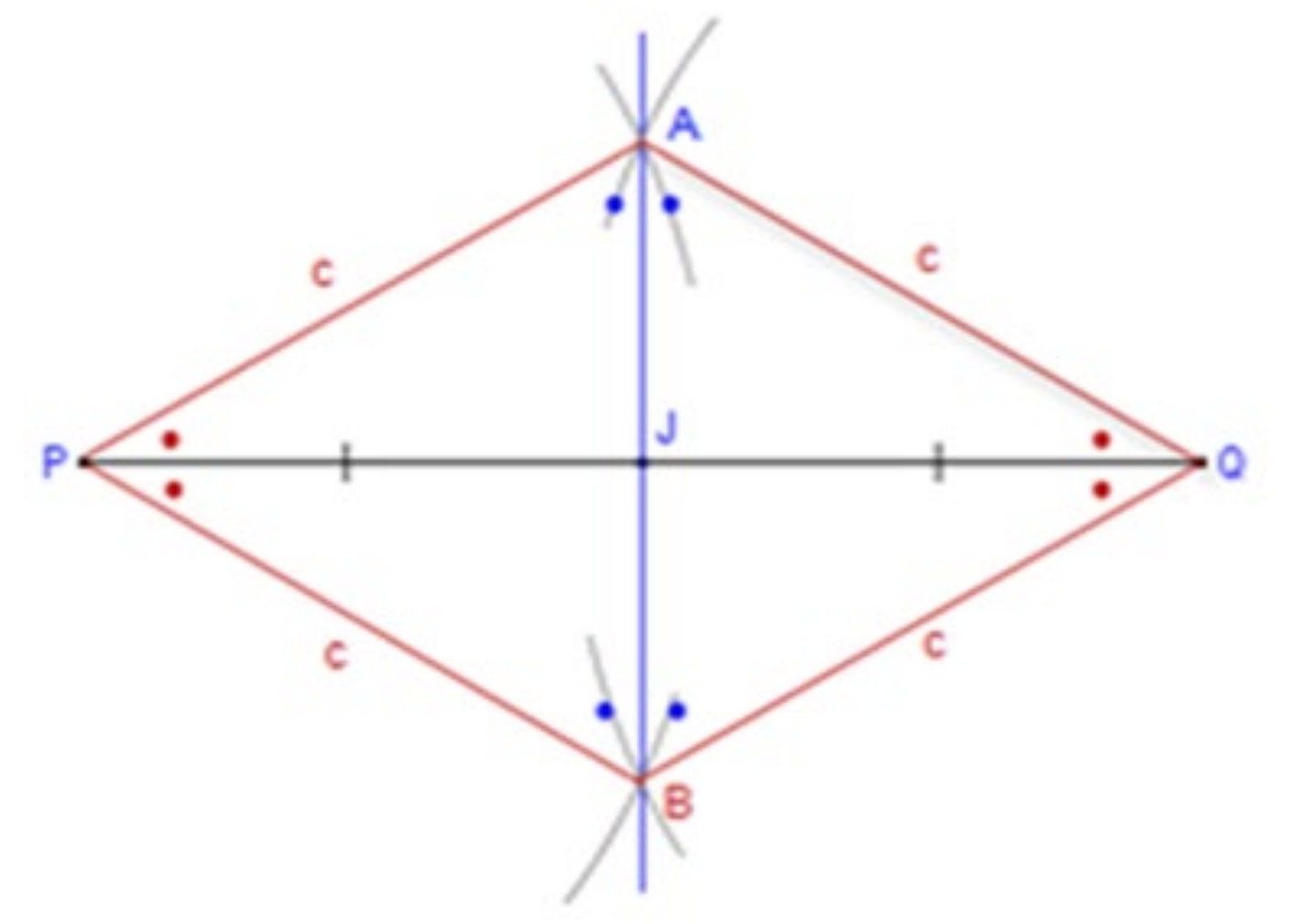
E.g.6: Construct a perpendicular bisector (mediator) as a locus and explain why the perpendicular bisector is a locus.
The line segment AB is a perpendicular bisector of PQ since line segments AP, AQ, PB, QB are all congruent.
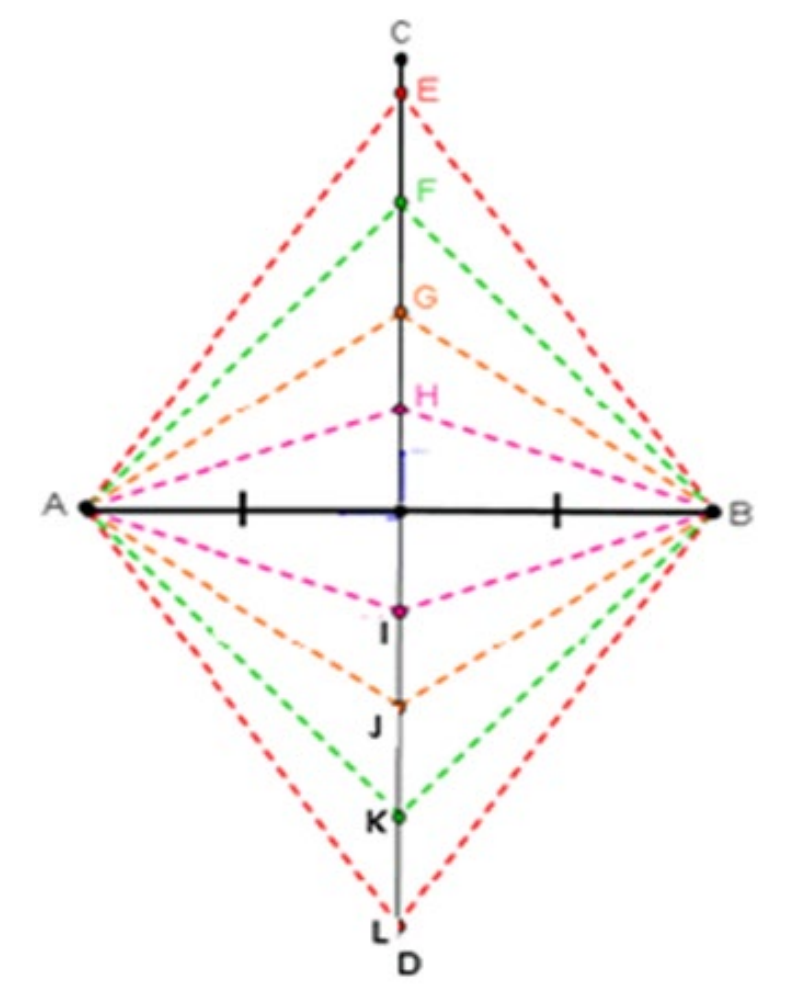
Any point on line CD is of equal distance from the two fixed points A and B.
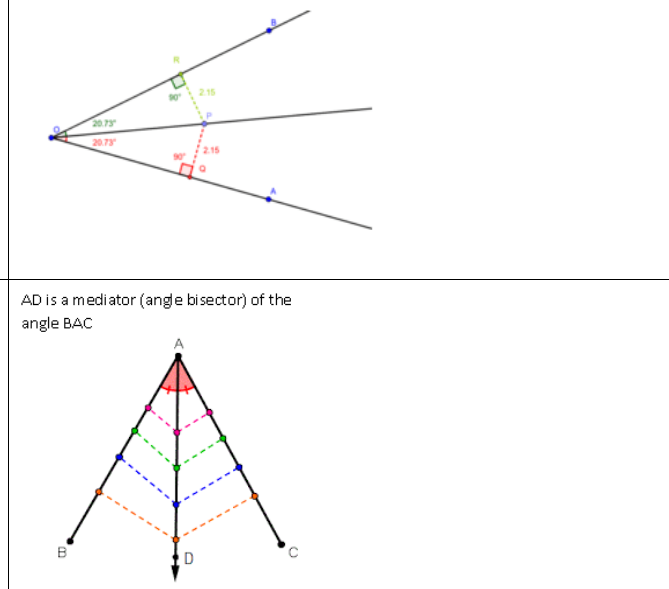
E.g. 7 Construct an angle bisector as a locus of points equidistant from two lines that meet and explain why the angle bisector is a locus.
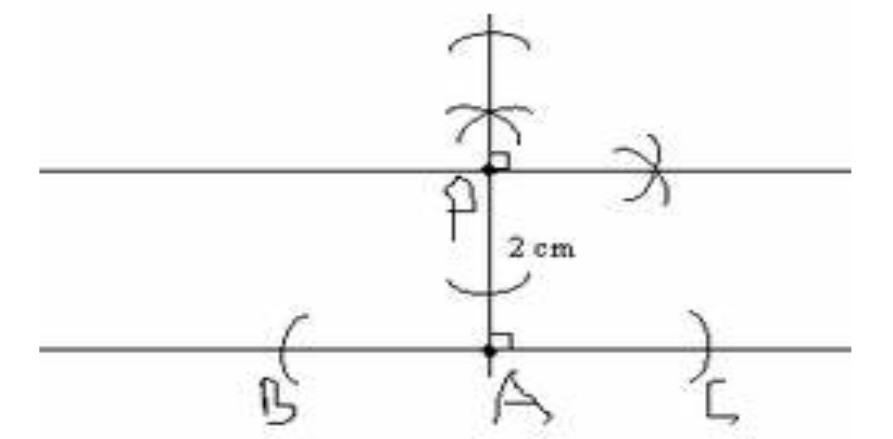
E.g.8: Construct parallel lines as a locus (i.e. tracing the path of a point say P which moves in such a way that its distance from line BC is always the same).
E.g.9: Perform geometric constructions to prove that two given lines are parallel. Show that two given lines AB and CD are parallel (i.e. locate three points P, Q and R) draw perpendicular to AB at PQ and R to intersect CD at E, F and G respectively.
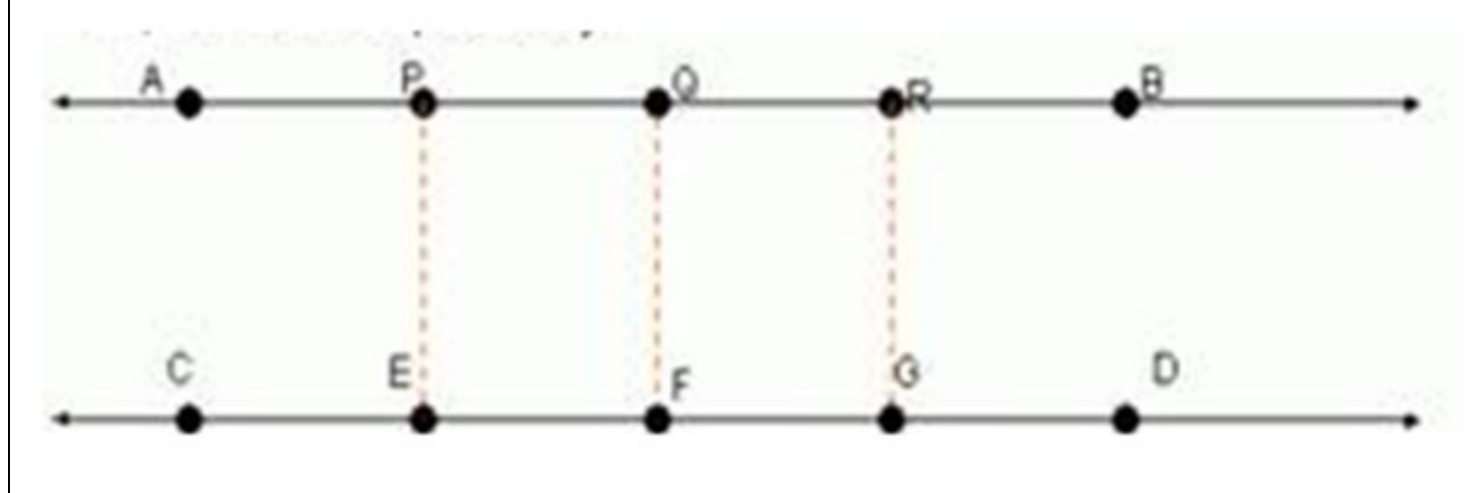
Measure the lengths of PE, QF, and RG. The perpendicular distance between two parallel lines is the same everywhere.