JHS1 Mathematics · Term 3, Week 7
Position and Transformation
Lesson notes
Learning Objectives
Indicator: B7.3.3.1.1 - Determine shapes in real life that have reflectional (or fold) symmetries.
By the end of the lesson, learners can:
- Identify lines of symmetry in given 2D shapes by folding or visual inspection.
- Recognise and name at least five real-life objects or designs in Ghana that have reflectional symmetry (e.g. adinkra symbols, buildings, fabric patterns).
- State the number of lines of symmetry possessed by common shapes (e.g. square, rectangle, equilateral triangle, circle).
- Complete a partially drawn shape so that it has a line of symmetry, and justify their choices.
- Sort a collection of everyday designs and objects into “has reflectional symmetry” and “has no reflectional symmetry” with reasons.
Sign in with your phone number to read the full note and download the GES plan - free.
Sign in with phone numberCurriculum details
- Strand
- Geometry and Measurement (Strand 3)
- Sub-strand
- Position and Transformation (3.3)
- Content standard
- B7.3.3.1 - Perform a single transformation (i.e. reflection and translation) on a 2D shape using graph paper (including technology) and describe the properties of the image under the transformation (i.e. congruence, similarity, etc.)
- Indicator
- B7.3.3.1.1 - Determine shapes in real life that have reflectional (or fold) symmetries.
- Suggested placement
-
Term 3, Week 7
(Week 31 of the year)
Our suggestion, laid out in curriculum order across three terms of twelve weeks. NaCCA does not fix the week, so follow your school's scheme of learning.
- Curriculum reference
-
Mathematics, Common Core Programme (JHS1-JHS3), 2023, p. 72
Transcribed from the official NaCCA publication. Check this page against the source.
Exemplars (from the NaCCA curriculum)
E.g. 1: Identify examples of designs (or objects) in everyday life that have reflectional (or fold) symmetries (e.g. adinkra symbols).
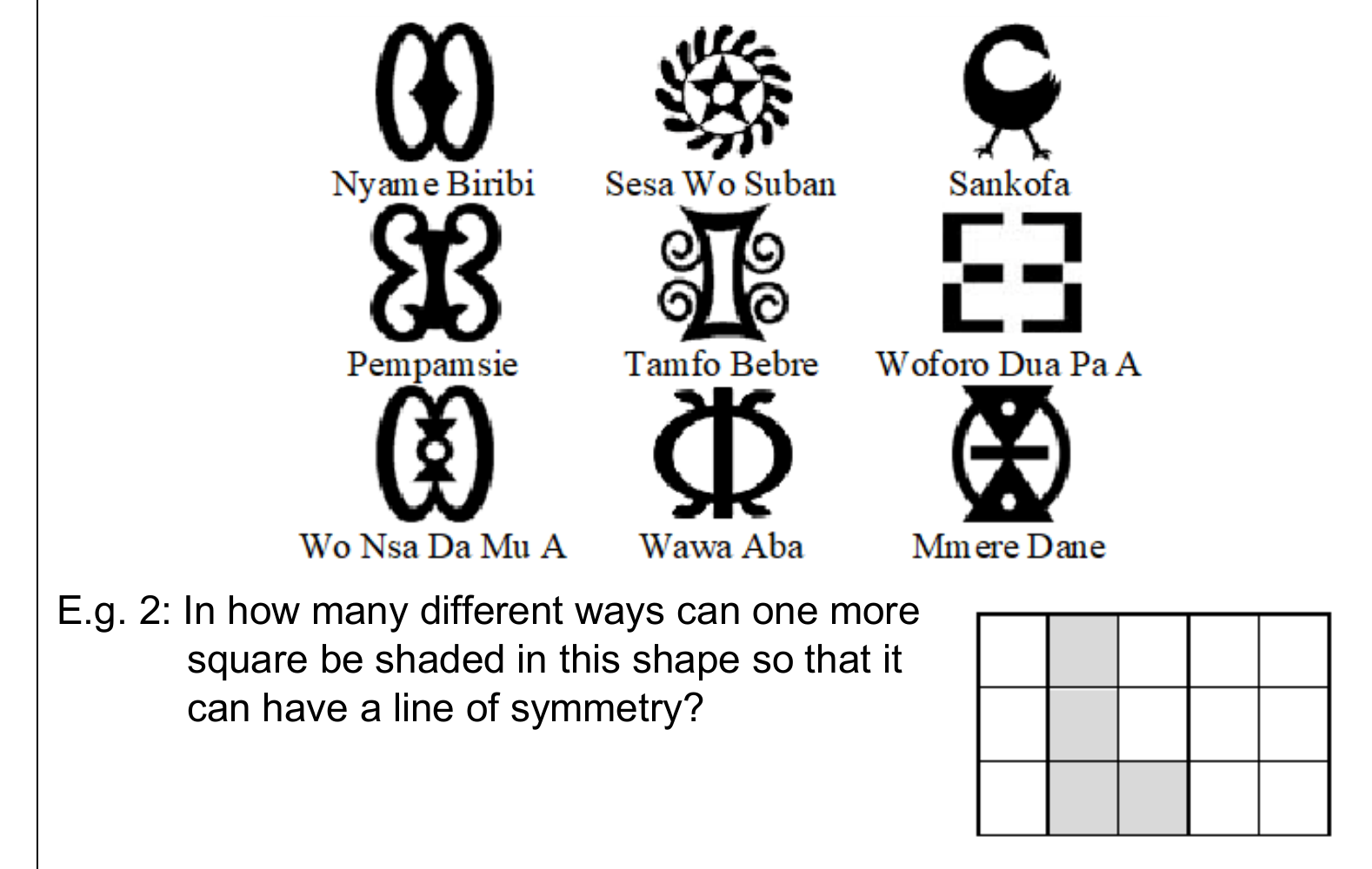
E.g. 2: In how many different ways can one more square be shaded in this shape so that it can have a line of symmetry?