JHS1 Mathematics · Term 3, Week 5
Measurement
Lesson notes
Learning Objectives
Indicator: B7.3.2.3.2 - Explain how to find the back bearing when the direction of travel has a bearing which is less than 180˚ and/ or greater than 180˚.
By the end of the lesson, learners can:
- State what a back bearing is and explain its relationship to the forward bearing.
- Calculate the back bearing by adding 180˚ when the forward bearing is less than 180˚.
- Calculate the back bearing by subtracting 180˚ when the forward bearing is greater than 180˚.
- Interpret bearing problems given in words and diagrams to identify the forward bearing correctly.
- Solve real-life problems involving back bearings, such as return journeys and navigation, showing all working steps.
Sign in with your phone number to read the full note and download the GES plan - free.
Sign in with phone numberCurriculum details
- Strand
- Geometry and Measurement (Strand 3)
- Sub-strand
- Measurement (3.2)
- Content standard
- B7.3.2.3 - Demonstrate understanding of bearings, vector and its components using real life cases.
- Indicator
- B7.3.2.3.2 - Explain how to find the back bearing when the direction of travel has a bearing which is less than 180˚ and/ or greater than 180˚.
- Suggested placement
-
Term 3, Week 5
(Week 29 of the year)
Our suggestion, laid out in curriculum order across three terms of twelve weeks. NaCCA does not fix the week, so follow your school's scheme of learning.
- Curriculum reference
-
Mathematics, Common Core Programme (JHS1-JHS3), 2023, p. 69
Transcribed from the official NaCCA publication. Check this page against the source.
Exemplars (from the NaCCA curriculum)
E.g.1
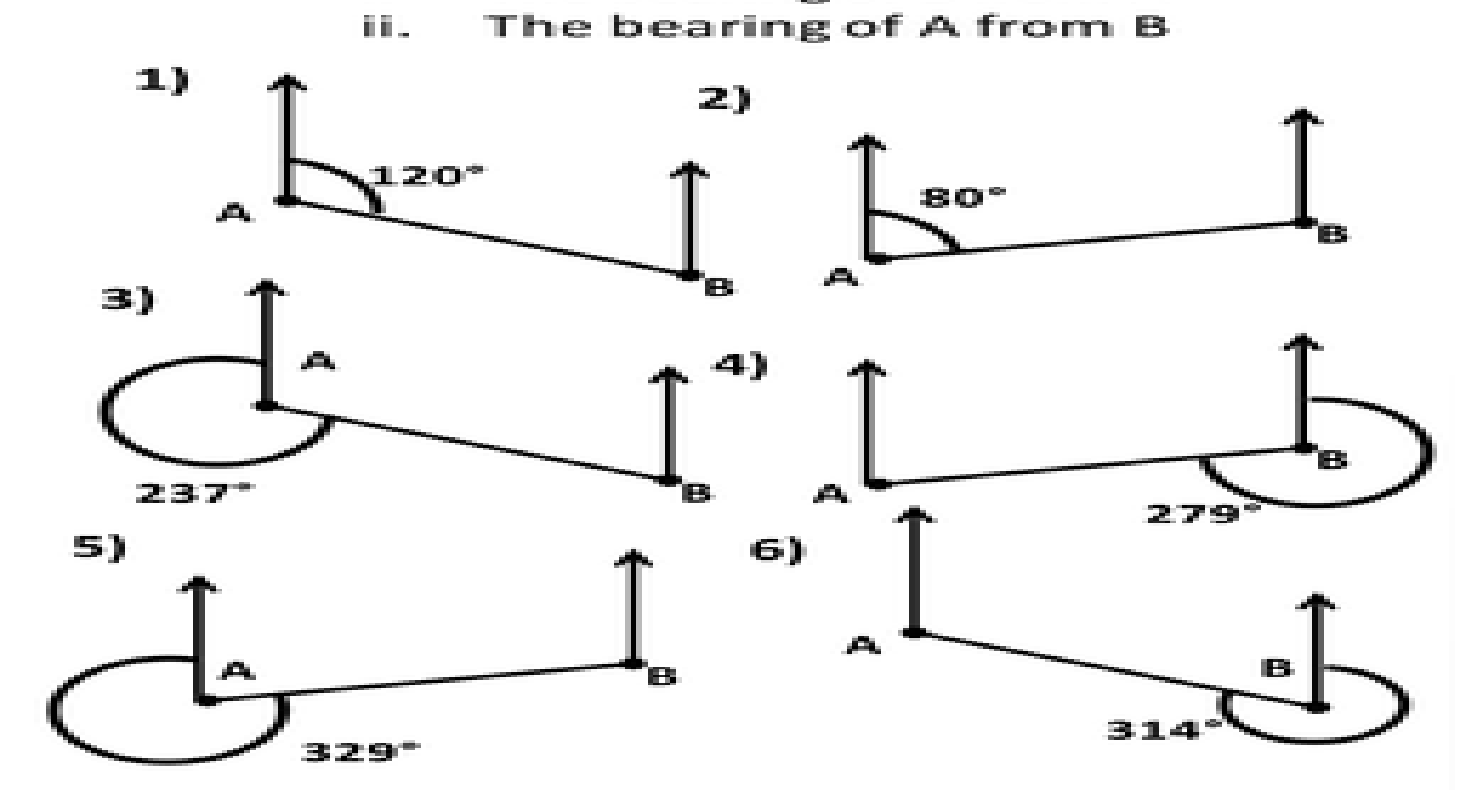
E.g.2 The bearing of P from Q is 060˚.What is the bearing of Q from P
E.g.3 The bearing of P from Q is 145˚.What is the bearing of Q from P