JHS1 Mathematics · Term 3, Week 2
Measurement
Lesson notes
Learning Objectives
Indicator: B7.3.2.1.1 - Calculate the perimeter of given shapes whose dimensions are in two units (i.e. cm and mm, m and cm, or km and m)
By the end of the lesson, learners can:
- Convert dimensions given in two units (cm and mm, m and cm, or km and m) to a single unit before finding perimeter.
- Calculate the perimeter of a shape by converting all dimensions to the smaller unit (e.g. km to m, m to cm, cm to mm) and adding.
- Calculate the perimeter of a shape by converting dimensions to decimal fractions in the larger unit (e.g. 7 cm 5 mm = 7.5 cm) and adding.
- State the perimeter of a shape with the correct unit label (mm, cm, m, or km).
- Apply both conversion methods to solve perimeter problems in everyday situations.
Sign in with your phone number to read the full note and download the GES plan - free.
Sign in with phone numberCurriculum details
- Strand
- Geometry and Measurement (Strand 3)
- Sub-strand
- Measurement (3.2)
- Content standard
- B7.3.2.1 - Demonstrate the ability to find the perimeter of plane shapes including circles using the concept of pi (π) to find the circumference of a circle.
- Indicator
- B7.3.2.1.1 - Calculate the perimeter of given shapes whose dimensions are in two units (i.e. cm and mm, m and cm, or km and m)
- Suggested placement
-
Term 3, Week 2
(Week 26 of the year)
Our suggestion, laid out in curriculum order across three terms of twelve weeks. NaCCA does not fix the week, so follow your school's scheme of learning.
- Source document note
-
The official curriculum document has a fault in this entry, so the curriculum text above is transcribed exactly as printed:
- content standard text - p.59: the standard's code is printed 'B.7.3.2.1', with a stop after the B
- Curriculum reference
-
Mathematics, Common Core Programme (JHS1-JHS3), 2023, p. 59
Transcribed from the official NaCCA publication. Check this page against the source.
Exemplars (from the NaCCA curriculum)
E.g. 1. Calculate the perimeter of a shape
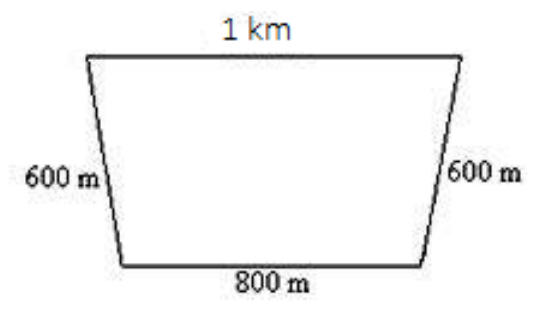
with dimensions given in km and m by converting to the smaller unit and adding the distance around the shapes.
E.g. 2 Calculate the perimeter of a shape with dimensions given in cm and
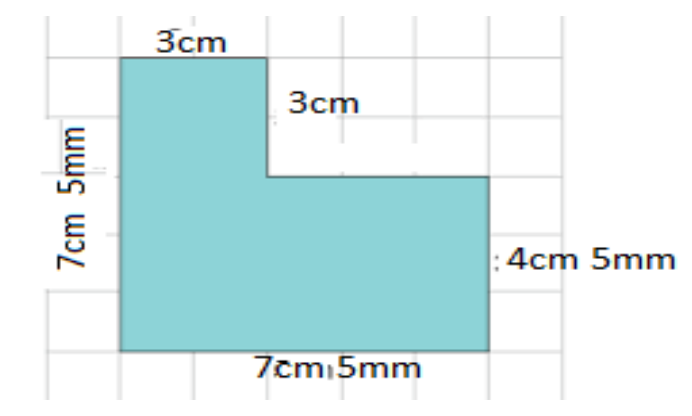
mm by converting to decimal fractions in the larger unit (i.e. 7cm 5mm = 7.5cm).
E.g. 3 Calculate the perimeter of a shape with dimensions given in m and cm by converting to decimal fractions in the larger unit (i.e. 1m 75cm
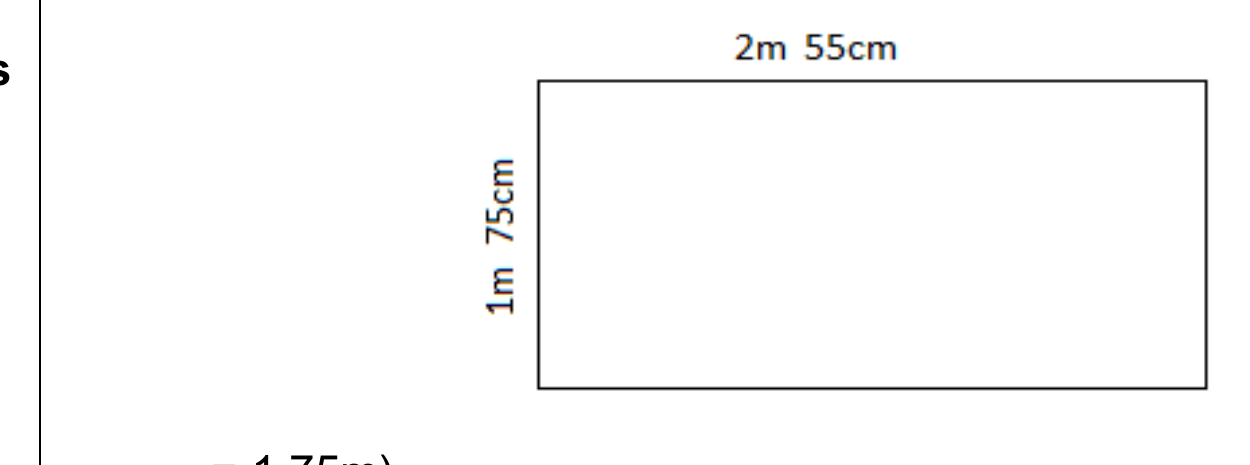
= 1.75m).