JHS1 Mathematics · Term 2, Week 1
Number: Ratios and Proportion
Lesson notes
Learning Objectives
Indicator: B7.1.4.1.3 - Make tables of equivalent ratios (written as common fractions) relating quantities that are proportional.
By the end of the lesson, learners can:
- Write a given ratio of two or three quantities in its simplest form as a common fraction and use it to create a table of equivalent ratios.
- Complete a table of equivalent ratios by scaling quantities up or down using multiplication or division.
- Use a table of equivalent ratios to find an unknown quantity when the value of one related quantity is given.
- Solve word problems that involve sharing or comparing quantities in a given ratio, using equivalent fraction tables.
- Explain that equivalent ratios represent the same proportional relationship, just written in different forms.
Sign in with your phone number to read the full note and download the GES plan - free.
Sign in with phone numberCurriculum details
- Strand
- Number (Strand 1)
- Sub-strand
- Number: Ratios and Proportion (1.4)
- Content standard
- B7.1.4.1 - Demonstrate an understanding of the concept of ratios and its relationship to fractions and use it to solve problems that involve rates, ratios, and proportional reasoning
- Indicator
- B7.1.4.1.3 - Make tables of equivalent ratios (written as common fractions) relating quantities that are proportional.
- Suggested placement
-
Term 2, Week 1
(Week 13 of the year)
Our suggestion, laid out in curriculum order across three terms of twelve weeks. NaCCA does not fix the week, so follow your school's scheme of learning.
- Curriculum reference
-
Mathematics, Common Core Programme (JHS1-JHS3), 2023, p. 25
Transcribed from the official NaCCA publication. Check this page against the source.
Exemplars (from the NaCCA curriculum)
E.g.1 Kafui, Adoley and Jantuah shared an amount of money in the ratio of their ages. Kafui is 36 years old, Adoley is 48years and Jantuah is 24years old. If Jantuah received GH₵24000, how much money did they share?
Solution
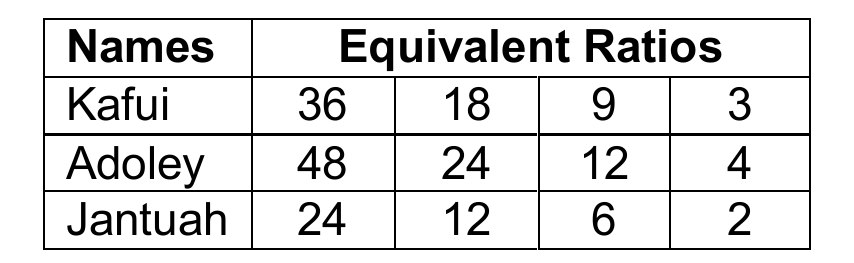
Names Equivalent Ratios Kafui 36 18 9 3 Adoley 48 24 12 4 Jantuah 24 12 6 2
Hint: Any of these ratios can be used for the calculation. 2 → 24000 9 →x 9 × 24000 = 2x 9 × 12000 = x x = 108,000, Hence, the amount of money shared = GH₵108,000