JHS1 Mathematics · Term 1, Week 12
Fractions, Decimals and Percentages
Lesson notes
Learning Objectives
Indicator: B7.1.3.3.4 - Determine the result of dividing a quantity (i.e. money or objects) or a fraction by a fraction
By the end of the lesson, learners can:
- Explain why dividing by a fraction is the same as multiplying by its reciprocal (the flipped fraction).
- Divide a whole number or a mixed number by a proper fraction using the reciprocal method, showing all steps clearly.
- Divide a fraction by another fraction and write the answer in its simplest form.
- Solve word problems involving sharing money (in GHS) or physical objects equally using division by a fraction.
- Verify division results by multiplying the quotient by the divisor to check that the original quantity is obtained.
Sign in with your phone number to read the full note and download the GES plan - free.
Sign in with phone numberCurriculum details
- Strand
- Number (Strand 1)
- Sub-strand
- Fractions, Decimals and Percentages (1.3)
- Content standard
- B7.1.3.3 - Demonstrate an understanding of the process of multiplying and dividing positive fractions and apply this in solving problems
- Indicator
- B7.1.3.3.4 - Determine the result of dividing a quantity (i.e. money or objects) or a fraction by a fraction
- Suggested placement
-
Term 1, Week 12
(Week 12 of the year)
Our suggestion, laid out in curriculum order across three terms of twelve weeks. NaCCA does not fix the week, so follow your school's scheme of learning.
- Curriculum reference
-
Mathematics, Common Core Programme (JHS1-JHS3), 2023, p. 23
Transcribed from the official NaCCA publication. Check this page against the source.
Exemplars (from the NaCCA curriculum)
E.g. 1. A set of stacked plates for serving snacks at a party weighs 10 kg. If each plate in the stack weighs 1 kg, how many plates are in the 4
stack? To divide by a fraction, multiply both dividend by divisor the reciprocal of the divisor, hence 10 ÷ 1 →(10 × 4 ) ÷ ( 1 × 4 ) = 40
4 1 4 1
(10× 4 ) ÷ (1) = (10 × 4 ) = 40 1 1
E.g. 2. A class was given 9 1 litres
2
of fruit juice to share equally. If there are 38 learners in the class, how many millilitres of fruit juice will each student get?
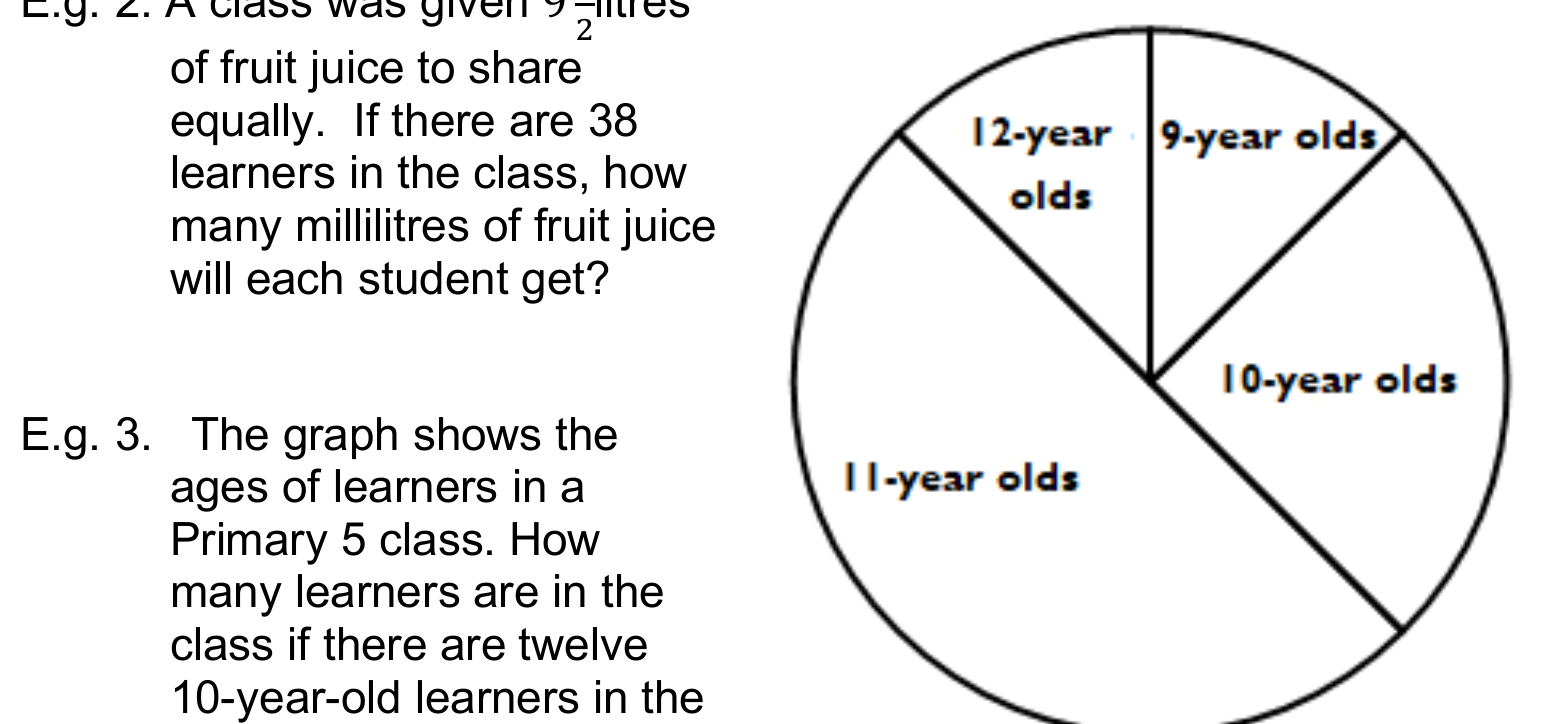
E.g. 3. The graph shows the ages of learners in a Primary 5 class. How many learners are in the class if there are twelve 10-year-old learners in the class?