JHS1 Mathematics · Term 1, Week 11
Fractions, Decimals and Percentages
Lesson notes
Learning Objectives
Indicator: B7.1.3.3.2 - Find a fraction of given quantity (i.e. money or given quantity of objects)
By the end of the lesson, learners can:
- Interpret the word “of” in a fraction problem as multiplication, and write the corresponding multiplication sentence.
- Find a unit fraction of a given quantity (money or objects) by dividing the quantity by the denominator.
- Find a non-unit fraction of a given quantity by first dividing by the denominator and then multiplying by the numerator.
- Solve word problems involving finding fractions of money amounts (GHS) and quantities of objects in everyday situations.
- Apply the concept of finding a fraction of a quantity to solve a multi-step problem involving comparison or remaining amounts.
Sign in with your phone number to read the full note and download the GES plan - free.
Sign in with phone numberCurriculum details
- Strand
- Number (Strand 1)
- Sub-strand
- Fractions, Decimals and Percentages (1.3)
- Content standard
- B7.1.3.3 - Demonstrate an understanding of the process of multiplying and dividing positive fractions and apply this in solving problems
- Indicator
- B7.1.3.3.2 - Find a fraction of given quantity (i.e. money or given quantity of objects)
- Suggested placement
-
Term 1, Week 11
(Week 11 of the year)
Our suggestion, laid out in curriculum order across three terms of twelve weeks. NaCCA does not fix the week, so follow your school's scheme of learning.
- Curriculum reference
-
Mathematics, Common Core Programme (JHS1-JHS3), 2023, p. 21
Transcribed from the official NaCCA publication. Check this page against the source.
Exemplars (from the NaCCA curriculum)
E.g. 1. To multiply a given quantity by a fraction is just like multiplying by a whole number, so the multiplication is read as 'of'. For instance, 2 ×GH₵60 means 2 of GH₵60, i.e. 2 × 60 = 2 ×60 =GH₵40. 3 3 3 1 3 ×1
E.g. 2. There are 132 learners in a class. If 2 of the learners are girls, how 3
many boys are in the class?
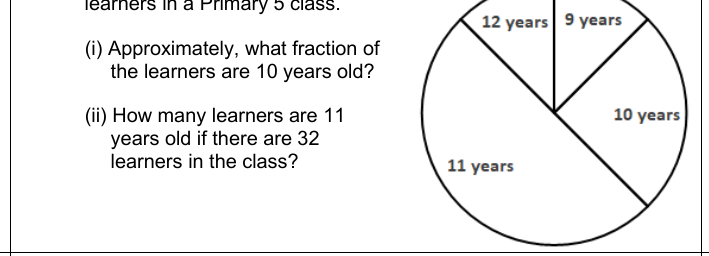
E.g. 3. The graph shows the ages of learners in a Primary 5 class.
(i) Approximately, what fraction of the learners are 10 years old?
(ii) How many learners are 11 years old if there are 32 learners in the class?