JHS1 Mathematics · Term 1, Week 1
Number and Numeration Systems
Lesson notes
Learning Objectives
Indicator: B7.1.1.1.3 - Round (off, up, down) whole numbers more than 1,000,000,000 to the nearest hundred-thousand, ten-thousands, thousands, hundreds and tens
By the end of the lesson, learners can:
- State the place value of digits in whole numbers up to billions (e.g., units, tens, hundreds, thousands, ten-thousands, hundred-thousands, millions, ten-millions, hundred-millions, billions).
- Round off whole numbers above 1,000,000,000 to the nearest hundred-thousand, ten-thousand, thousand, hundred, and ten using the standard rounding rule (5 or more rounds up, 4 or less rounds down).
- Distinguish between rounding up and rounding down as deliberate choices of the larger or smaller neighbouring value, and apply each where required.
- Apply rounding to real-life quantities such as population figures, national budgets, and distances.
Sign in with your phone number to read the full note and download the GES plan - free.
Sign in with phone numberCurriculum details
- Strand
- Number (Strand 1)
- Sub-strand
- Number and Numeration Systems (1.1)
- Content standard
- B7.1.1.1 - Demonstrate understanding and the use of place value for expressing quantities recorded as base ten numerals as well as rounding these to given decimal places and significant figures.
- Indicator
- B7.1.1.1.3 - Round (off, up, down) whole numbers more than 1,000,000,000 to the nearest hundred-thousand, ten-thousands, thousands, hundreds and tens
- Suggested placement
-
Term 1, Week 1
(Week 1 of the year)
Our suggestion, laid out in curriculum order across three terms of twelve weeks. NaCCA does not fix the week, so follow your school's scheme of learning.
- Curriculum reference
-
Mathematics, Common Core Programme (JHS1-JHS3), 2023, p. 4
Transcribed from the official NaCCA publication. Check this page against the source.
Exemplars (from the NaCCA curriculum)
E.g. 1. Round off whole numbers up to over 1,000,000,000 to the nearest hundred-thousands, ten-thousands, thousands, hundreds, etc.
i. 1,879,653 is 1,900,000 to the nearest hundred thousand and 1,880,000 to the nearest ten thousand
E.g. 2. Explain the differences between the "round up" and "round down" concepts. When rounding up, we consider the larger number, while when rounding down, we consider the smaller of the two. The table below may bring out the meaning of the concept.
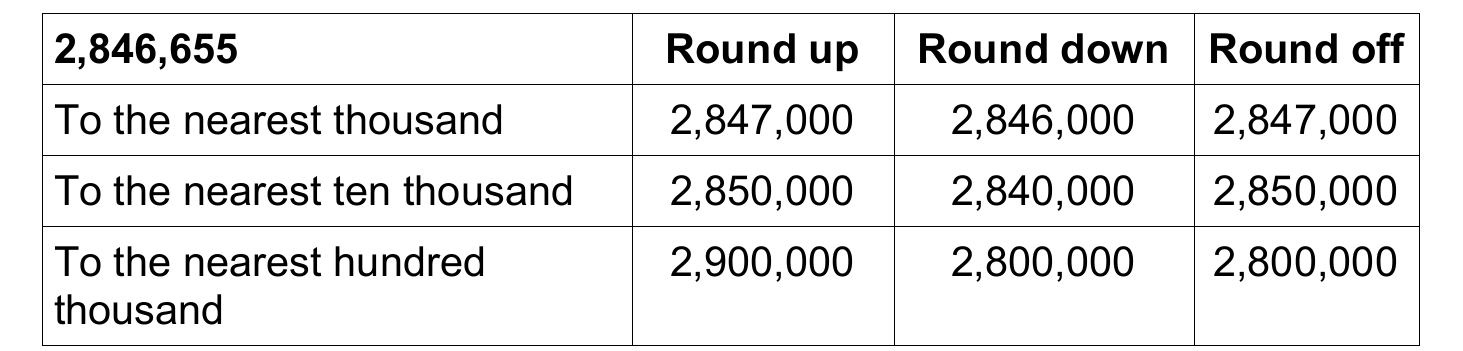
2,846,655 Round up Round down Round off To the nearest thousand 2,847,000 2,846,000 2,847,000 To the nearest ten thousand 2,850,000 2,840,000 2,850,000 To the nearest hundred 2,900,000 2,800,000 2,800,000 thousand
E.g.3. Express whole numbers to significant figures (i) 857386321
- five significant figures
- four significant figures
- three significant figures, etc.