B6 Mathematics · Term 3, Week 4
Geometric Reasoning
Lesson notes
Learning Objectives
Indicator: B6.3.3.5.1
By the end of the lesson, learners can:
- Identify the line of reflection (mirror line) when shown an object and its reflected image on a grid.
- Draw the reflected image of a 2D shape when the mirror line is outside the shape, using a grid or graph board.
- State the properties of images under reflection: the object and image have the same size and shape, and corresponding points are equidistant from the mirror line.
- Describe the position of an image after reflection using directional language (left, right, above, below) in relation to the mirror line.
Sign in with your phone number to read the full note and download the GES plan - free.
Sign in with phone numberCurriculum details
- Strand
- Geometry and Measurement (Strand 3)
- Sub-strand
- Geometric Reasoning (3.3)
- Content standard
- B6.3.3.5 - Perform a single transformation (i.e. reflection translation) on a 2D shape
- Indicator
- B6.3.3.5.1 - Perform and identify images of a single transformation (i.e. reflection) on 2D shapes in a plane
- Suggested placement
-
Term 3, Week 4
(Week 28 of the year)
Our suggestion, laid out in curriculum order across three terms of twelve weeks. NaCCA does not fix the week, so follow your school's scheme of learning.
- Source document note
-
The official curriculum document has a fault in this entry, so the curriculum text above is transcribed exactly as printed:
- exemplars - p.147
- Curriculum reference
-
Mathematics Curriculum for Primary Schools (Basic 4-6), 2019, p. 147
Transcribed from the official NaCCA publication. Check this page against the source.
Exemplars (from the NaCCA curriculum)
E.g. 1. Give learners photocopied worksheets with several incomplete 2D shapes to review the drawing of images of objects when reflected in the line of symmetry which is outside the object
E.g. 2. Review the properties of images under reflection, i.e. object and image sizes and shape, distances from mirror line and shape
E.g. 3 Use a grid or graph board to demonstrate the 'horizontal followed by vertical' movements called translation. E.g. In the figure is 'the movement which takes each point four units horizontally to the right and one unit vertically down' or 4 right, one down', is a vector or translation vector (2→, 1↓) and written as ( 2 ). Q is
-1 the image of P under the translation by the vector 2 ( )
-1
E.g. 4 Discuss the properties of images under translations, i.e. object and image sizes and shape
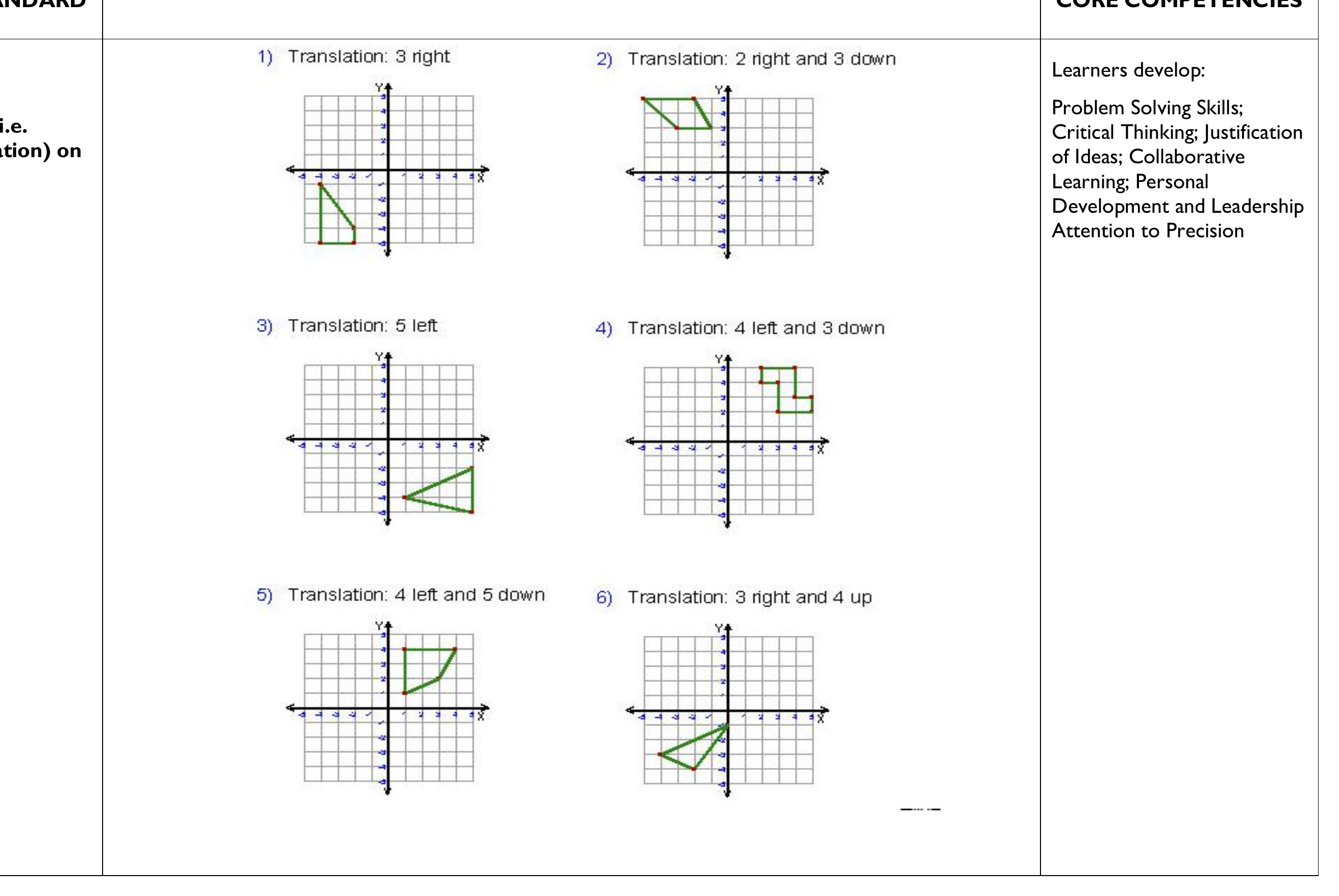
E.g. 5 Give learners photocopied worksheets with several 2D shapes and ask them to draw images of each under the translation vector given Note: Diagram is on the next page
This is the second of the two indicators the document codes B6.3.3.5.1 - see the note on the p.146 row. Its content standard (also printed B6.3.3.5) is the transformation one, whose next indicator is printed B6.3.3.5.2 on p.150.