B6 Mathematics · Term 2, Week 9
Pattern and Relationships
Lesson notes
Learning Objectives
Indicator: B6.2.1.1.4 - Represent a given pattern visually to verify predictions
By the end of the lesson, learners can:
- Draw the next two terms of a given matchstick pattern to check whether their numerical prediction is correct.
- Create a visual representation (diagram or drawing) of a matchstick pattern from a table of values.
- Verify a stated prediction by drawing the pattern and counting the matchsticks.
- Use visual representations to justify whether a predicted number of matchsticks for a given pattern number is correct or incorrect.
- Construct their own matchstick pattern, draw it, and use the drawing to make and verify a prediction.
Sign in with your phone number to read the full note and download the GES plan - free.
Sign in with phone numberCurriculum details
- Strand
- Algebra (Strand 2)
- Sub-strand
- Pattern and Relationships (2.1)
- Content standard
- B6.2.1.1 - Determine the pattern rule to make predictions about subsequent elements.
- Indicator
- B6.2.1.1.4 - Represent a given pattern visually to verify predictions
- Suggested placement
-
Term 2, Week 9
(Week 21 of the year)
Our suggestion, laid out in curriculum order across three terms of twelve weeks. NaCCA does not fix the week, so follow your school's scheme of learning.
- Source document note
-
The official curriculum document has a fault in this entry, so the curriculum text above is transcribed exactly as printed:
- exemplars - p.138
- Curriculum reference
-
Mathematics Curriculum for Primary Schools (Basic 4-6), 2019, p. 138
Transcribed from the official NaCCA publication. Check this page against the source.
Exemplars (from the NaCCA curriculum)
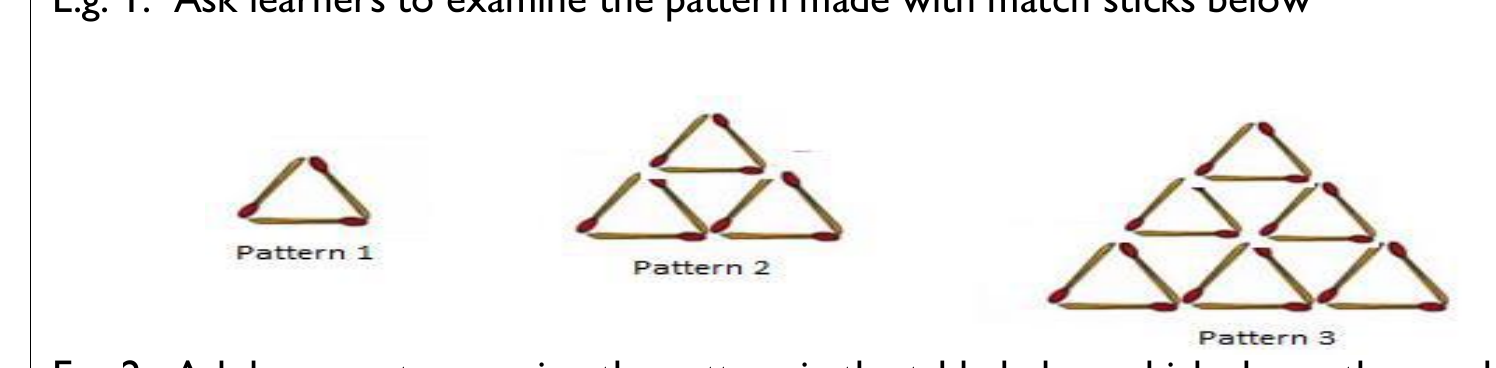
E.g. 1. Ask learners to examine the pattern made with match sticks below
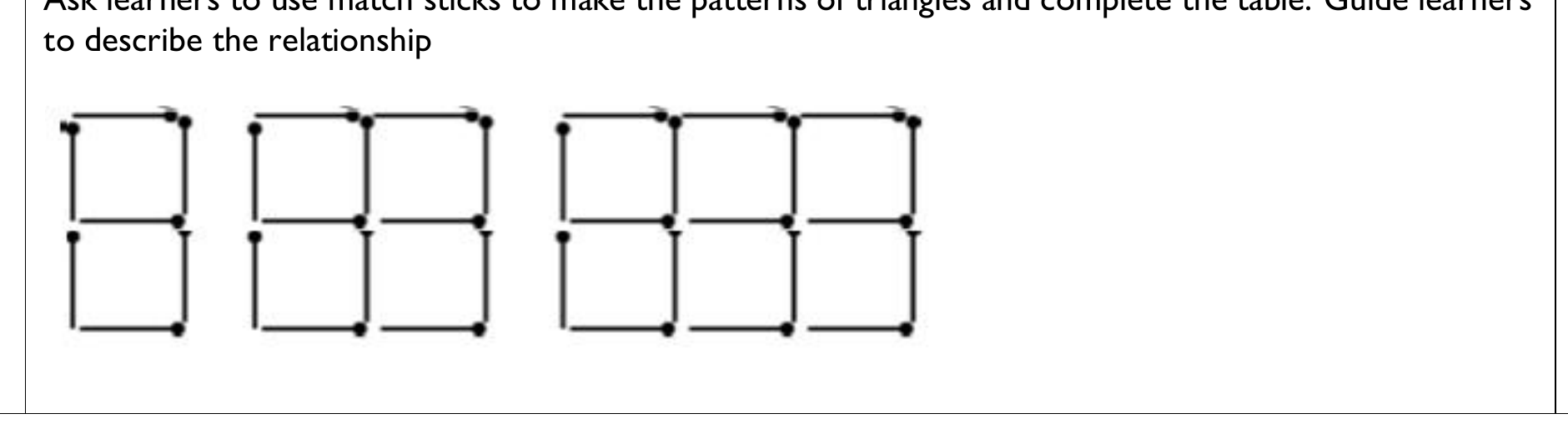
E.g. 2. Ask learners to examine the pattern in the table below which shows the number of match sticks used in making a pattern of squares. Pattern Number 1 2 3 4 5 6 7 8 9 Match sticks in the
3 6
perimeter Match sticks enclosed
0 3
in the pattern Ask learners to use match sticks to make the patterns of triangles and complete the table. Guide learners to describe the relationship
E.g. 3. Ask learners to write questions based on number or geometric patterns for their friends to find answers to; e.g. how many match sticks will be used for the 9th pattern of triangles? How many match sticks will be used for the 8th pattern of squares? Number of triangles 1 2 3 4 5 6 7 8 9 Match sticks 7 12 This is the first algebra indicator in B6 and the document numbers it .4: there is no B6.2.1.1.1, .2 or .3. The two match-stick tables are set below the exemplars and their cells interleave with them in the text layer; the figures show them.