B6 Mathematics · Term 2, Week 8
Ratios and Proportion
Lesson notes
Learning Objectives
Indicator: B6.1.4.2.3 - Use various strategies to solve proportional reasoning problems involving rates and scales
By the end of the lesson, learners can:
- Identify a rate as a special ratio comparing two quantities with different units, such as cost per kilogram or distance per litre.
- Use the unit rate strategy to solve problems involving rates, finding the cost or quantity for any given amount.
- Use the scale factor strategy to calculate actual measurements from scale drawings and map distances.
- Use the cross-multiplication strategy to solve proportional reasoning problems where the unit rate is not obvious.
- Justify their chosen strategy for solving a proportional reasoning problem and check the reasonableness of their answers.
Sign in with your phone number to read the full note and download the GES plan - free.
Sign in with phone numberCurriculum details
- Strand
- Number (Strand 1)
- Sub-strand
- Ratios and Proportion (1.4)
- Content standard
- B6.1.4.2 - Understand the concept of proportion and its relationship to ratios and rates. Use proportional reasoning and rates to solve real- world and mathematical problems.
- Indicator
- B6.1.4.2.3 - Use various strategies to solve proportional reasoning problems involving rates and scales
- Suggested placement
-
Term 2, Week 8
(Week 20 of the year)
Our suggestion, laid out in curriculum order across three terms of twelve weeks. NaCCA does not fix the week, so follow your school's scheme of learning.
- Source document note
-
The official curriculum document has a fault in this entry, so the curriculum text above is transcribed exactly as printed:
- exemplars - p.137
- Curriculum reference
-
Mathematics Curriculum for Primary Schools (Basic 4-6), 2019, p. 137
Transcribed from the official NaCCA publication. Check this page against the source.
Exemplars (from the NaCCA curriculum)
E.g. 1. Use diagrams to explain the concept of rate a ratio that compares two different quantities measured in different units; e.g. the ratio → cost : weight = 8:2 = 4:1. This Two kilograms of meat cost ¢8. What is the cost of (i) 5kg (ii) 12kg and (iii) 25kg. ratio is the unit ratio and show the rate for selling a unit or 1kg of the meat. Meat (kg) 2 5 12 25 Cost (l) 8

E.g. 2. Work out rates and use them in solving problems. E.g. A litre of sachet water costs 40p. Find the cost of (i) 1 litre (ii) 7 litres 2 (iii) 9 litres
E.g. 3. Use diagrams to explain the concept of scale as a ratio that compares two different sizes
- an object and its model; e.g. plan of a house or room. [Here is the plan of a bedroom. The scale is 1:100, which means that 1cm in the drawing represents 100 cm in the actual room. What is the actual length of (i) the room if it measures 4 1 cm; (ii) the bed if it measures 1.8cm?] 2
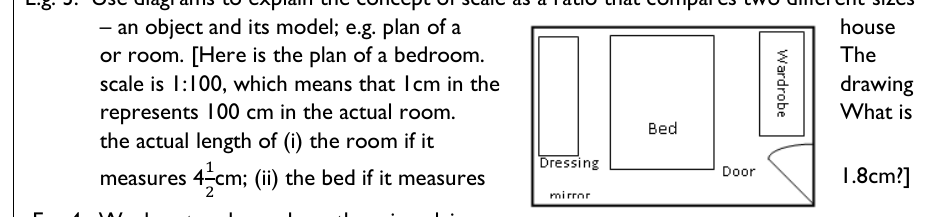
E.g. 4. Work out scales and use them in solving problems; e.g. If 10cm on a map stands for 10km, what distances on the map stands for (i) 1km (ii) 7km (iii) 41km? There is no B6.1.4.2.2: content standard B6.1.4.2 runs B6.1.4.2.1 (printed p.136) then B6.1.4.2.3 (printed p.137). The meat/cost table and the bedroom plan are set beside the exemplars and their words interleave with them in the text layer; the figures show them.