B4 Mathematics · Term 2, Week 3
Ratios and Proportion
Full lesson notes coming
Notes for this lesson are being prepared. The curriculum details below are complete and ready to use for your planning.
Curriculum details
- Strand
- Number (Strand 1)
- Sub-strand
- Ratios and Proportion (1.4)
- Content standard
- B4.1.4.1 - Develop an understanding of decimals (tenths and hundredths) using concrete and pictorial representations and write decimal fractions as base ten numbers with place value.
- Indicator
- B4.1.4.1.1 - Describe and represent decimals (tenths and hundredths) concretely, pictorially, and symbolically
- Suggested placement
-
Term 2, Week 3
(Week 15 of the year)
Our suggestion, laid out in curriculum order across three terms of twelve weeks. NaCCA does not fix the week, so follow your school's scheme of learning.
- Source document note
-
The official curriculum document has a fault in this entry, so the curriculum text above is transcribed exactly as printed:
- exemplars - p.25
- Curriculum reference
-
Mathematics Curriculum for Primary Schools (Basic 4-6), 2019, p. 25
Transcribed from the official NaCCA publication. Check this page against the source.
Exemplars (from the NaCCA curriculum)
E.g. 1. Use pictorial representations or number line to revise tenths and hundredths and ask pupils to identify the fractions (i.e. A, B, C, D, & E).
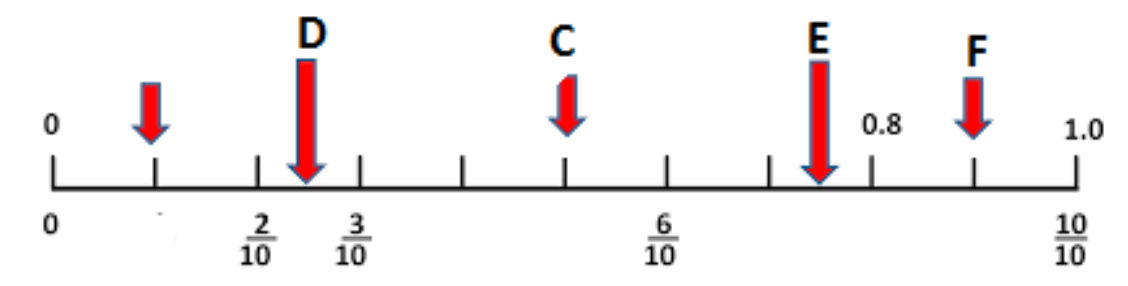
E.g. 2. Use the tenth and hundredth place value chart to illustrate how to write the fraction as a base ten number with the introduction of the decimal point "∙" after ones place in the place value chart.
E.g. 3. Give pupils several common fractions (including improper fractions) to convert into tenths and hundredths and write their decimal names.
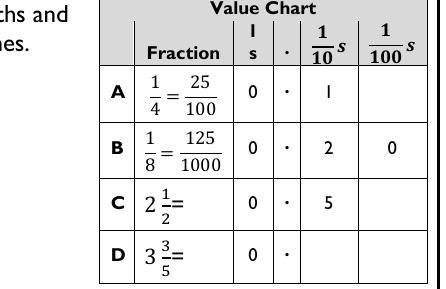
The "Tenth and Hundredth Place Value Chart" (rows A to D, columns Fraction / 1s / . / 1/10 s / 1/100 s) is set beside E.g. 3 and its cells interleave with the exemplar in the text layer; the figure shows it. E.g. 3 also carries a worked line the text layer garbles, printed as "E.g. 7 2/5 = ?/10 = ?".