B4 Mathematics · Term 2, Week 2
Fractions
Full lesson notes coming
Notes for this lesson are being prepared. The curriculum details below are complete and ready to use for your planning.
Curriculum details
- Strand
- Number (Strand 1)
- Sub-strand
- Fractions (1.3)
- Content standard
- B4.1.3.2 - Demonstrate an understanding of strategies for comparing, adding and subtracting fractions (same denominator, or one being a multiple of the others)
- Indicator
- B4.1.3.2.1 - Compare and order fractions with like denominators by using pictorial representations and finding equivalent fractions using the Lowest Common Denominator (LCD)
- Suggested placement
-
Term 2, Week 2
(Week 14 of the year)
Our suggestion, laid out in curriculum order across three terms of twelve weeks. NaCCA does not fix the week, so follow your school's scheme of learning.
- Source document note
-
The official curriculum document has a fault in this entry, so the curriculum text above is transcribed exactly as printed:
- exemplars - p.23
- Curriculum reference
-
Mathematics Curriculum for Primary Schools (Basic 4-6), 2019, p. 23
Transcribed from the official NaCCA publication. Check this page against the source.
Exemplars (from the NaCCA curriculum)
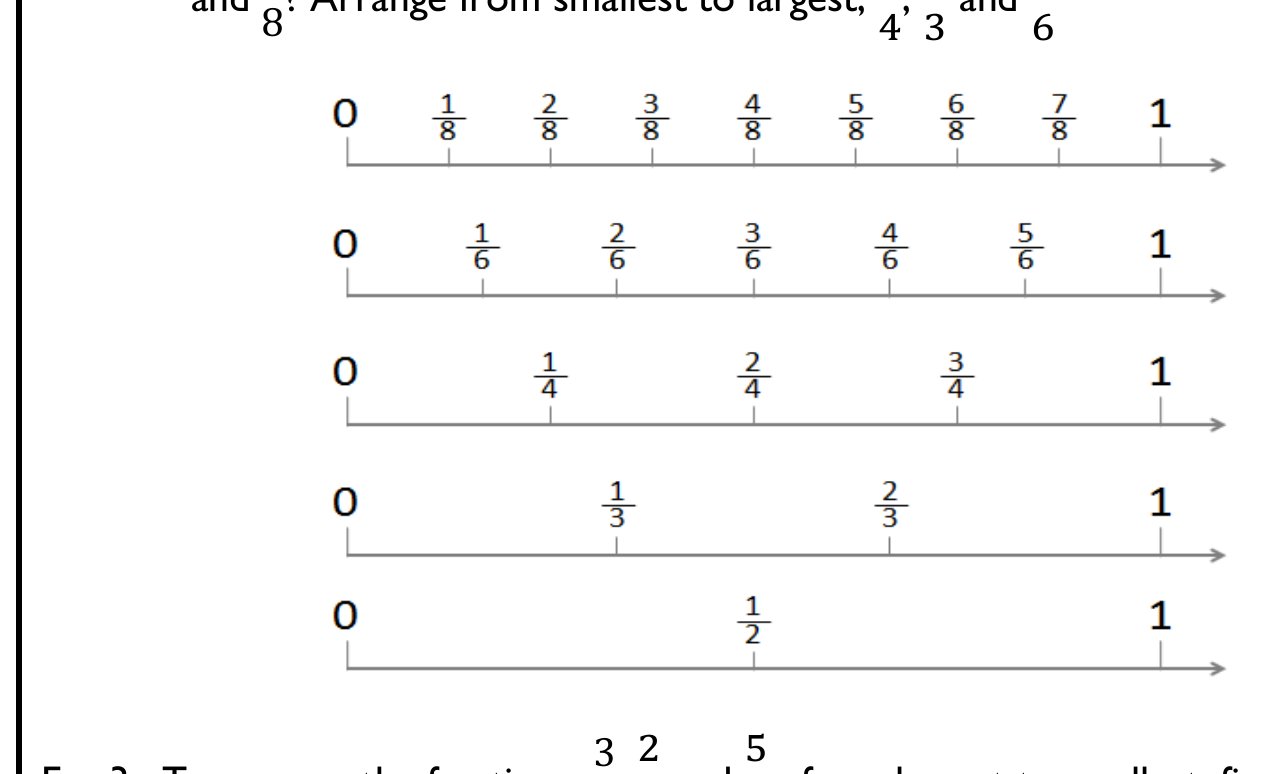
E.g. 1. Use number line or fraction chart to illustrate the concept of comparable fractional units or denominators; i.e. halves, fourths and eighths are comparable; i.e. half can be changed to equivalent fractions in fourths and eighths, and fourths can changed to eighths. Also thirds can changed to sixths.
E.g. 2. Use number line or fraction charts to compare and order unit fractions. Which is larger, 5/8 and 3/4 or 3/6 and 4/8? Arrange from smallest to largest, 3/4, 2/3 and 5/6
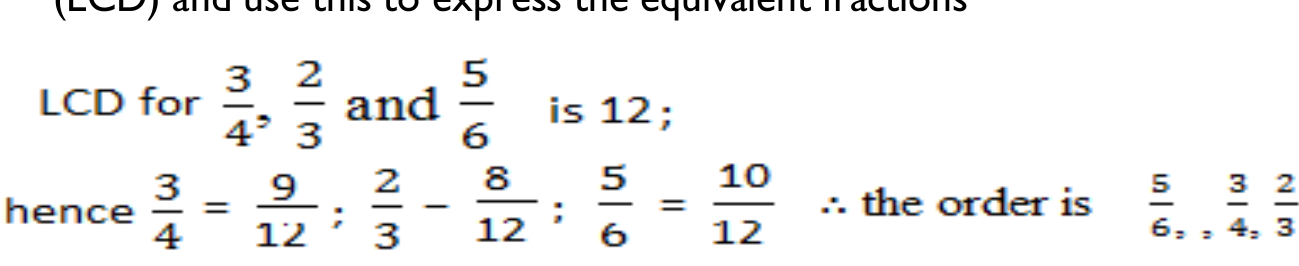
E.g. 3. To arrange the fractions, 3/4, 2/3 and 5/6, from largest to smallest, find the Lowest Common Denominator (LCD) and use this to express the equivalent fractions
The fractions are stacked and are written inline. In E.g. 2 the page prints the pair as "Which is larger, 5/8 and 3/4 or 3/6 and 4/8?" with the fractions set above and below the line of text; a reviewer should confirm the pairing against the page.