B4 Mathematics · Term 1, Week 3
Counting, Representation & Cardinality
Full lesson notes coming
Notes for this lesson are being prepared. The curriculum details below are complete and ready to use for your planning.
Curriculum details
- Strand
- Number (Strand 1)
- Sub-strand
- Counting, Representation & Cardinality (1.1)
- Content standard
- B4.1.1.1 - Demonstrate an understanding of quantities and place value for multi-digit whole numerals up to 100,000.
- Indicator
- B4.1.1.1.5 - Round (off, up, down) whole numbers up to 10000 to the nearest, thousands, hundreds and tens
- Suggested placement
-
Term 1, Week 3
(Week 3 of the year)
Our suggestion, laid out in curriculum order across three terms of twelve weeks. NaCCA does not fix the week, so follow your school's scheme of learning.
- Source document note
-
The official curriculum document has a fault in this entry, so the curriculum text above is transcribed exactly as printed:
- exemplars - p.6
- Curriculum reference
-
Mathematics Curriculum for Primary Schools (Basic 4-6), 2019, p. 6
Transcribed from the official NaCCA publication. Check this page against the source.
Exemplars (from the NaCCA curriculum)
E.g. 1 Learners round off numbers to the nearest 1000, 100 and 10. For instance; 9500 is approximately 10,000 and 9100 as approximately 9,000
E.g. 2 Learners round up and round down to estimate sums and differences
NB: To round down learners consider the smaller of the two approximated numbers, while round up considers the bigger of the two numbers. The table below may bring the meaning of these two concepts clearer
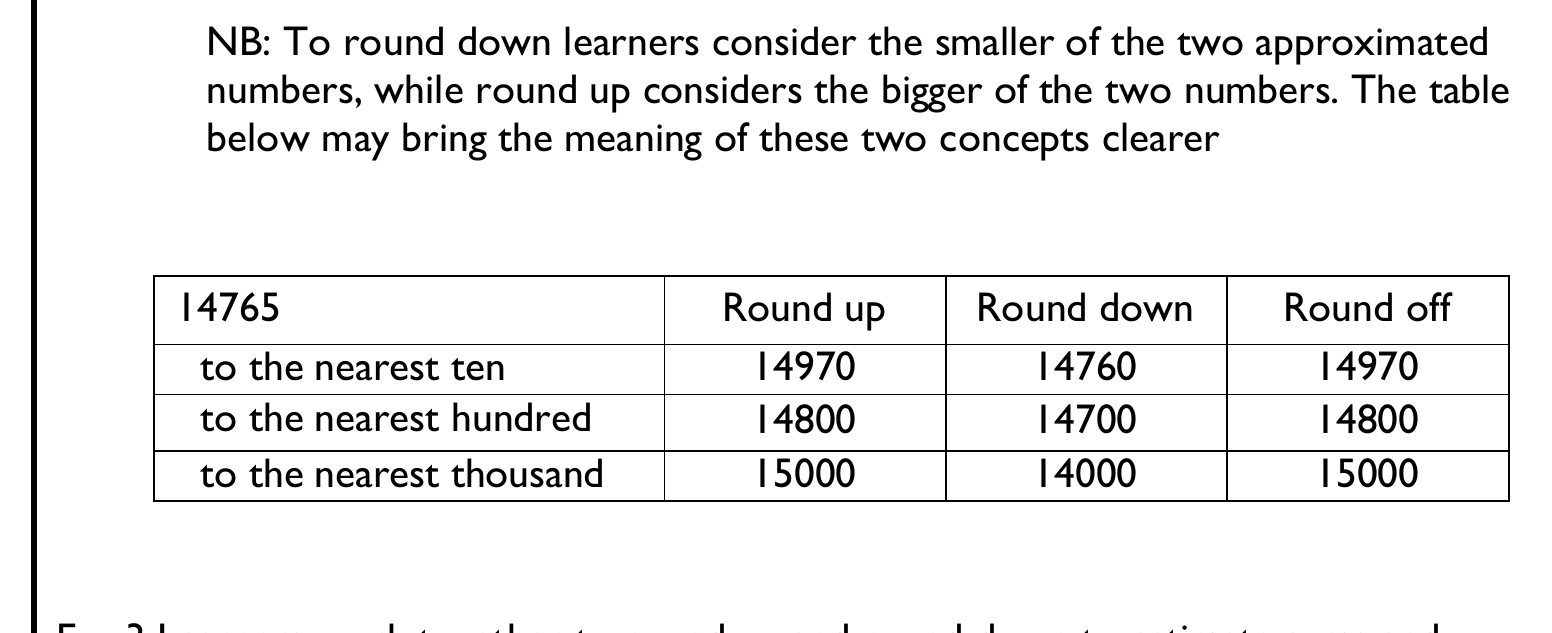
E.g. 3 Learners work together to round up and round down to estimate sums and differences. For instance. 230 + 160 as approximately 400 because 230 is approximately 200 while 160 is approximately 200 , therefore 200 + 200 = 400 The E.g. 2 table (14765; round up / round down / round off; to the nearest ten, hundred, thousand) is set beside the exemplar and its cells interleave with the sentence in the text layer; the figure shows it. In E.g. 3 the numbers 200, 200 and 400 are printed in a row under the words "therefore + =", and are written here inline.