B6 English Language · Term 1, Week 12
Word Families, minimal pairs and Common Digraphs
Lesson notes
Learning Objectives
Indicator: B6.2.3.1.2 - Use words with digraphs to make meaningful sentences
By the end of the lesson, learners can:
- Identify common digraphs (ch, ck, ph, ng, sh, qu, wh) in given words.
- Sort words according to the digraph they contain (ch, ck, ph, ng, sh, qu, wh).
- Use at least three words containing digraphs to construct meaningful sentences.
- Read aloud sentences containing digraph words with correct pronunciation.
- Write two original sentences, each containing a word with a different digraph.
Sign in with your phone number to read the full note and download the GES plan - free.
Sign in with phone numberCurriculum details
- Strand
- Reading (Strand 2)
- Sub-strand
- Word Families, minimal pairs and Common Digraphs (2.3)
- Content standard
- B6.2.3.1 - Identify minimal pairs and common digraphs
- Indicator
- B6.2.3.1.2 - Use words with digraphs to make meaningful sentences
- Suggested placement
-
Term 1, Week 12
(Week 12 of the year)
Our suggestion, laid out in curriculum order across three terms of twelve weeks. NaCCA does not fix the week, so follow your school's scheme of learning.
- Source document note
-
The official curriculum document has a fault in this entry, so the curriculum text above is transcribed exactly as printed:
- exemplars - p.169
- Curriculum reference
-
English Language Curriculum (Basic 4-6), 2019, p. 169
Transcribed from the official NaCCA publication. Check this page against the source.
Exemplars (from the NaCCA curriculum)
- Have learners identify words having specific digraphs and form meaningful sentences with the words.
e.gs. of digraphs: ch-chair ck-duck ph- phone ng- sting sh- ship qu- queen wh-whale
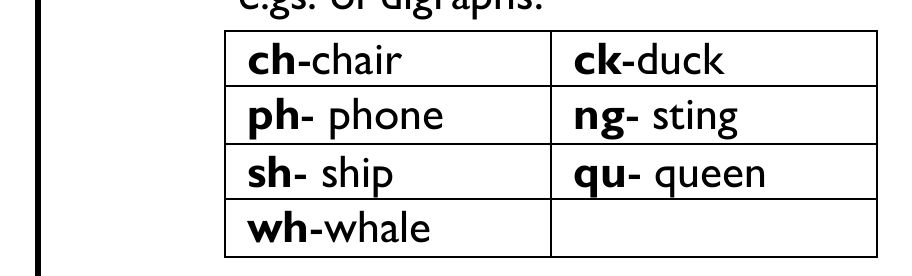
The digraph examples are set in a drawn two-column table (ch-chair / ck-duck, ph-phone / ng-sting, sh-ship / qu-queen, wh-whale) whose cells arrive in the text layer as one run of words; the figure shows it.