B4 Our World And Our People · Term 1, Week 12
The Environment and the Weather
Lesson notes
Learning Objectives
Indicator: B4.2.1.3.1 - Describe the sun as the source of light and heat to the earth
By the end of the lesson, learners can:
- State at least three facts about the sun, including that it is a star, it is at the centre of the solar system, and the earth moves around it.
- Demonstrate through a simple experiment how the sun gives us light and heat.
- Explain what would happen to life on earth if the sun stopped shining.
- Identify and practise at least two ways to protect themselves from the sun’s rays on sunny days.
- Discuss at least one human activity that can increase the sun’s heat on the earth.
Sign in with your phone number to read the full note and download the GES plan - free.
Sign in with phone numberCurriculum details
- Strand
- All Around Us (Strand 2)
- Sub-strand
- The Environment and the Weather (2.1)
- Content standard
- B4.2.1.3 - Recognise the sun as an important body in our global environment.
- Indicator
- B4.2.1.3.1 - Describe the sun as the source of light and heat to the earth
- Suggested placement
-
Term 1, Week 12
(Week 12 of the year)
Our suggestion, laid out in curriculum order across three terms of twelve weeks. NaCCA does not fix the week, so follow your school's scheme of learning.
- Source document note
-
The official curriculum document has a fault in this entry, so the curriculum text above is transcribed exactly as printed:
- exemplars - the figure is the torchlight experiment; the labels printed on it are 'Earth (Learner holds out)', 'Moon (Round Object)', 'Sun (Torchlight)' and 'Reflec', the last of which is truncated on the page p.8
- Curriculum reference
-
Our World and Our People Curriculum (Basic 4-6), 2019, p. 8
Transcribed from the official NaCCA publication. Check this page against the source.
Exemplars (from the NaCCA curriculum)
Learners discuss the sun as the ultimate source of energy and life on earth and learn more facts about the sun: it is a star, it is at the centre of the solar system, the earth moves round the sun, the sun is 149.6 kilometers from the earth, it is over one million times bigger than the earth.
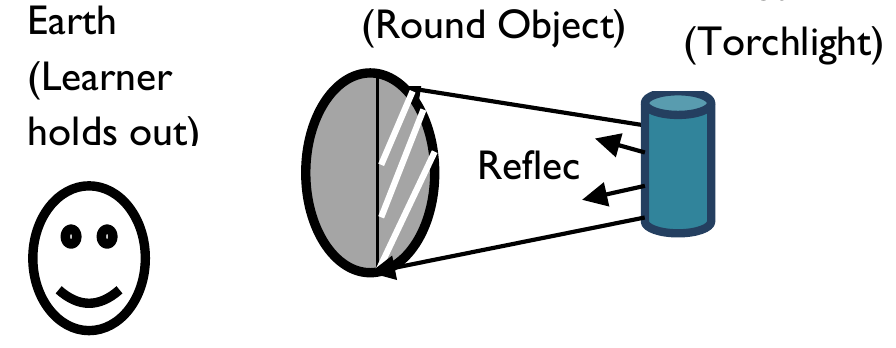
Learners conduct the above experiment or engage in other activities to show how we get light and heat from the sun.
Learners talk about some of the ways they can protect themselves against sun rays: use umbrella, do not wear heavy clothes, do not wear black and red cloths, wear white, cream, sea blue clothes on sunny days to reflect the heat.
Learners reflect on human activities that can lead to increase in the sun's heat on the earth.