SHS3 Mathematics · Semester 2, Week 4
Spatial Sense
Full lesson notes coming
Notes for this lesson are being prepared. The curriculum details below are complete and ready to use for your planning.
Curriculum details
- Strand
- Geometry Around Us (Strand 3)
- Sub-strand
- Spatial Sense (3.1)
- Content standard
- 3.3.1.CS.2 - Demonstrate knowledge and understanding of geometrical construction, use the knowledge to construct plane shapes and apply these in the world around them. 3.3.1.LO.2 Perform geometric construction of quadrilaterals and given loci.
- Indicator
- 3.3.1.LI.3 - Construct a particular locus for a given condition.
- Suggested placement
-
Semester 2, Week 4
(Week 24 of the year)
Our suggestion, laid out in curriculum order across three terms of twelve weeks. NaCCA does not fix the week, so follow your school's scheme of learning.
- Curriculum reference
- NaCCA curriculum document, p. 349
Exemplars (from the NaCCA curriculum)
Group discussions: Learners discuss the concept of loci and draw various loci for triangles and quadrilaterals using the appropriate mathematical and IT tools to boost their interest and desire to solve more problems on their own.
Example 1: Locus Theorems Locus Theorem 1: The locus of points at a fixed distance, d, from the point P is a circle with the given point P as its centre and d as its radius. Locus Theorem 2: The locus of the points at a fixed distance, d, from a line, l, is a pair of parallel lines d distance from l and on either side of l.
Locus Theorem 3: The locus of points equidistant from two points, P and Q, is the perpendicular bisector of the line segment determined by the two points. Locus Theorem 4: The locus of points equidistant from two parallel lines, l 1 and l 2 , is a line parallel to both l 1 and l 2 and midway between them. Locus Theorem 5: The locus of points equidistant from two intersecting lines, l 1 and l 2 , is a pair of bisectors that bisect the angles formed by l 1 and l 2 .
Example 2: Drawing various Loci
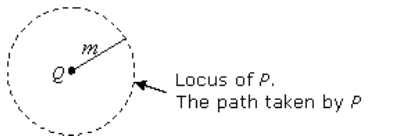
CONDITION 1: A point P moves such that it is always m units from the point Q. Locus formed: A circle with centre Q and radius m.
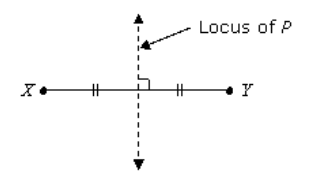
CONDITION 2: A point P moves such that it is equidistant from two fixed points, X and Y. Locus formed: A perpendicular bisector of the line XY.
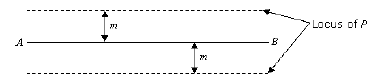
CONDITION 3: A point P moves so that it is always m units from a straight-line AB. Locus formed: A pair of parallel lines m units from AB.
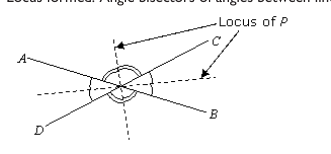
CONDITION 4: A point P moves so that it is always equidistant from two intersecting lines, AB and CD. Locus formed: Angle bisectors of angles between lines AB and CD.
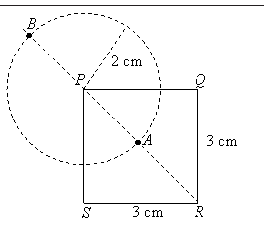
Group discussions: In convenient groups, solve problems involving Loci. Example 1: Given a square PQRS with sides 3 cm. Construct the locus of a point that is 2 cm from P and equidistant from PQ and PS. Mark the points as A and B.
Solution: Construct a circle with centre P and radius of 2 cm. Since PQRS is a square, the diagonal PR would be the angle bisector of the angle formed by the lines PQ and PS. The diagonal, when extended, intersects the circle at points A and B.
Examples: i. A goat is on a lead tethered to a post in the corner of a garden. The lead is 5 m long. A horse is free to roam all parts of the garden but is not allowed within 3 m of the dog by its owner. Show the safe area where the horse can safely roam. ii. A treasure map shows a treasure hidden in a park near a tree and a statue. The map indicates that the tree and the stature are 10 feet apart. The treasure is buried 7 feet from the base of the tree and also 5 feet from the base of the stature. How many places are possible locations for the treasure to be buried? Draw a diagram of the treasure map and indicate with an X each possible location of the treasure. iii. Adobea's backyard has two trees that are 40 feet apart. She wants to place lampposts so that the posts are 30 feet from both of the trees. Draw a sketch to show where the lamp posts could be placed in relation to the trees. How many locations for the lamp posts are possible?
Teaching and Learning Resources:
- * Mathematical sets, Graph sheet. * Technology tools such as computers, mobile phones, etc. * Computer software applications like GeoGebra.
Assessment (3.3.1.AS.3). The document marks these depth-of-knowledge levels for this indicator: Level 3 Strategic reasoning.