SHS3 Mathematics · Semester 1, Week 18
Spatial Sense
Full lesson notes coming
Notes for this lesson are being prepared. The curriculum details below are complete and ready to use for your planning.
Curriculum details
- Strand
- Geometry Around Us (Strand 3)
- Sub-strand
- Spatial Sense (3.1)
- Content standard
- 3.3.1.CS.1 - Demonstrate a conceptual understanding of spatial sense with respect to circles and their theorems and apply its properties to solve everyday life problems. 3.3.1.LO.1 Draw circles for given radii and use the circle theorems; identify the tangent as perpendicular to the radius at the point of contact and verify that tangents drawn from an external point to the same circle are equal when measured from their point of contact.
- Indicator
- 3.3.1.LI.3 - Identify the tangent as perpendicular to the radius at the point of contact and verify the Alternate Segment Theorem.
- Suggested placement
-
Semester 1, Week 18
(Week 18 of the year)
Our suggestion, laid out in curriculum order across three terms of twelve weeks. NaCCA does not fix the week, so follow your school's scheme of learning.
- Curriculum reference
- NaCCA curriculum document, p. 337
Exemplars (from the NaCCA curriculum)
Group discussions: In convenient groups, learners discuss the concept of tangent and prove that the tangent at the point of contact with the circumference of the circle is perpendicular to the radius.
Example: A tangent to a circle is a line intersecting the circle at exactly one point, the point of tangency or tangency point. An important result is that the radius from the centre of the circle to the point of tangency is perpendicular to the tangent line.
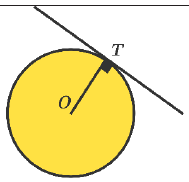
Proof: Let T be the point of tangency, O be the centre of the circle, and P be the foot of the altitude from O to the tangency line. Suppose that P and T are different points. Since ∠OPT=90 and OT<OP, ∠OTP>∠OPT, ∠OTP>90. But then △OPT has an angle sum greater than 180∘, which is a contradiction. Thus, P and T must be the same point, so the radius from the centre of the circle to the point of tangency is perpendicular to the tangent line, as desired.
Group discussions: In convenient groups, learners discuss the alternate segment theorem and establish the proof. Help learners to dispel misconceptions/myths about gender as they relate to each other in their groups.
Example: Alternate Segment Theorem Statement The alternate segment theorem is one of the circle theorems. The theorem states that "For any circle, the angle formed between the tangent and the chord through the point of contact of the tangent is equal to the angle formed by the chord in the alternate segment". The alternate segment theorem is also known as the tangent-chord theorem.
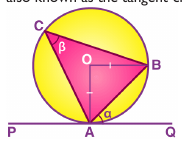
Let us assume that the tangent is drawn to the circle, such that the point of contact is A.
Through A, a chord AB is drawn that should be inclined to the tangent at an angle "α". Suppose that AB subtends an angle β at point C anywhere on the surface of the circle, as shown in the figure.
Assume that ∠ACB = ∠β is the alternate angle in the alternate segment for the angle between the tangent A and the chord AB.
Proof: Let A be the point on the circumference of the circle, and "O" be the centre of the circle. Assume that PQ is the tangent of the circle that passes through point A. The tangent makes an angle α with the chord AB. Now, consider that ∠ACB = ∠β in the alternate segment. Now, we have to prove that ∠α =∠β.
Thus, OA =OB (Both are the radii of the circle) Also, ∠OAB = ∠OBA (since the angles opposite to the equal sides are equal) Since, OAB is an isosceles triangle ∠AOB = 180° - ∠OAB - ∠OBA ∠AOB = 180° - 2∠OAB ...(1) Since the line segment, PQ is the tangent line, ∠OAQ = 90° Therefore, α= 90° - ∠OAB ...(2) From the equations (1) and (2), we can write ∠AOB = 2α
We know that the angle at the centre of the circle is twice the angle at the circumference of the circle. ∠AOB = 2∠ACB ∠ACB= (½)∠AOB Now, substitute ∠AOB = 2α in the above equation, we get ∠β= (½) 2α ∠β= ∠α Thus, the alternate segment theorem is proved.
Alternate Segment Theorem Quadrilateral

Considering the image given above, by using the alternate segment theorem, we can say that ∠p = ∠r Now, we need to prove that ∠s = ∠q As the tangent line, LM, is straight, we get ∠p + ∠s = 180° ...(3)
Since the angles ∠r and ∠q are the opposite angles in the cyclic quadrilateral, we can say that ∠q + ∠r = 180° ...(4)
Now equating equations (3) and (4), we get ∠p + ∠s = ∠q + ∠r Thus, ∠p = ∠r and ∠s = ∠q. Hence, proved.
Example: Find the unknown angles in the figure, given that the chord BC makes the angles 65° with the tangent line PQ.
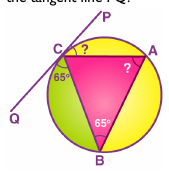
 Solution: Given that, ∠QCB = 65° By using the alternate segment theorem, we can say that ∠CAB = 65° Similarly, by using the angles in the alternate segment, ∠PCA = 65° Therefore, ∠CAB = 65° and ∠PCA = 65°.
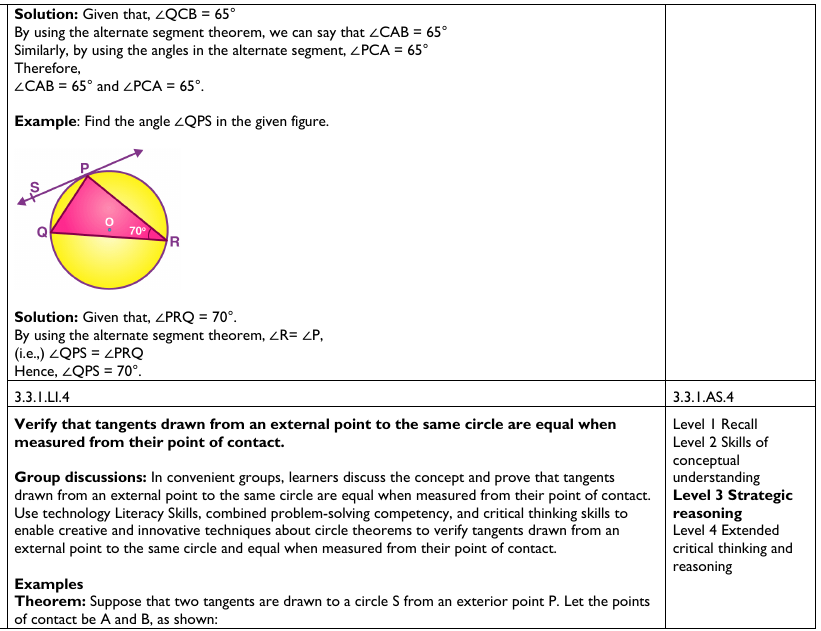
Example: Find the angle ∠QPS in the given figure.
Solution: Given that, ∠PRQ = 70°. By using the alternate segment theorem, ∠R= ∠P, (i.e.,) ∠QPS = ∠PRQ Hence, ∠QPS = 70°.
Teaching and Learning Resources:
- * Mathematical sets. Graph sheet. * Technology tools such as computers, mobile phones, etc. * Computer software applications like GeoGebra.
Assessment (3.3.1.AS.3). The document marks these depth-of-knowledge levels for this indicator: Level 1 Recall; Level 2 Skills of conceptual understanding; Level 3 Strategic reasoning.