SHS3 Mathematics · Semester 1, Week 17
Spatial Sense
Full lesson notes coming
Notes for this lesson are being prepared. The curriculum details below are complete and ready to use for your planning.
Curriculum details
- Strand
- Geometry Around Us (Strand 3)
- Sub-strand
- Spatial Sense (3.1)
- Content standard
- 3.3.1.CS.1 - Demonstrate a conceptual understanding of spatial sense with respect to circles and their theorems and apply its properties to solve everyday life problems. 3.3.1.LO.1 Draw circles for given radii and use the circle theorems; identify the tangent as perpendicular to the radius at the point of contact and verify that tangents drawn from an external point to the same circle are equal when measured from their point of contact.
- Indicator
- 3.3.1.LI.2 - Discuss the circle theorems by identifying the statements, proofs, examples and applications.
- Suggested placement
-
Semester 1, Week 17
(Week 17 of the year)
Our suggestion, laid out in curriculum order across three terms of twelve weeks. NaCCA does not fix the week, so follow your school's scheme of learning.
- Curriculum reference
- NaCCA curriculum document, p. 332
Exemplars (from the NaCCA curriculum)
Using think-pair-share activities, learners discuss the various circle theorem statements. Encourage students to have a decision-making role related to classroom activities and rules.
Example: Circle Theorems Statements
- The angle subtended by a chord at the centre is twice the angle subtended by it at the circumference.
- The angle subtended by the diameter at the circumference is a right angle.
- The angles subtended at the circumference by the same arc are equal.
- Two equal chords subtend equal angles at the centre of the circle.
- If the angles subtended by two chords at the centre are equal, then the two chords are equal.
- The opposite angles in a cyclic quadrilateral are supplementary.
- The angle between the radius and the tangent at the point of contact is 90 degrees.
Think-pair-share activities: In pairs, discuss the various circle theorem proofs.
Example: Circle Theorems Proofs
Theorem 1: The angle subtended by a chord at the centre is twice the angle subtended by it at the circumference.
Proof: Consider the following circle, in which an arc (or segment) AB subtends ∠AOB at the centre O and ∠ACB at a point C on the circumference. We have to prove that ∠AOB = 2 × ∠ACB. Draw a line segment through O and C, and let it intersect the circle again at point D, as shown.
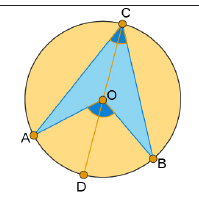
There are two triangles formed: ΔOAC and ΔOBC. So, we make the following observations. In ΔOAC, ∠OAC = ∠OCA because OA = OC (OA and OC being the radii. Angles opposite to equal sides are equal). In ΔOBC, ∠OBC = ∠OCB because OB = OC (OB and OC being the radii. Angles opposite to equal sides are equal). Hence, using the exterior angle theorem, we get, ∠AOD= 2×∠ACO ⋯ (1) ∠DOB= 2×∠OCB ⋯ (2) Add equations (1) and (2): ∠AOD+ ∠DOB= 2× (∠ACO+ ∠OCB) ⇒ ∠AOB= 2× ∠ACB
Theorem 2: The angle subtended by the diameter at the circumference is a right angle.
Proof: Consider the figure below, where AB is the diameter of the circle. We need to prove that ∠ACB= 90°
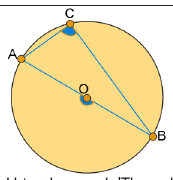
Using theorem 1, 'The angle subtended by a chord at the centre is twice the angle subtended by it at the circumference.' We have ∠AOB= 2× ∠ACB. Now, ∠AOB = 180° as AB is a straight line (diameter). So, 2 × ∠ACB = 180° which implies ∠ACB = 90°.
Theorem 3: The angles subtended at the circumference by the same arc are equal.
Proof: Consider the following figure, which shows an arc AB subtending angles ACB and ADB at two arbitrary points, C and D, on the circumference. O is the centre of the circle.
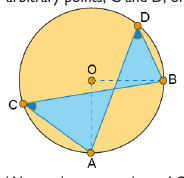
We need to prove that ∠ACB= ∠ADB.
Using the circle theorem, 'The angle subtended by a chord at the centre is twice the angle subtended by it at the circumference.' we have that ∠ACB= 1/2× ∠AOB ⋯ (1) ∠ADB= 1/2× ∠AOB ⋯ (2) From equations (1) and (2), we get ∠ACB= ∠ADB. Since angles ACB and ADB are arbitrary angles, therefore, the result is true for all angles subtended by the same arc.
Theorem 4: Two equal chords subtend equal angles at the centre of the circle.
Proof: Consider a circle given below with centre O and two chords AB and CD, such that AB = CD. Now, we need to prove ∠AOB = ∠COD.
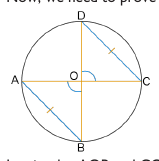
In triangles AOB and COD, we have OA = OC (Radii) OB = OD (Radii) AB = CD (Given)
So, triangles AOB and COD are congruent by SSS congruence rule. So, we have ∠AOB = ∠COD (Corresponding parts of congruent triangles).
Theorem 5: If the angles subtended by two chords at the centre are equal, then the two chords are equal.
Proof: Consider a circle given below with centre O and two chords, AB and CD, such that ∠AOB = ∠COD. Now, we need to prove AB = CD. In triangles AOB and COD, we have OA = OC (Radii) OB = OD (Radii) ∠AOB = ∠COD (Given) So, triangles AOB and COD are congruent by SAS congruence rule. So, we have AB = CD (Corresponding parts of congruent triangles).
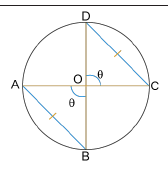
Group discussions: In groups, task learners to apply the various circle theorems to solve some examples. Encourage learners to show respect to individuals of different backgrounds in their groups as they solve real-life problems on circle theorems.
Example 1: Consider a circle with Centre O given below. Find the value of x using circle theorems.
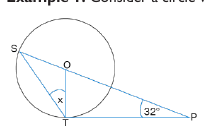
Solution: We are given a circle with a centre O. Sine OS, and OT are radii, OS = OT. Using the circle theorem 'The angle between the radius and the tangent at the point of contact is 90 degrees', we have ∠OTP = 90°. In triangle OTP, using the angle sum theorem, we have ∠TOP + ∠OTP + ∠OPT = 180° ⇒ ∠TOP + 90° + 32° = 180° ⇒ ∠TOP = 180° - (90° + 32°) = 58° Since OS = OT ⇒ ∠OSP = ∠OTP = x (because angles opposite to equal sides are equal). Using the exterior angle theorem, we have ∠OSP + ∠OTP = ∠TOP ⇒ x + x = 58° ⇒ 2x = 58° ⇒ x = 29°
Answer: x = 29°
Example 2: Consider the circle given below with centre O. Find the angle x using the circle theorems.
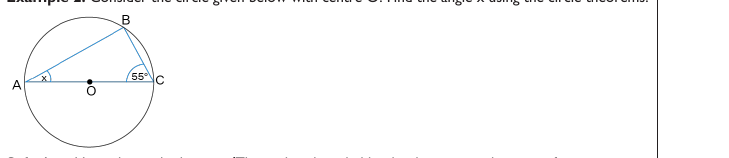
Solution: Using the circle theorem 'The angle subtended by the diameter at the circumference is a right angle', we have ∠ABC = 90°. So, using the triangle sum theorem, ∠BAC + ∠ACB + ∠ABC = 180° ⇒ x + 55° + 90° = 180° ⇒ x + 145° = 180° ⇒ x = 180° - 145° = 35° Answer: x = 35
Teaching and Learning Resources:
- * Mathematical sets. Graph sheet. * Technology tools such as computers, mobile phones, etc. * Computer software applications like GeoGebra.
Assessment (3.3.1.AS.2). The document marks these depth-of-knowledge levels for this indicator: Level 1 Recall; Level 2 Skills of conceptual understanding; Level 3 Strategic reasoning.