SHS3 Mathematics · Semester 2, Week 3
Spatial Sense
Full lesson notes coming
Notes for this lesson are being prepared. The curriculum details below are complete and ready to use for your planning.
Curriculum details
- Strand
- Geometry Around Us (Strand 3)
- Sub-strand
- Spatial Sense (3.1)
- Content standard
- 3.3.1.CS.2 - Demonstrate knowledge and understanding of geometrical construction, use the knowledge to construct plane shapes and apply these in the world around them. 3.3.1.LO.2 Perform geometric construction of quadrilaterals and given loci.
- Indicator
- 3.3.1.LI.2 - Construct a triangle or quadrilateral under given conditions.
- Suggested placement
-
Semester 2, Week 3
(Week 23 of the year)
Our suggestion, laid out in curriculum order across three terms of twelve weeks. NaCCA does not fix the week, so follow your school's scheme of learning.
- Curriculum reference
- NaCCA curriculum document, p. 346
Exemplars (from the NaCCA curriculum)
Group discussions: In small groups, learners draw various triangles and quadrilaterals using the appropriate technology tools to enable creative and innovative techniques to construct and verify a triangle or a quadrilateral under given conditions.
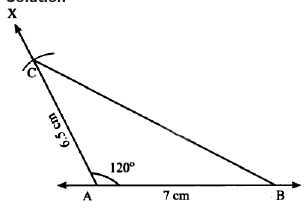
Example 1: Construct a triangle ABC with given conditions. (i) AB = 7 cm, AC = 6.5 cm and ∠A = 120°.
Solution
Example 2: Construct triangle PQR such that ∠P = 115°, ∠Q = 40° and PQ = 6
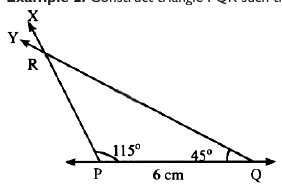
Construction steps:
- Step 1: Drawn a line. Marked P and Q on the line such that PQ = 6 cm.
- Step 2: At P, draw O ray PX, making an angle of 115° with PQ.
- Step 3: At Q, draw another ray QY, making an angle of 40° with PQ. Marked the point of intersection of the rays PX and Q Y as R. PQR is the required triangle.
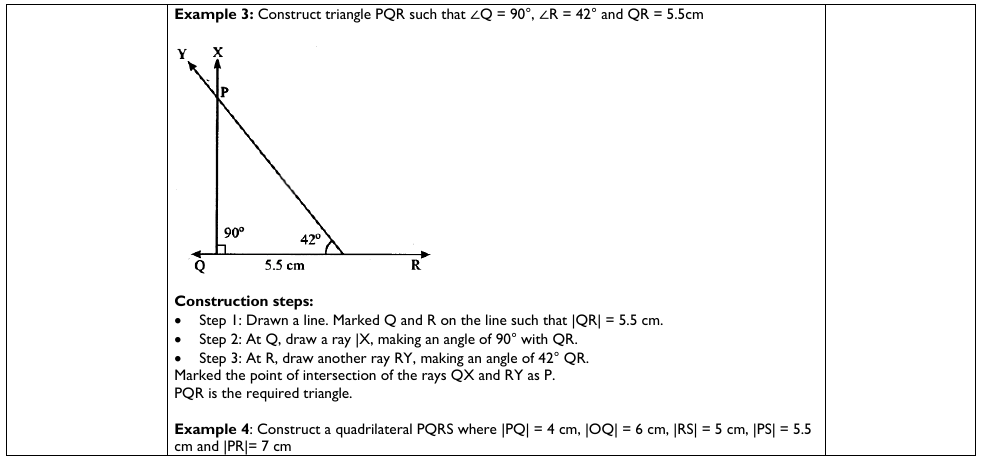
 Example 3: Construct triangle PQR such that ∠Q = 90°, ∠R = 42° and QR = 5.5cm
Construction steps:
- Step 1: Drawn a line. Marked Q and R on the line such that |QR| = 5.5 cm.
- Step 2: At Q, draw a ray |X, making an angle of 90° with QR.
- Step 3: At R, draw another ray RY, making an angle of 42° QR. Marked the point of intersection of the rays QX and RY as P. PQR is the required triangle.
Example 4: Construct a quadrilateral PQRS where |PQ| = 4 cm, |OQ| = 6 cm, |RS| = 5 cm, |PS| = 5.5 cm and |PR|= 7 cm
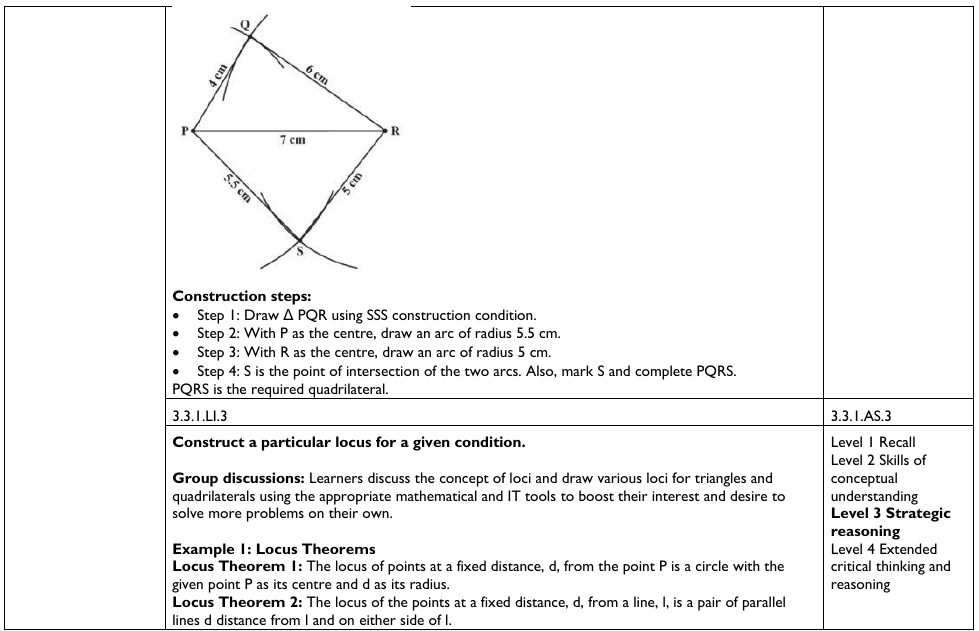
Construction steps:
- Step 1: Draw Δ PQR using SSS construction condition.
- Step 2: With P as the centre, draw an arc of radius 5.5 cm.
- Step 3: With R as the centre, draw an arc of radius 5 cm.
- Step 4: S is the point of intersection of the two arcs. Also, mark S and complete PQRS. PQRS is the required quadrilateral.
Teaching and Learning Resources:
- * Mathematical sets, Graph sheet. * Technology tools such as computers, mobile phones, etc. * Computer software applications like GeoGebra.
Assessment (3.3.1.AS.2). The document marks these depth-of-knowledge levels for this indicator: Level 2 Skills of conceptual understanding.