SHS2 Mathematics · Semester 2, Week 1
Spatial Sense
Lesson notes
Learning Objectives
Indicator: 2.3.1.LI.2 - Identify and explain the reflection of an object in a mirror line and describe the image points of shapes in a reflection.
By the end of the lesson, learners can:
- Define reflection as a transformation that flips a shape over a mirror line, keeping every point the same distance from the mirror line.
- Describe the image points of a shape after reflection over the x-axis, y-axis, and the line y = x using coordinate notation.
- Apply the reflection rules (over the x-axis, y-axis, and y = x) to determine the coordinates of image points and draw the reflected shape on a graph sheet.
- Locate the mirror line of a reflection by finding the midpoints between corresponding vertices of the original and reflected shapes.
- Explain how obeying mathematical reflection rules connects to the value of following rules and procedures in everyday life.
Sign in with your phone number to read the full note and download the GES plan - free.
Sign in with phone numberCurriculum details
- Strand
- Geometry Around Us (Strand 3)
- Sub-strand
- Spatial Sense (3.1)
- Content standard
- 2.3.1.CS.1 - Demonstrate a conceptual understanding of spatial sense regarding changes and invariance achieved by performing a combination of successive transformations (reflection, translation, rotation) in a 2D shape. 2.3.1.LO.1 Carry out a variety of transformations through translation, reflection, rotation and enlargement of plane shapes and identify scale drawing as an enlargement/reduction of a plane shape.
- Indicator
- 2.3.1.LI.2 - Identify and explain the reflection of an object in a mirror line and describe the image points of shapes in a reflection.
- Suggested placement
-
Semester 2, Week 1
(Week 21 of the year)
Our suggestion, laid out in curriculum order across three terms of twelve weeks. NaCCA does not fix the week, so follow your school's scheme of learning.
- Source document note
-
The official curriculum document has a fault in this entry, so the curriculum text above is transcribed exactly as printed:
- exemplars - p.219: this exemplar sets a two-dimensional construct - a stacked fraction, an index or a column vector - which the text layer flattens into separate lines, so the parts are present but their vertical arrangement is lost; read the page
- Curriculum reference
- NaCCA curriculum document, p. 216
Exemplars (from the NaCCA curriculum)
Think-pair share activities: Learners in pairs research and make presentations on the concept of reflection in Mathematics.
Example
- A reflection requires a mirror line.
- Reflection is a type of transformation that flips a shape in a mirror line (also called a line of reflection) so that each point is the same distance from the mirror line as its reflected point.
- A mirror line reflects the original image. All the vertices, or corners, of the shape, are always the same distance from the mirror line in the reflected image as they are in the original image.
- Reflections may be shown on a grid, and the mirror line is given as an equation.
- To find a mirror line, locate the mid-point between each set of vertices and draw the mirror line through these mid-points.
Think-pair share activities: Learners in pairs research and make presentations on the reflection rules. As learners talk about rules of reflection, encourage discussions on the need to obey rules and the consequences of doing otherwise in everyday life.
Example: Reflection Rules The reflection rules and reflection formulas are summarized in the table. Reflection Reflection In Words What it Rule looks like on the graph Over the x-axis (x,y)-->(x,-y) Negate the y Image is coordinates directly above or below the original Over the y-axis (x,y)-->(-x,y) Negate the x Image is left coordinates or right of the original Over y=x (x,y)-->(y,x) Swap the x and y=x passes y coordinates through the plane at a 45-degree angle. Image
is above or below this line from the original. Origin (x,y)-->(-x,-y) Negate both Image is the x and y rotated 180 coordinates degrees
Experiential Learning: In small groups, task learners to perform reflection on a plane. Encourage learners to appreciate the importance of dwelling on their strength to embark on a given task to its successful conclusion.
E.g.,1: Reflect the polygon in Figure 1 over the x-axis.
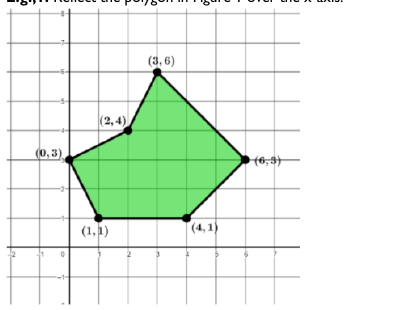
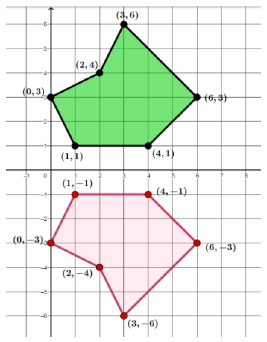
Solution: Only the y coordinates are affected since the reflection is over the x-axis, and this is a vertical reflection. Therefore, the y coordinates are affected. As a result, the sign on the y coordinate of each point is negated.
Before reflection After reflection x y y x 1 1 1 -1 0 3 0 -3 2 4 2 -4 3 6 3 -6 6 3 6 -3 4 1 4 -1
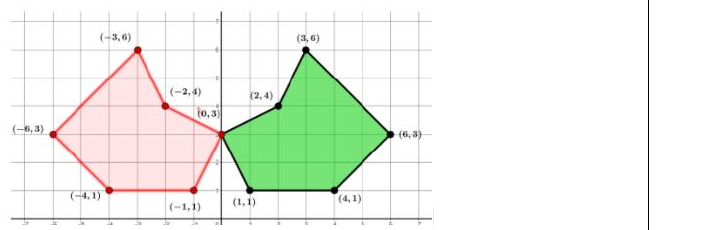
E.g.2: Let's reflect the polygon over the y-axis.
Solution: Only the x coordinates are affected since the reflection is over the y-axis, and this is a horizontal reflection. Therefore, the x coordinates are affected. As a result, the sign on the x coordinate of each point is negated.
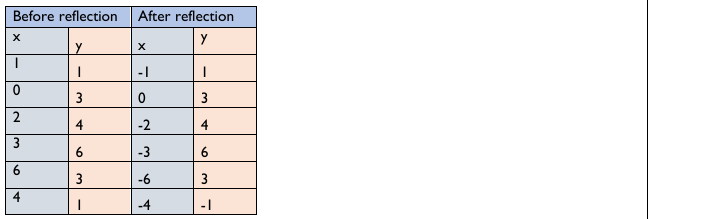
Before reflection After reflection x y y x 1 1 -1 1 0 3 0 3 2 4 -2 4 3 6 -3 6 6 3 -6 3 4 1 -4 -1
Teaching and Learning Resources:
- Mathematical sets. Graph sheet.
- Technology tools such as computers, mobile phones, etc.
- Computer software applications like
- GeoGebra.
- Compass
- clock face, etc.
Assessment (2.3.1.AS.2). The document marks these depth-of-knowledge levels for this indicator: Level 1 Recall; Level 2 Skills of conceptual understanding; Level 3 Strategic reasoning.