SHS2 Additional Mathematics · Semester 2, Week 1
Spatial Sense
Lesson notes
Learning Objectives
Indicator: 2.2.1.LI.1 - Apply the knowledge of operations of vectors to solve simple geometric problems, including the position vector of a point that divides a vector internally and externally in a given ratio.
By the end of the lesson, learners can:
- Add and subtract vectors given in component form and convert a vector to its unit vector form.
- State the formula for the position vector of a point that divides a line segment in the ratio m : n.
- Find the position vector of a point that divides a line segment internally in a given ratio.
- Find the position vector of a point that divides a line segment externally in a given ratio, using a negative ratio.
- Apply the position-vector formula to solve word problems involving division of line segments in geometric contexts.
Sign in with your phone number to read the full note and download the GES plan - free.
Sign in with phone numberCurriculum details
- Strand
- Geometric Reasoning and Measurement (Strand 2)
- Sub-strand
- Spatial Sense (2.1)
- Content standard
- 2.2.1.CS.2 - Demonstrate knowledge and understanding of spatial sense in relation to related problems. 2.2.1.LO.1 Deduce the equation of a circle and find its centre and radius. 2.2.1.LO.2 Determine the equation of a locus under a given condition.
- Indicator
- 2.2.1.LI.1 - Apply the knowledge of operations of vectors to solve simple geometric problems, including the position vector of a point that divides a vector internally and externally in a given ratio.
- Suggested placement
-
Semester 2, Week 1
(Week 21 of the year)
Our suggestion, laid out in curriculum order across three terms of twelve weeks. NaCCA does not fix the week, so follow your school's scheme of learning.
- Source document note
-
The official curriculum document has a fault in this entry, so the curriculum text above is transcribed exactly as printed:
- indicator text - p.348: the page prints this indicator 1.2.1.LI.1 and its assessment 1.2.1.AS.1 inside the Year 2 table, under the printed content standard 2.2.1.CS.2 and beside 2.2.1.LI.2 and 2.2.1.LI.3. Filed by the section as 2.2.1.LI.1, the free number its siblings leave, since a Year 1 code cannot validate in an SHS2 file
- Curriculum reference
- NaCCA curriculum document, p. 348
Exemplars (from the NaCCA curriculum)
Experiential Learning, Collaborative Learning, Talk for Learning and building on what others say
Learning Experience: Learners in collaborative groups apply knowledge of vectors to solve geometric problems, including deducing the position vector of a point that divides a vector internally and externally in a given ratio.
Activity 1: Learners brainstorm using examples to recollect the idea of transposition of vectors and unit vectors in the direction of vectors, e.g. as shown in Example 1.
Example 1: 𝐴 is a parallelogram such that «««««⃗ «««««⃗ = 5𝑖 − 3𝑗. Find: 𝐴 = 3𝑖 + 𝑗 and 𝐴 i) 𝐵 «««««⃗
ii) 𝐵 ««««««⃗ «««««⃗ iii) the unit vector in the direction of 𝐵
Solution
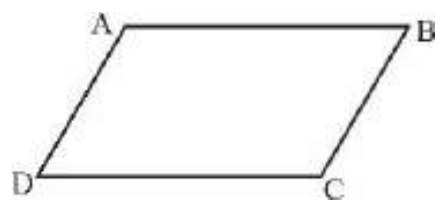
«««««⃗ + 𝐵 «««««⃗ = 𝐴 «««««⃗ i. 𝐴 «««««⃗ 𝐵 = «««««⃗ 𝐴 − «««««⃗ 𝐴 (5𝑖 − 3𝑗) − (−3𝑖 − 𝑗) 𝐵 «««««⃗ = 2𝑖 − 4𝑗
««««««⃗ = 𝐵 «««««⃗ + 𝐶 «««««⃗ ii. 𝐵 = 𝐵 «««««⃗ − 𝐴 «««««⃗ = (2𝑖 − 4𝑗) − (3𝑖 + 𝑗) = −𝑖 − 5𝑗 «««««⃗ ® = w2 ) + (−4) ) iii. ®𝐵
= 2√5 1 «««««⃗ 𝐵 = (2𝑖 − 4𝑗) 2√5 √5 = (𝑖 − 2𝑗) 5
Activity 2: Find the position vector 𝑂 ««««««⃗ that divides a given vector (or line) in a given ratio.
- Learners to study the diagram below carefully and use it to arrive at a solution when line AB is divided in the ratio 𝑚: 𝑛.
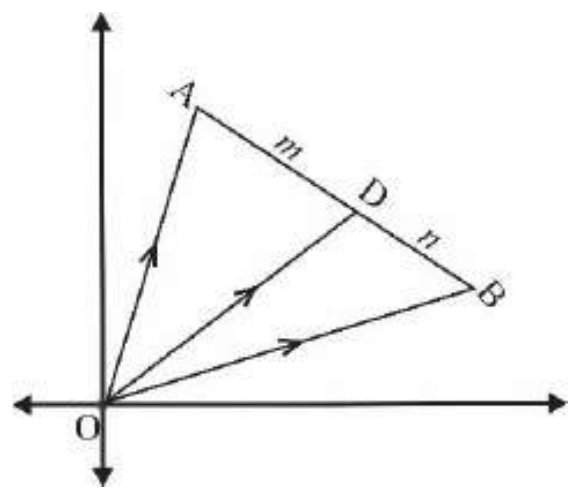
«««««⃗ such that 𝐴 «««««⃗ ∶ ««««««⃗ D is a point on 𝐴 𝐷 = 𝑚: 𝑛 ««««««⃗ = 𝑂 𝑂 «««««⃗ + 𝐴 «««««⃗ «««««⃗ 𝐴 = «««««⃗ 𝑂 + ®𝐴 «««««⃗® ®𝐴 «««««⃗®
«««««⃗ + ∙ 𝐴 RK «««««⃗ ... ... . 𝑒quation (1) = 𝑂 RT But 𝐴 «««««⃗: 𝐷 ««««««⃗ = 𝑚: 𝑛, i.e 𝐴 = 𝑚 + 𝑛 # So 𝑑 = 𝑎 + (𝑏 − 𝑎) #$% %&$#' 𝑑 = ... .... equation (2) #$%
Note: The vector 𝐴 «««««⃗ is equal to the product of its magnitude and the unit vector in the same
direction as 𝐴 «««««⃗ i.e «««««⃗ 𝐴 𝐴 ∙ ®𝐴 «««««⃗ ®
Equation (2) gives the required position vector whether the line or vector is divided internally or externally. In the internal case, both 𝑚 and 𝑛 are positive. However, in the external case, any one of the ratios is taken as negative.
Example: 𝑃 and 𝑄 are points on the position vectors 2𝑖 − 3𝑗 and 2𝑗 − 𝑖, respectively, on a vector «««««⃗ «««««⃗ such that 𝑃: 𝑇 = 2: 3. Find the position vector of the point 𝑇. 𝑃 . 𝑇 is a point on 𝑃
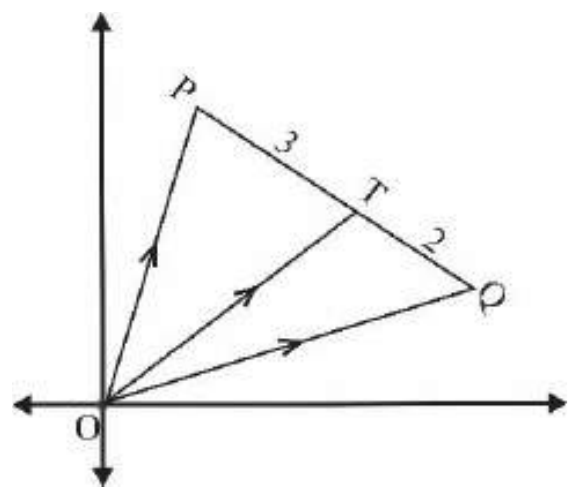
«««««««⃗: Solution: Finding position vector 𝑂: 2𝑂 ««««««⃗ + 3𝑂 «««««⃗ «««««⃗ 𝑂 = 2+3 2(−𝑖 + 2𝑗) + 3(2𝑖 − 3𝑗) = 5 4𝑖 − 5𝑗 = 5 1 = (4𝑖 − 5𝑗) 5
Teaching and Learning Resources:
- SHS curriculum, Mathematical set, ICT apps
Assessment (2.2.1.AS.1). The document marks these depth-of-knowledge levels for this indicator: Level 4 Extended critical thinking and reasoning.