SHS2 Mathematics · Semester 2, Week 3
Spatial Sense
Lesson notes
Learning Objectives
Indicator: 2.3.1.LI.4 - Carry out an enlargement of a plane shape given a scale factor.
By the end of the lesson, learners can:
- Define enlargement and reduction in their own words, distinguishing between the two based on the scale factor.
- State the properties of enlargement, including the relationship between the object and image (similarity) and the meaning of scale factor k for k > 1, 0 < k < 1, k = 1, and k < 0.
- Construct the image of a given plane shape (triangle or quadrilateral) under an enlargement, given a centre of enlargement and a positive scale factor, using a ruler and a pair of compasses.
- Determine the coordinates of the image of a shape on a Cartesian plane when the centre of enlargement is the origin (0, 0) and the scale factor is a positive integer.
- Draw both the object and its image on a graph sheet, verifying that corresponding sides are in the ratio of the scale factor.
Sign in with your phone number to read the full note and download the GES plan - free.
Sign in with phone numberCurriculum details
- Strand
- Geometry Around Us (Strand 3)
- Sub-strand
- Spatial Sense (3.1)
- Content standard
- 2.3.1.CS.1 - Demonstrate a conceptual understanding of spatial sense regarding changes and invariance achieved by performing a combination of successive transformations (reflection, translation, rotation) in a 2D shape. 2.3.1.LO.1 Carry out a variety of transformations through translation, reflection, rotation and enlargement of plane shapes and identify scale drawing as an enlargement/reduction of a plane shape.
- Indicator
- 2.3.1.LI.4 - Carry out an enlargement of a plane shape given a scale factor.
- Suggested placement
-
Semester 2, Week 3
(Week 23 of the year)
Our suggestion, laid out in curriculum order across three terms of twelve weeks. NaCCA does not fix the week, so follow your school's scheme of learning.
- Curriculum reference
- NaCCA curriculum document, p. 225
Exemplars (from the NaCCA curriculum)
Think-pair share activities: Learners in pairs research and make presentations on the concept of enlargement/reduction in transformations.
Example: In transformation, enlargement/reduction is when the size of an object is changed without changing its original shape. When the size of the object is increased, it is called an enlargement, and when the size of an object is decreased, it is called a reduction. Look at the images here.
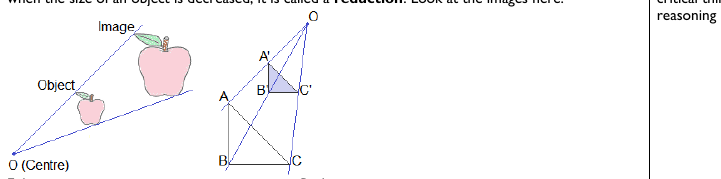
Enlargement Reduction
The enlargement is made with the help of a fixed point called the centre of enlargement and by the fixed ratio called scale factor, i.e., the ratio of the corresponding sides of the image and object.
Think-pair-share activities: Learners in pairs discuss the properties of enlargement/reduction. And, as learners talk about properties and rules of enlargement/reduction, encourage discussions on the need to obey rules and the consequences of doing otherwise in everyday life.
Example 1: Properties of enlargement/reduction 1. The object and the image under the enlargement are similar. 2. Scale factor (k) =
𝑙𝑒𝑛𝑔𝑡ℎ 𝑜𝑓 𝑡ℎ𝑒 𝑠𝑖𝑑𝑒 𝑜𝑓 𝑡ℎ𝑒 𝑖𝑚𝑎𝑔𝑒 𝑓𝑖𝑔𝑢𝑟𝑒 𝑙𝑒𝑛𝑔ℎ𝑡 𝑜𝑓 𝑡ℎ𝑒 𝑐𝑜𝑟𝑟𝑒𝑠𝑝𝑜𝑛𝑑𝑖𝑛𝑔 𝑠𝑖𝑑𝑒 𝑜𝑓 𝑡ℎ𝑒 𝑜𝑏𝑗𝑒𝑐𝑡 𝑓𝑖𝑔𝑢𝑟𝑒
3. If the scale factor k>1, then the transformation is called enlargement. 4. If the scale factor 0<k<1, then the transformation is called reduction. 5. If the scale factor k=1, then the transformation is identity. 6. If the scale factor k<0, then the image will be on the opposite side of the object from the centre of enlargement.
Example 2: Find the image of ΔABC under the enlargement with the centre of enlargement O and scale factor 2. [It is denoted by E(O, 2)]
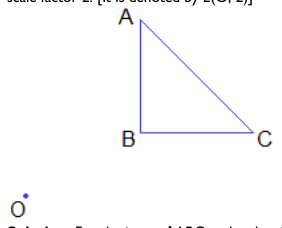
Solution: For the image ΔABC under the given enlargement, perform the following steps: Step 1: Join OA, OB and OC. Step 2: Produce OA up to A' such that OA' = 2OA. Step 3: Produce OB up to B' such that OB' = 2OB. Step 4: Produce OC up to C' such that OC' = 2OC. Step 5: Join A'B', B'C' and C'A'.
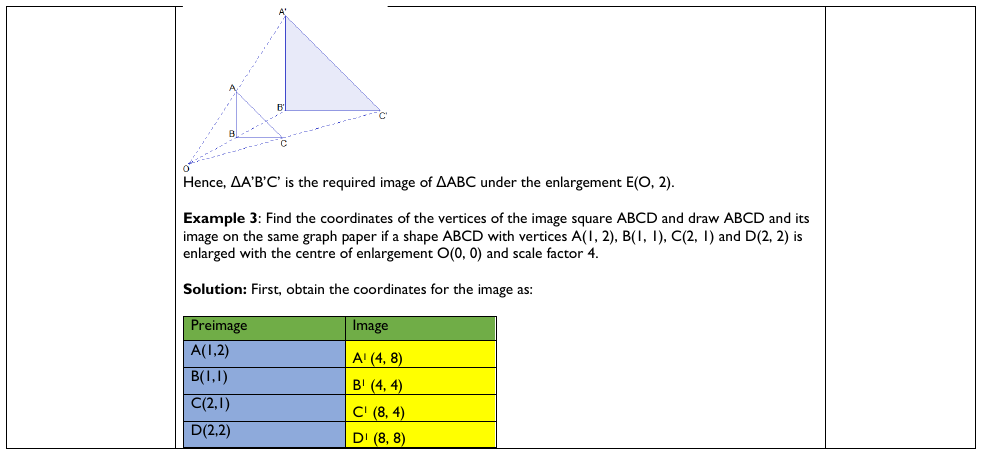
Hence, ΔA'B'C' is the required image of ΔABC under the enlargement E(O, 2).
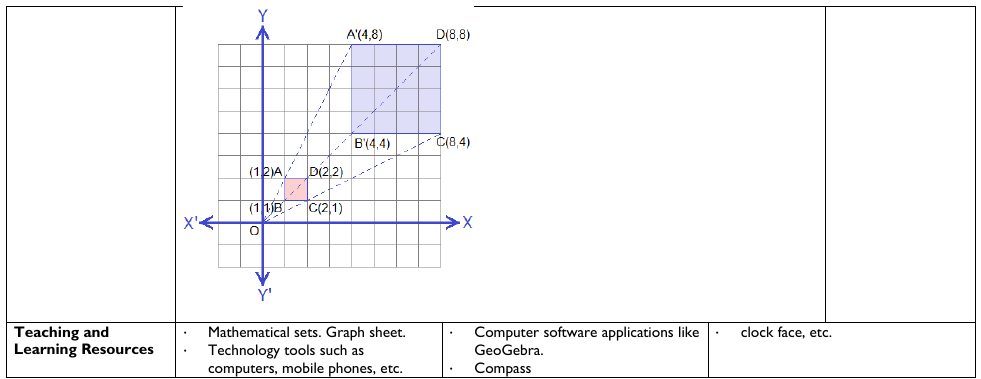
Example 3: Find the coordinates of the vertices of the image square ABCD and draw ABCD and its image on the same graph paper if a shape ABCD with vertices A(1, 2), B(1, 1), C(2, 1) and D(2, 2) is enlarged with the centre of enlargement O(0, 0) and scale factor 4.
Solution: First, obtain the coordinates for the image as:
Preimage Image
A(1,2) A 1 (4, 8) B(1,1) B 1 (4, 4) C(2,1) C 1 (8, 4) D(2,2) D 1 (8, 8)
Teaching and Learning Resources:
- Mathematical sets. Graph sheet.
- Technology tools such as computers, mobile phones, etc.
- Computer software applications like
- GeoGebra.
- Compass
- clock face, etc.
Assessment (2.3.1.AS.4). The document marks these depth-of-knowledge levels for this indicator: Level 1 Recall; Level 2 Skills of conceptual understanding; Level 3 Strategic reasoning.