SHS2 Additional Mathematics · Semester 2, Week 3
Spatial Sense
Lesson notes
Learning Objectives
Indicator: 2.2.1.LI.3 - Use vectors to establish the sine and cosine rules and solve problems involving areas of polygons.
By the end of the lesson, learners can:
- Use the scalar (dot) product of vectors to establish the cosine rule for any triangle.
- Use the magnitude of vectors and the sine of an included angle to derive the area formula for a triangle.
- Apply the sine and cosine rules to calculate unknown sides and angles in triangles.
- Solve problems involving the areas of polygons by decomposing them into triangles and using vector methods.
- Use column vectors to find angles and areas in coordinate geometry problems, presenting answers to an appropriate degree of accuracy.
Sign in with your phone number to read the full note and download the GES plan - free.
Sign in with phone numberCurriculum details
- Strand
- Geometric Reasoning and Measurement (Strand 2)
- Sub-strand
- Spatial Sense (2.1)
- Content standard
- 2.2.1.CS.2 - Demonstrate knowledge and understanding of spatial sense in relation to related problems. 2.2.1.LO.1 Deduce the equation of a circle and find its centre and radius. 2.2.1.LO.2 Determine the equation of a locus under a given condition.
- Indicator
- 2.2.1.LI.3 - Use vectors to establish the sine and cosine rules and solve problems involving areas of polygons.
- Suggested placement
-
Semester 2, Week 3
(Week 23 of the year)
Our suggestion, laid out in curriculum order across three terms of twelve weeks. NaCCA does not fix the week, so follow your school's scheme of learning.
- Source document note
-
The official curriculum document has a fault in this entry, so the curriculum text above is transcribed exactly as printed:
- exemplars - p.354: adjacent duplicated CambriaMath characters were collapsed, but this PDF also maps some equation glyphs to the wrong letter or operator; verify every mathematical expression in this row against the rendered page
- exemplars - p.356: a stacked fraction, matrix, vector or other two-dimensional construct is flattened by the text layer; all visible parts require comparison with the rendered page
- Curriculum reference
- NaCCA curriculum document, p. 354
Exemplars (from the NaCCA curriculum)
Collaborative learning, Talk for Learning and building on what others say
Learning Experience: Learners in their groups discuss their understanding of vectors and use the idea to establish the cosine and sine rules.
Exemplars Activity 1: The Cosine rule: Learners in groups refer to triangle 𝑃 with the sides 𝑝, 𝑞 and 𝑟, respectively and use the diagram to establish the cosine rule given as 𝑝 ) = 𝑞 ) + 𝑟 ) − 2𝑞, where 𝜃 ≤ 𝑃
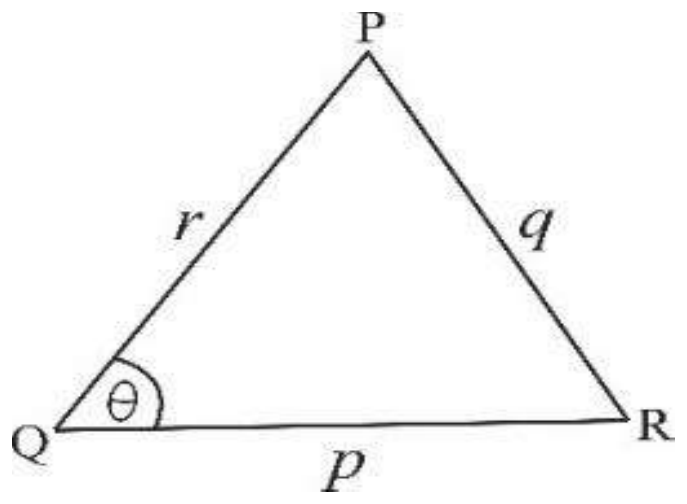
From the diagram «««««⃗ 𝑄 = 𝑞 − 𝑟 𝑄 ∙ 𝑄 = (𝑞 − 𝑟) ∙ (𝑞 − 𝑟) «««««⃗ «««««⃗ = 𝑞 ) + 𝑟 ) − 2𝑞 = |𝑞 | + |𝑟 ) | − 2|𝑞||𝑟|𝑐𝑃° ) Thus |𝑝| ) = |𝑞| ) |𝑟| ) − 2|𝑞||𝑟|𝑐𝑃° ∴ 𝑝 ) = 𝑞 ) + 𝑟 ) − 2𝑞𝑃° Also 𝑞 = 𝑝 + 𝑟 − 2𝑝𝑄° ) ) ) And 𝑟 ) = 𝑝 ) + 𝑞 ) − 2𝑝𝑅° Where 𝑃° , 𝑄° and 𝑅° are angles at points P, Q and R.
Activity 2: Area of a triangle using the Sine rule Learners refer to, draw or construct triangle 𝑃 as shown below. In mixed-ability groups, learners discuss how to determine the area of a triangle.
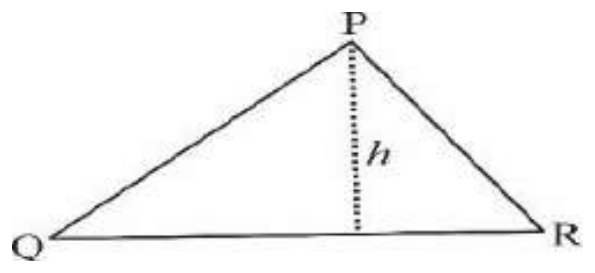
Area of triangle 𝑃 is given by ! Area= ) × |𝑃| × ℎ
1 = 𝑟 × ℎ 2 But ℎ = |𝑃|𝑠 = |𝑞|𝑠 So ! Area = ) |𝑞||𝑟|𝑠
Example 1: 𝐴(1, −2), 𝐵(3,0) and 𝐶(1,2) are vertices of triangle 𝐴
- «««««⃗, «««««⃗ 𝐵 and «««««⃗ Express 𝐴 𝐶 as column vectors
- Use scalar dot product to calculate angle 𝐴
- Find the area of triangle 𝐴
Solution i. 𝐴 «««««⃗ = (3 0 ) − (1 − 2 ) = (2 2 ) «««««⃗ 𝐵 = (1 2 ) − (3 0 ) = (−2 2 ) «««««⃗ 𝐶 = (1 − 2 ) − (1 2 ) = (0 − 4 )
qqqqq⃗ qqqqq⃗ TS ∙TR , «««««⃗ «««««⃗ ii. Finding angle 𝐴 = tTS 𝐵 = −𝐴 qqqqq⃗ ttTR qqqqq⃗t «««««⃗® = w(−2) ) + (−2) ) = 2√2 ®𝐵 «««««⃗® = 2√2 ®𝐵 (−2 2 ) ∙ (−2 − 2 ) 𝑐 < 𝐴 = 2√2 × 2√2 𝑐 < 𝐴 = 0 < 𝐴 = 𝑐 *! 0 ∴< 𝐴 = 90° iii. Area of Triangle ! 𝐴 = ) |𝐴|𝐴45°
But |𝐴| = √8 ) + 8 )
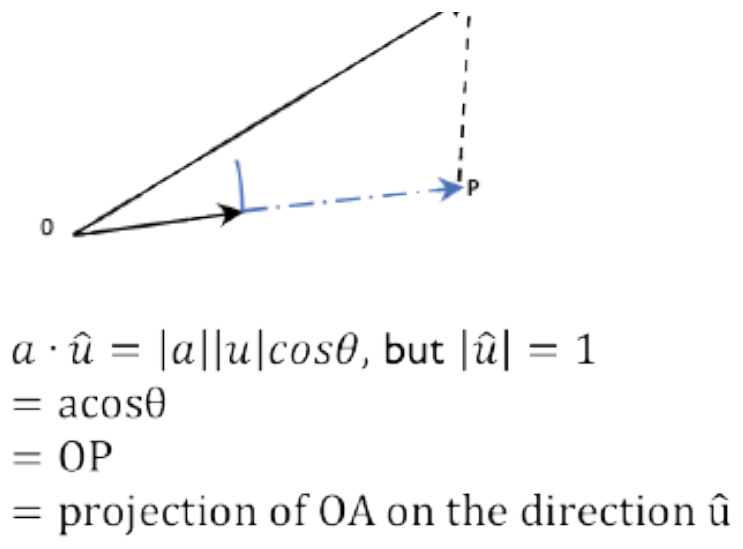
Example 1: Find the projection of a vector 𝑎 = 2𝑖 + 3𝑗 in the direction of vector 𝑏 = 𝑖 + 2𝑗.
Solution: Find |𝑏| = √1 ) + 2 ) = √5 𝑏 = |𝑏|𝑏° = √5𝑏° Now, the projection of 𝑎 in the direction of 𝑏° is given by 𝑎 ∙ 𝑏° ! 𝑎 ∙ 𝑏° = (2𝑖 + 3𝑗) ∙ (𝑖 + 2𝑗) √. 2+6 √5 = =8 √5 5 √. So the projection of 𝑎 in the direction of 𝑏 is 8 units long. .
Teaching and Learning Resources:
- SHS curriculum, Mathematical set, ICT apps
Assessment (2.2.1.AS.3). The document marks these depth-of-knowledge levels for this indicator: Level 2 Skills of conceptual understanding.