SHS1 Additional Mathematics · Semester 2, Week 1
Spatial Sense
Lesson notes
Learning Objectives
Indicator: 1.2.1.LI.4 - Recall the formula for finding the gradient of a line and apply it to find the equation of a straight line in various forms.
By the end of the lesson, learners can:
- Recall and state the gradient formula m = (y₂ − y₁)/(x₂ − x₁) and use it to find the gradient of a line passing through two given points.
- Derive the equation of a straight line passing through two points using the point-slope form y − y₁ = m(x − x₁).
- Find the equation of a line given its gradient and one point on the line, expressing the answer in the form y = mx + c or ax + by + c = 0.
- Determine the x-intercept and y-intercept of a line and use intercepts to write the equation of a line in general form ax + by + c = 0.
- Identify when the general form ax + by + c = 0 is necessary, including cases where the line is vertical or horizontal.
Sign in with your phone number to read the full note and download the GES plan - free.
Sign in with phone numberCurriculum details
- Strand
- Geometric Reasoning and Measurement (Strand 2)
- Sub-strand
- Spatial Sense (2.1)
- Content standard
- 1.2.1.CS.1 - Demonstrate knowledge and understanding of spatial sense in relation to lines and angles between intersecting lines. 1.2.1.LO.1 Describe the properties of lines, including parallel, perpendicular and midpoints. 1.2.1.LO.2 Derive the equation of a line in various forms, find the shortest distance between a point and a line and the perpendicular distance from an external point to a line. 1.2.1.LO.3 Solve problems on acute angles between two intersecting lines. 1.2.1.LO.4 Perform algebraic manipulations of Vectors and resolve vectors using the triangle, parallelogram and polygon laws of addition.
- Indicator
- 1.2.1.LI.4 - Recall the formula for finding the gradient of a line and apply it to find the equation of a straight line in various forms.
- Suggested placement
-
Semester 2, Week 1
(Week 21 of the year)
Our suggestion, laid out in curriculum order across three terms of twelve weeks. NaCCA does not fix the week, so follow your school's scheme of learning.
- Source document note
-
The official curriculum document has a fault in this entry, so the curriculum text above is transcribed exactly as printed:
- exemplars - p.144: adjacent duplicated CambriaMath characters were collapsed, but this PDF also maps some equation glyphs to the wrong letter or operator; verify every mathematical expression in this row against the rendered page
- exemplars - p.146: a stacked fraction, matrix, vector or other two-dimensional construct is flattened by the text layer; all visible parts require comparison with the rendered page
- Curriculum reference
- NaCCA curriculum document, p. 144
Exemplars (from the NaCCA curriculum)
Learning Experience: Learners in group members recollect how to find the gradient of a line and apply it to find the equation of a line in various forms.
Activity 1: Think, pair and share the concept of the gradient of a line.
Learners work in pairs to recollect and state the formula for finding the gradient of a line. A *A A *A The formula is 𝑚 = ! $ 𝑜 $ ! . 0 ! *0 $ 0 $ *0 !
Learners in pairs solve examples of direct and indirect questions about the gradient of a line and share their solutions with the whole class.
Example 1: Find the gradient of the line passing through the points 𝐴(6, −4) and 𝐵(4,2).
Activity 2: Use collaborative groups to find the Equation of a line passing through two points.
Learners in mixed-ability recollect the equation of a line as 𝑦 = 𝑚 + 𝑐.
Learners in mixed-ability groups, manipulate the formula for finding a gradient to deduce the equation of a line given two points, say 𝐴 and 𝐵.
Learners discover that:
- If 𝐴(𝑥 ! , 𝑦 ! ) and 𝐵(𝑥 ) , 𝑦 ) ), choose any arbitrary point within the line, say 𝑃(𝑥, 𝑦).
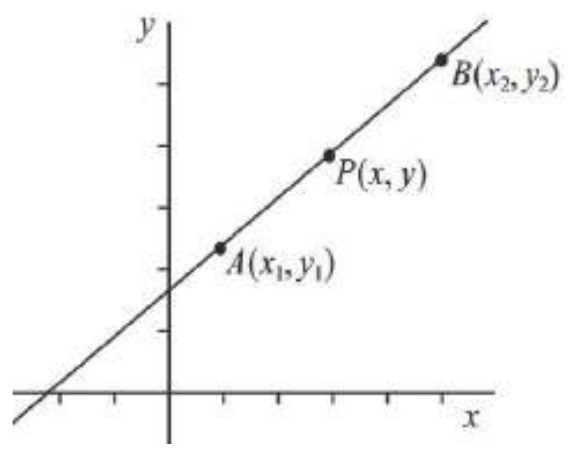
- If 𝑃 lies on the same line, then the gradient of the line 𝐴 is equal to the gradient of the line 𝐴, that is 𝑀 RT = 𝑀 RU . A *A A*A $
- If the relationship is expressed algebraically, we will have ! $ = . 0 ! *0 $ 0*0 $
- If 𝑦 − 𝑦 ! is made the subject, the formula becomes A *A 𝑦 − 𝑦 ! = (𝑥 − 𝑥 ! ) ∙ ! $ 0 ! *0 $
- This can be rewritten as 𝑦 − 𝑦 ! = 𝑚(𝑥 − 𝑥 ! )
Example 1: Find the equation of the line that passes through the points (−2,4) and (4,8).
Steps:
- In mixed-ability groups, learners use the formula A *A A *A 1*, ) 𝑚 = ! $ 𝑜 $ ! to find the gradient of the line as 𝑚 = = " . 0 ! *0 $ 0 $ *0 ! ,*(*))
- Group leaders in the various groups lead their members to substitute 𝑚 and either (𝑥 ! , 𝑦 ! ) of (𝑥 ) , 𝑦 ) ) into the formula 𝑦 − 𝑦 ! = 𝑚(𝑥 − 𝑥 ! ) or 𝑦 − 𝑦 ) = 𝑚(𝑥 − 𝑥 ) ). Choosing (−2,4), The substitution results to 2 𝑦 − 4 = (𝑥 + 2) 3
- Use the correct algebraic manipulation and make 𝑦 the subject. 2 16 𝑦 = 𝑥 + 3 3
Activity 3: Use collaborative learning to find the Equation of a line given a gradient and one point.
Learners in mixed-ability group use their previous knowledge of finding the equation of a line to find the equation of a line given a gradient and one point.
Learners in groups deduce that when given a gradient and one point, 𝑚 and (𝑥 ! , 𝑦 ! ) will be substituted in the formula 𝑦 − 𝑦 ! = 𝑚(𝑥 − 𝑥 ! ) or 𝑦 − 𝑦 ) = 𝑚(𝑥 − 𝑥 ) )
𝑦 is made the subject of the equation or equate the expression to 0.
- ! Example 1: Find the equation of a line passing through the point (6, −2) and has a gradient , .
Solution: 𝑦 − 𝑦 ! = 𝑚(𝑥 − 𝑥 ! ) −1 𝑦 + 2 = (𝑥 − 6) 4 4𝑦 + 𝑥 + 2 = 0 or 𝑦 = , − ,
- 0 !
Activity 4: In mixed-ability groups learners discuss equation of a line (Intercept Form).
Learners in the mixed-ability group recollect how to find 𝑥 and 𝑦 intercepts.
Example 1: Find the 𝑥 and 𝑦 intercepts of the equation 4𝑦 + 𝑥 + 2 = 0
Solution: The 𝑦-intercept is found by substituting 𝑥 = 0 −1 ∴ 𝑦 = 2 𝑥-intercept is found by substituting 𝑦 = 0 ∴ 𝑥 = −2
Learners in their groups apply the knowledge of intercepts and the equation of a line, that is 𝑦 = 𝑚 + 𝑐, to deduce the equation of a given gradient and an intercept.
Learners in groups investigate the conditions that make it impossible to use the intercept form to find the equation of a line. Learners discover that the conditions are:
- If the line is parallel to an axis.
- If the line passes through the origin.
Activity 4: General Equation of a line (Standard Form)
Learners in mixed-ability equate various examples of equations of a line to 0 and establish that the general equation of a line is given by 𝑎 + 𝑏 + 𝑐 = 0.
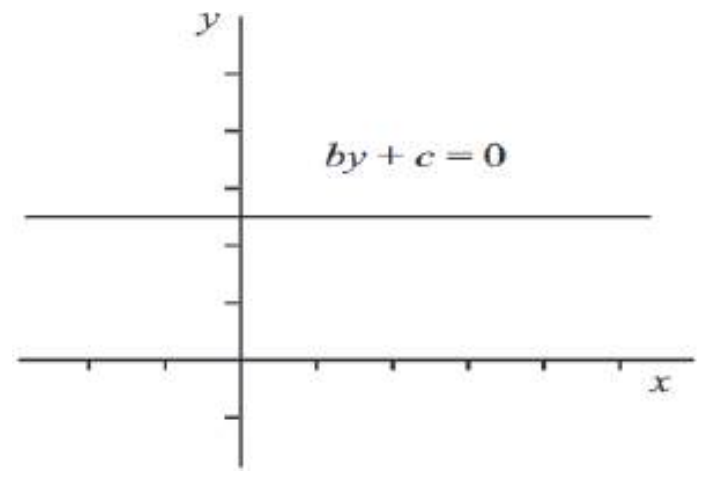
Learners in groups investigate what happens to the general equation of a line when 𝑎 or 𝑏 is zero. Learners discover that:
-
- ; When 𝑎 = 0, 𝑏 + 𝑐 = 0 ∴ 𝑦 = ' , these lines are horizontal and parallel to the 𝑥 − 𝑎
- ;
- When 𝑏 = 0, 𝑎 + 𝑐 = 0 ∴ 𝑥 = & , these lines are vertical and parallel to the 𝑦 − 𝑎
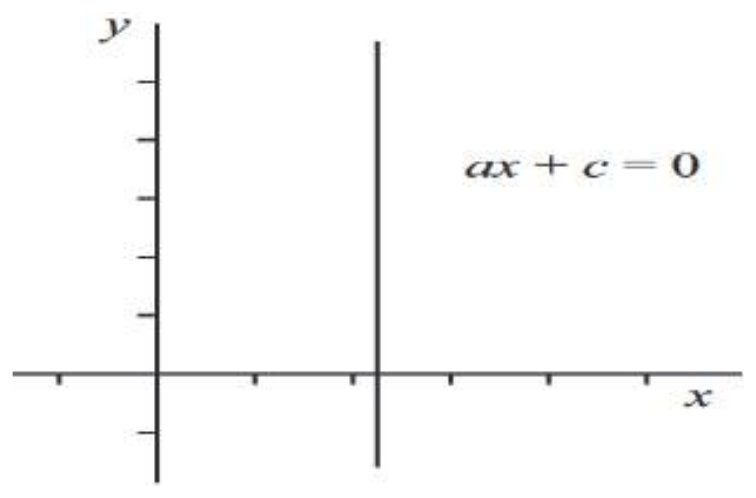
Learners in groups confirm that the equation of a vertical line cannot be written in the form 𝑦 = 𝑚 + 𝑐. The equation 𝑎 + 𝑏 + 𝑐 = 0 is the most general equation for a straight line and can be used where other forms of equation are not suitable.
Teaching and Learning Resources:
- SHS Curriculum
- Mathematical set calculators.
Assessment (1.2.1.AS.4). The document marks these depth-of-knowledge levels for this indicator: Level 3 Strategic reasoning.
Extended Critical thinking and reasoning