SHS1 Additional Mathematics · Semester 1, Week 19
Spatial Sense
Lesson notes
Learning Objectives
Indicator: 1.2.1.LI.1 - Describe the properties of lines, including parallel, perpendicular and midpoints.
By the end of the lesson, learners can:
- Define a straight line and list its key properties, including that it is one-dimensional, has no width, and extends forever in both directions.
- Identify and classify straight lines as horizontal, vertical, slanted, parallel, or perpendicular using diagrams and real-world examples.
- State the defining property of parallel lines (equidistant, never intersecting) and of perpendicular lines (intersecting at 90 degrees).
- Calculate the distance between two points when the segment joining them is horizontal or vertical, using the difference of the appropriate coordinates.
- Apply the Pythagorean theorem to find the distance between two points when the segment joining them is neither horizontal nor vertical.
Sign in with your phone number to read the full note and download the GES plan - free.
Sign in with phone numberCurriculum details
- Strand
- Geometric Reasoning and Measurement (Strand 2)
- Sub-strand
- Spatial Sense (2.1)
- Content standard
- 1.2.1.CS.1 - Demonstrate knowledge and understanding of spatial sense in relation to lines and angles between intersecting lines. 1.2.1.LO.1 Describe the properties of lines, including parallel, perpendicular and midpoints. 1.2.1.LO.2 Derive the equation of a line in various forms, find the shortest distance between a point and a line and the perpendicular distance from an external point to a line. 1.2.1.LO.3 Solve problems on acute angles between two intersecting lines. 1.2.1.LO.4 Perform algebraic manipulations of Vectors and resolve vectors using the triangle, parallelogram and polygon laws of addition.
- Indicator
- 1.2.1.LI.1 - Describe the properties of lines, including parallel, perpendicular and midpoints.
- Suggested placement
-
Semester 1, Week 19
(Week 19 of the year)
Our suggestion, laid out in curriculum order across three terms of twelve weeks. NaCCA does not fix the week, so follow your school's scheme of learning.
- Source document note
-
The official curriculum document has a fault in this entry, so the curriculum text above is transcribed exactly as printed:
- exemplars - p.139: adjacent duplicated CambriaMath characters were collapsed, but this PDF also maps some equation glyphs to the wrong letter or operator; verify every mathematical expression in this row against the rendered page
- Curriculum reference
- NaCCA curriculum document, p. 139
Exemplars (from the NaCCA curriculum)
Learning Experience: History of and its significance in real life and for further studies and discussion on parallel and perpendicular lines in pairs and present answers
Activity 1: Initiate Talk for Learning to discuss the history of geometry and its significance. Initiate Talk for Learning on how geometry came into being, its significance and application in real life, as well as further studies.
Activity 2: Use Think-pair-share approaches to discuss straight lines, their types and characteristics. Learners brainstorm and find out that:
- A straight line is formed when two points are joined with the shortest distance, and it can be extended forever in both directions.
- A straight line has no curves within.
- A straight line is one-dimensional and has no width.
- Types of straight lines are horizontal lines, vertical lines, slanted lines, parallel lines and perpendicular lines.
Activity 3: Use Think-pair-share to discuss parallel and perpendicular lines, their characteristics, and examples in real life. Learners brainstorm and find out that:
- Parallel lines are two straight lines that are always the same distance (equidistant) apart. They never intersect. Examples are Railway tracks, edges of a ruler, and zebra crossing (parallel white lines).
- Perpendicular lines are two lines that intersect, but all the angles at that intersection are the same, that is, 90°. For example, "T" junctions on roads, corners of a football pitch, etc.
Activity 4: Use collaborative learning to find the distance between two points and share. Learners to work in groups to discover that:
- Distances are always positive.
- Distances can only be zero if the points coincide.
- The distance from 𝑃 to 𝑄 is the same as the distance from 𝑄 to 𝑃
- The distance between vertical lines is the distance between their 𝑥 coordinates.
Example 1: Find the distance between the line with coordinates 𝐴(2,4) and 𝐵(6,4)
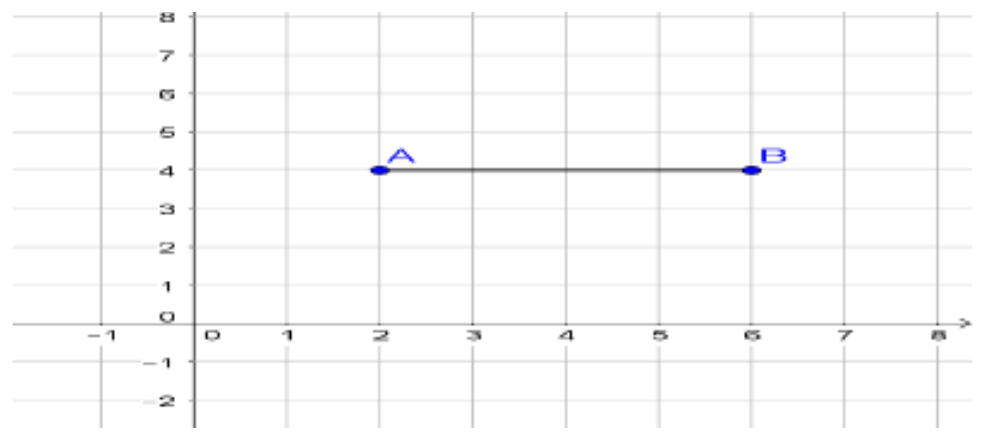
Solution: The distance between 𝐴 and 𝐵 is 6 − 2 = 4
Activity 5: Use collaborative Learning to discover that Pythagoras' theorem calculates the distance between two points when the interval between the points is neither vertical nor horizontal.
Example 1: Find the distance between the line segment joining the points A (1, 2) and B(4, 6)
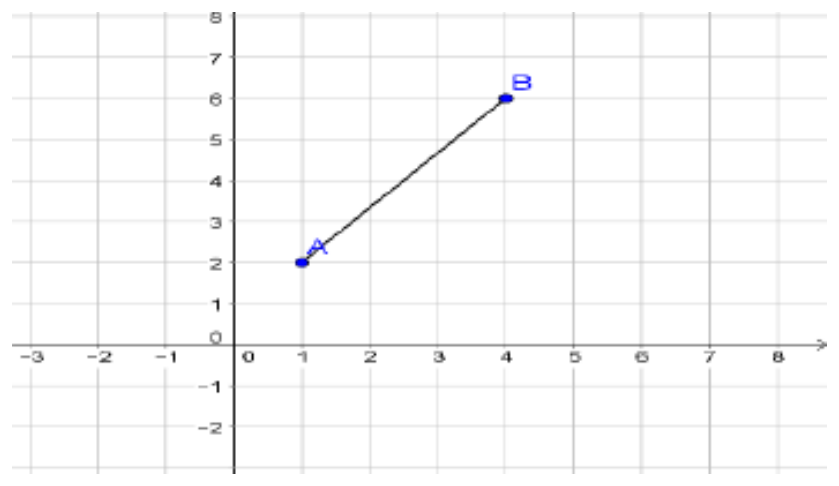
Solution: 𝐴 = w(𝑥 ) − 𝑥 ! ) ) + (𝑦 ) − 𝑦 ! ) )
∴ 𝐴 = w(4 − 1) ) + (6 − 2) ) =5
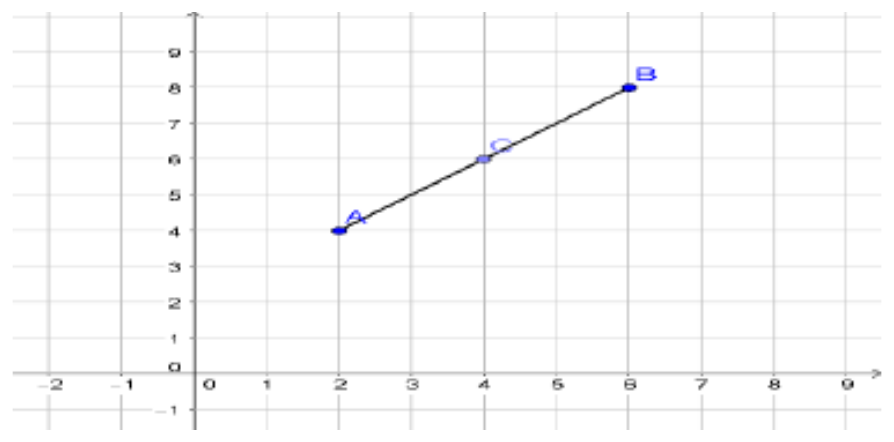
" Solution: i ) , 6j
Activity 3: Learners in collaborative groups generalise that the midpoint of a line segment is the average of the 𝑥 coordinates and the average of the 𝑦 coordinates.
Activity 4: Use collaborative learning to solve direct and indirect questions and explain to the whole group and class.
Teaching and Learning Resources:
- SHS Curriculum
- Mathematical set calculators.
Assessment (1.2.1.AS.1). The document marks these depth-of-knowledge levels for this indicator: Level 1 Recall; Level 2 Skills of conceptual understanding; Level 3 Strategic reasoning.