SHS3 Additional Mathematics · Semester 1, Week 13
Spatial Reasoning
Full lesson notes coming
Notes for this lesson are being prepared. The curriculum details below are complete and ready to use for your planning.
Curriculum details
- Strand
- Geometric Reasoning and Measurement (Strand 2)
- Sub-strand
- Spatial Reasoning (2.1)
- Content standard
- 3.2.1.CS.1 - Demonstrate an understanding of Parabola and its properties. 3.2.1.LO.1 Construct a parabola of a given quadratic equation (𝑦 = 𝑎𝑥 ) + 𝑏 + 𝑐) and explain its key features 3.2.1.LO.2 Sketch a parabola and use it to deduce the relation 𝑦 ) = 4𝑎 3.2.1.LO.3 Sketch a parabola given the directrix Communication: Provide learners the opportunity to engage and and focus. 3.2.1.LO.4 Deduce the equation of the tangent and normal to a parabola
- Indicator
- 3.2.1.LI.6 - Deduce the directrix and focus from a parabolic equation and vice versa.
- Suggested placement
-
Semester 1, Week 13
(Week 13 of the year)
Our suggestion, laid out in curriculum order across three terms of twelve weeks. NaCCA does not fix the week, so follow your school's scheme of learning.
- Source document note
-
The official curriculum document has a fault in this entry, so the curriculum text above is transcribed exactly as printed:
- exemplars - p.489: adjacent duplicated CambriaMath characters were collapsed, but this PDF also maps some equation glyphs to the wrong letter or operator; verify every mathematical expression in this row against the rendered page
- exemplars - p.491: a stacked fraction, matrix, vector or other two-dimensional construct is flattened by the text layer; all visible parts require comparison with the rendered page
- Curriculum reference
- NaCCA curriculum document, p. 489
Exemplars (from the NaCCA curriculum)
Experiential Learning, Talk for Learning, Group work, and Building on what others say.
Learning Experience: Learners in mixed-ability groups deduce the directrix and focus of a parabola as well as write the equation of a parabola given its focus and directrix.
Activity 1 Deducing the directrix and focus of a given parabola with vertex at the origin. Learners in their mixed-ability group brainstorm to deduce the directrix and focus of a given parabola with vertex at the origin.
Example: Find the focus and directrix of 𝑦 ) = −8𝑥
Solution: Compare the equation given to the standard equation of a parabola, i.e. 𝑦 ) = 4𝑎 ∴ 4𝑎 = −8 𝑎 = −2 Therefore, the focus of the parabola is (0, −2), and the directrix is 2.
Activity 2: Learners in their mixed-ability groups create and solve questions on deducing the directrix and focus of a given parabola with vertex at the origin.
Activity 3 Deducing the directrix and focus of a given parabola of a parabola not at the origin. Learners in their mixed-ability groups to brainstorm to deduce the directrix and focus of a given parabola with the vertex not at the origin.
Example: Find the directrix and focus of (𝑦 − 1) ) = −16(𝑥 + 3) Solution
- Comparing the equation to (𝑦 − 𝑘) ) = 4𝑝(𝑥 − ℎ), ℎ = −3 𝑎 𝑘 = 1)
- Also 4𝑝 = −16, and 𝑝 = −4
- Since 𝑝 < 0, the parabola opens left, ∴ 𝑡ℎ𝑒 𝑐 𝑜 𝑡ℎ𝑒 𝑓 𝑖 (ℎ + 𝑝, 𝑘) ∴ 𝑓 = (−3 − 4,1) (−7,1)
Activity 4: Learners in their mixed-ability groups create and solve questions on deducing the directrix and focus of a given parabola with vertex not at the origin.
Activity 5: Deriving the equation of a parabola given its focus and directrix. Learners in their mixed-ability groups brainstorm on how to derive the equation of a parabola, given its focus and directrix.
Example: Determine the equation of the parabola with focus (3, −1) and directrix 𝑥 = 6.
Solution
- Learners led by a leader brainstorm to sketch the curve and deduce the general equation of this parabola as (𝑦 − 𝑘) ) = −4𝑎(𝑥 − ℎ)
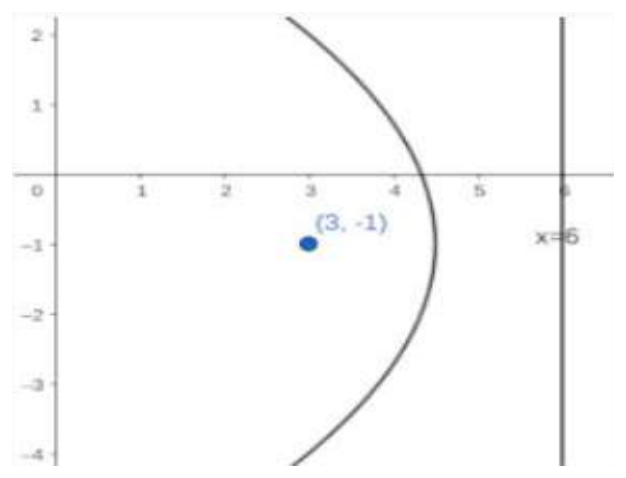
- Through interaction and building on what others say, learners establish that the vertex (ℎ, 𝑘) is the midpoint of (3, −1) and (6, −1) 3+6 ∴ (ℎ, 𝑘) = £ , −1¤ 2 9 = £ , −1¤ 2
- Through interaction and building on what others say, learners establish that 𝑎 is half the distance /*" " between the focus and the directrix, that is ) = ) , since it opens to the left 𝑎 < 0
Therefore, the equation of the parabola is 3 9 (𝑦 + 1) ) = 4 ∙ − £ ¤ £𝑥 − ¤ 2 2 9 (𝑦 + 1) ) = −6 £𝑥 − ¤ 2
Example: Determine the equation of the parabola with focus (−2,13) and directrix 𝑦 = 5.
Solution: The equation of the parabola is (𝑥 − ℎ) ) = 4𝑎(𝑦 − 𝑘) The vertex is the midpoint of the focus and directrix; 13 + 5 = £−2, ¤ 2 = (−2,9)
𝑎 is half the distance between from (−2,13) to (2,5) 13 − 5 =4 2 ∴ 𝑡ℎ𝑒 𝑒 𝑖 (𝑥 + 2) ) = 4 ∙ 4(𝑦 − 9) (𝑥 + 2) ) = 16(𝑦 − 9)
Activity 5: Learners in their mixed-ability groups brainstorm to make generalisations on how to derive the equation of a parabola given its focus and directrix. NB: In general, the equation of the parabola with focus (𝑎, 𝑏) and directrix 𝑦 = 𝑐 is (𝑥 − 𝑎) ) + 𝑏 ) − 𝑐 ) = 2(𝑏 − 𝑐)𝑦
Teaching and Learning Resources:
- SHS Curriculum, Graph boards, mathematical set, ICT tools
Assessment (3.2.1.AS.6). The document marks these depth-of-knowledge levels for this indicator: Level 2 Skills of conceptual understanding; Level 3 Strategic reasoning; Level 4 Extended critical thinking and reasoning.