SHS2 Mathematics · Semester 1, Week 1
Real Number and Numeration System
Lesson notes
Learning Objectives
Indicator: 2.1.1.LI.1 - Carry out operations on surds and rationalize monomial denominators.
By the end of the lesson, learners can:
- Identify surds by verifying the three conditions (irrational, involves a radical sign, radicand is a positive rational number that is not a perfect power) and give examples, non-examples and counterexamples.
- Simplify surds by expressing the radicand as a product of a perfect square and another factor.
- Add and subtract like surds, and multiply and divide surds using the laws √a × √b = √(ab) and √a ÷ √b = √(a/b).
- Square binomial expressions involving surds using the identity (√a ± √b)² = a + b ± 2√(ab).
- Rationalize monomial denominators of the form 1/√a and √a/√b by multiplying the numerator and denominator by the surd in the denominator.
Sign in with your phone number to read the full note and download the GES plan - free.
Sign in with phone numberCurriculum details
- Strand
- Numbers for Everyday Life (Strand 1)
- Sub-strand
- Real Number and Numeration System (1.1)
- Content standard
- 2.1.1.CS.1 - Demonstrate knowledge and understanding of surds, indices and logarithms and establish their laws and properties. 2.1.1.LO.1 Evaluate the relationships between the laws and properties of surds, indices and logarithms and apply them to solve problems with radicands.
- Indicator
- 2.1.1.LI.1 - Carry out operations on surds and rationalize monomial denominators.
- Suggested placement
-
Semester 1, Week 1
(Week 1 of the year)
Our suggestion, laid out in curriculum order across three terms of twelve weeks. NaCCA does not fix the week, so follow your school's scheme of learning.
- Curriculum reference
- NaCCA curriculum document, p. 164
Exemplars (from the NaCCA curriculum)
Through think-pair-share activities, find lengths of segments on Geodot (or grid paper) to introduce the concept of surds (including conditions for surds, examples, non-examples and counterexamples). Ensure participation by all learners and tolerate one another, leading to the development of showing empathy and willingness to work with people of different backgrounds.

 K K K K K K K K K K K K K K K K K K K K K K K K K K K K K K K K K K K K K K K K K K K K K K K K
Figure 2.1 Geodot illustrations
Problem-based Learning: In interactive and collaborative groups, solve problems involving arithmetic operations with surds (I.e., Adding, subtracting, multiplying, dividing, squaring and rationalizing). Allow for innovation and creativity in learners' responses and solutions, leading to the development of self-awareness and independence in learners.
Examples 1. i.e., n a ± n b = n ( a ± b )
where a and b are non-negative m a × n b = mn ab 2. m a . n b = mn 3. m a . n b = mn 4.
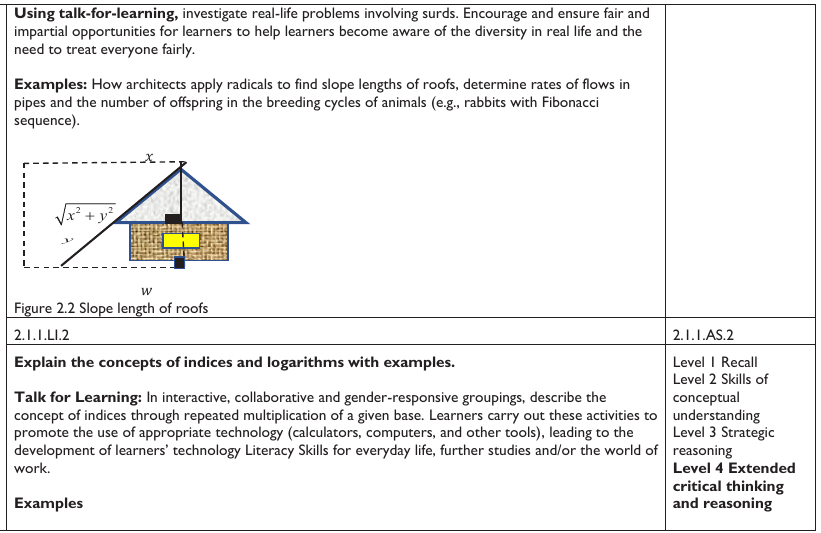
 Using talk-for-learning, investigate real-life problems involving surds. Encourage and ensure fair and impartial opportunities for learners to help learners become aware of the diversity in real life and the need to treat everyone fairly.
Examples: How architects apply radicals to find slope lengths of roofs, determine rates of flows in pipes and the number of offspring in the breeding cycles of animals (e.g., rabbits with Fibonacci sequence).
𝑥
x 2 + y 2
y
𝑤 Figure 2.2 Slope length of roofs
Teaching and Learning Resources:
- * Geodot * Rubber bands * Computer
- * GeoGebra * Google search * Mobile phone
- Calculator
- YouTube videos, etc.
- Geodot,
- Rubber bands
- Cardboards
- Measuring instruments
Assessment (2.1.1.AS.1). The document marks these depth-of-knowledge levels for this indicator: Level 4 Extended critical thinking and reasoning.