SHS2 Additional Mathematics · Semester 2, Week 7
Principles of Calculus
Lesson notes
Learning Objectives
Indicator: 2.3.1.LI.3 - Find derivatives of functions and relations that are not functions (Implicit differentiation).
By the end of the lesson, learners can:
- State what it means for a relation not to be a function and identify when implicit differentiation is required.
- Differentiate both sides of an equation with respect to x, applying the chain rule correctly to terms involving y.
- Rearrange the resulting equation to solve for dy/dx in terms of x and y.
- Apply implicit differentiation to find the slope of a tangent to a curve at a given point.
- Use implicit differentiation to solve related rates problems involving two or more quantities changing with time.
Sign in with your phone number to read the full note and download the GES plan - free.
Sign in with phone numberCurriculum details
- Strand
- Calculus (Strand 3)
- Sub-strand
- Principles of Calculus (3.1)
- Content standard
- 2.3.1.CS.1 - Determine the appropriate rule to use in finding the derivative of a function and relations. 2.3.1.LO.1 Determine the appropriate rule and use it to find the derivative of a function. 2.3.1.LO.2 Estimate the area under a curve using the trapezoid rule.
- Indicator
- 2.3.1.LI.3 - Find derivatives of functions and relations that are not functions (Implicit differentiation).
- Suggested placement
-
Semester 2, Week 7
(Week 27 of the year)
Our suggestion, laid out in curriculum order across three terms of twelve weeks. NaCCA does not fix the week, so follow your school's scheme of learning.
- Source document note
-
The official curriculum document has a fault in this entry, so the curriculum text above is transcribed exactly as printed:
- exemplars - p.382: adjacent duplicated CambriaMath characters were collapsed, but this PDF also maps some equation glyphs to the wrong letter or operator; verify every mathematical expression in this row against the rendered page
- exemplars - p.383: a stacked fraction, matrix, vector or other two-dimensional construct is flattened by the text layer; all visible parts require comparison with the rendered page
- Curriculum reference
- NaCCA curriculum document, p. 382
Exemplars (from the NaCCA curriculum)
Talk for Learning, Think-pair-share, Experiential Learning, and Group Work/Collaborative Learning.
Activity 1: Derivative Applications In pairs or groups, task learners to discuss how to find a derivative of a relation that is not a function and implement it on a given function. 2𝑥 " + 3𝑦 " = 9𝑥
Solution: <A <A 6𝑥 ) + 3𝑦 ) <0 = 9(𝑥 <0 + 𝑦) 𝑑 𝑑 6𝑥 ) + 3𝑦 ) = 9𝑥 + 9𝑦 𝑑 𝑑 <A 6𝑥 ) − 9𝑦 = <0 (9𝑥 − 3𝑦 ) )
<A /0 ! *2A = 20*"A ! <0 )0 ! *"A <A = "0*A ! <0
Activity 2: Implicit Differentiation Learners will be working in convenient groups (ability, mixed-ability and mixed gender) to solve problems on implicit differentiation and share it across groups. E.g. In convenient groups, learners find the derivative of: i. 𝑥 ) 𝑦 + 2 = 5𝑦 , − 𝑥 ii. 𝑒 )A 𝑥 + 2 𝑠 𝑠 (𝑦) = 5𝑥 + 2 − 3𝑥
Activity 3: Everyday Problems Involving Derivatives Learners in specific groups use chain notes to solve everyday problems involving derivatives of relations that are not functions. Learners discuss and demonstrate their understanding of the problem and the solutions arrived at.
Example 1: Two cars start out 500 miles apart. Car A is to the west of Car B and starts driving to the east (i.e., towards Car B) at 35 mph, and at the same time, Car B starts driving south at 50 mph. After 3 hours of driving, at what rate is the distance between the two cars changing? Is it increasing or decreasing?
Solution:
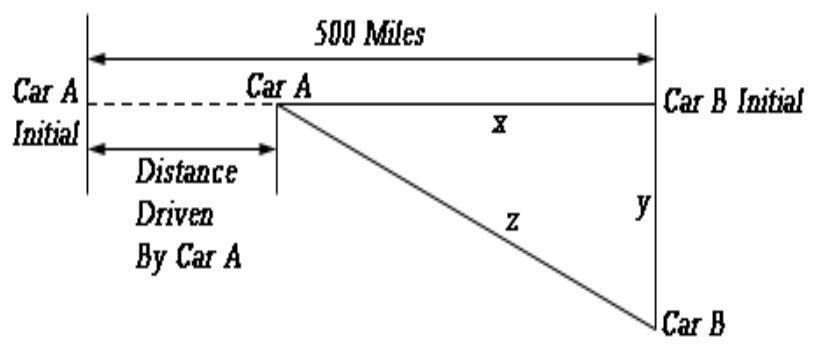
In this figure, y represents the distance driven by Car B, x represents the distance separating Car A from the initial position of Car B, and z represents the distance separating the two cars. After 3 hours of driving time, we have the following values of x and y:
𝑥 = 500 − 35(3) = 395 𝑦 = 50(3) = 150 By Pythagoras theorem, 𝑧 ) = 𝑥 ) + 𝑦 ) = 395 ) + 150 ) = 178525 𝑧 = √178525 = 422.5222 Now to determine 𝑧 - , we apply implicit differentiation as all variables change with time. Given 𝑥 - = −35 𝑎 𝑦 - = 50 𝑧 ) = 𝑥 ) + 𝑦 ) ⟹ 2𝑧 = 2𝑥 + 2𝑦 - - - 𝑧 - (422.5222) = (395)(−35) + (150)(50)
- /"). 𝑧 - = = −14.9696 ,))..)))
So, after three hours, the distance between them is decreasing at a rate of 14.9696 mph.
Example 2: Air is being pumped into a spherical balloon at a rate of 5 cm 3 /min. Determine the rate at which the radius of the balloon is increasing when the diameter of the balloon is 20 cm.
Solution: The volume 𝑉(𝑡) and radius 𝑟(𝑡) are varying with time. 𝑑 𝑉 - (𝑡) = 5, 𝑟 - (𝑡) =? 𝑤ℎ𝑒 𝑟(𝑡) = = 10𝑐 2 Volume of a sphere is given by; 𝑉(𝑡) = " 𝜋[𝑟(𝑡)] " ,
By implicit differentiation; 𝑉 - = 4𝜋𝑟 ) 𝑟 - 5 = 4𝜋(10 ) )𝑟 - ! ⟹ 𝑟 - = 1( 𝑐/𝑚
Example 3: A trough of water is 8 meters in length, and its ends are in the shape of isosceles triangles whose width is 5 meters and height is 2 meters. If water is pumped in at a constant rate of 6m 3 /sec, at what rate is the height of the water changing when the water has a height of 120 cm? At what rate is the width of the water changing when the water has a height of 120cm?
Solution:
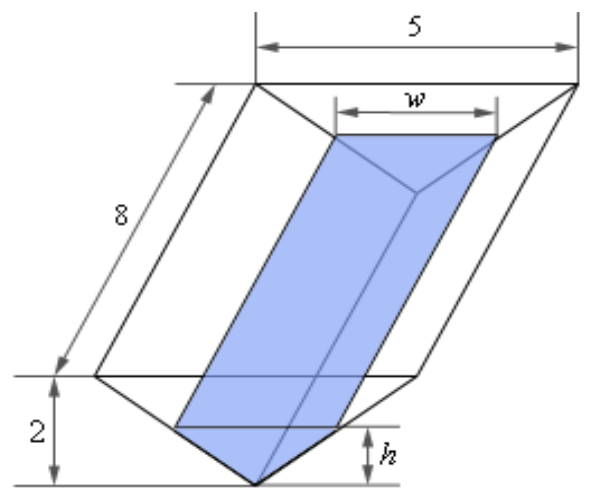
/# " 𝑉 - = ℎ - =? 𝑎 ℎ = 1.2𝑚 ON; 𝑉 = (𝐴 𝑜 𝐸)(𝑑ℎ) = i ) 𝑏 × ℎ𝑒ℎ𝑡j (𝑑ℎ) !
! = ) ℎ𝑤(8) = 4ℎ𝑤
h W . = ) ⟹ 𝑤 = ) ℎ .
. 𝑉 = 4ℎ𝑤 = 4ℎ i ℎj = 10ℎ ) ) By implicit differentiation; 𝑉 - = 20ℎℎ - 6 = 20(1.2)ℎ - ⟹ ℎ - = 0.25 𝑚/𝑠
So, the height of the water is rising at a rate of 0.25 m/sec
. 𝑤 = ) ℎ . ⟹ 𝑤 - = ) ℎ -
𝑤 - = (0.25) = 0.625 𝑚/𝑠 . ) Therefore, the width is increasing at a rate of 0.625 m/sec.
Teaching and Learning Resources:
- Reading resource
- Colour pens
- Notebook
- Graph sheets
- Mathematical sets
- Technological tools
Assessment (2.3.1.AS.3). The document marks these depth-of-knowledge levels for this indicator: Level 2 Skills of conceptual understanding; Level 4 Extended critical thinking and reasoning.