SHS1 Additional Mathematics · Semester 2, Week 11
Principles of Calculus
Lesson notes
Learning Objectives
Indicator: 1.3.1.LI.6 - Generalise the behaviour of a moving object along a path or curve.
By the end of the lesson, learners can:
- Determine whether a given linear function is increasing, decreasing, or momentarily at rest by examining its derivative.
- Find the critical values of a polynomial function by setting its derivative equal to zero.
- Construct intervals on the real number line using critical values and test each interval to determine where a function increases or decreases.
- Generalise the behaviour of a moving object along a curve by interpreting the sign of the derivative in terms of motion (moving forward, moving backward, momentarily stopped).
- Present and defend their generalisations about a function’s behaviour during whole-class discussion, using correct mathematical language.
Sign in with your phone number to read the full note and download the GES plan - free.
Sign in with phone numberCurriculum details
- Strand
- Calculus (Strand 3)
- Sub-strand
- Principles of Calculus (3.1)
- Content standard
- 1.3.1.CS.1 - Demonstrate understanding of the limit of a function, investigate the behaviour of a function near a value in its domain and establish the derivative of a function. 1.3.1.LO.1 Describe graphically and algebraically the behaviour of the function about an input value and determine its derivative.
- Indicator
- 1.3.1.LI.6 - Generalise the behaviour of a moving object along a path or curve. Collaborative learning, Experiential Learning, and initiate Talk for Learning.
- Suggested placement
-
Semester 2, Week 11
(Week 31 of the year)
Our suggestion, laid out in curriculum order across three terms of twelve weeks. NaCCA does not fix the week, so follow your school's scheme of learning.
- Source document note
-
The official curriculum document has a fault in this entry, so the curriculum text above is transcribed exactly as printed:
- exemplars - p.201: adjacent duplicated CambriaMath characters were collapsed, but this PDF also maps some equation glyphs to the wrong letter or operator; verify every mathematical expression in this row against the rendered page
- exemplars - p.202: a stacked fraction, matrix, vector or other two-dimensional construct is flattened by the text layer; all visible parts require comparison with the rendered page
- Curriculum reference
- NaCCA curriculum document, p. 201
Exemplars (from the NaCCA curriculum)
Learning Experience: Learners working in mixed-ability groups investigate the behaviour of a moving object along a path or curve and provide their generalisations for whole class discussions.
Activity 1 Think-pair share: Ask Learners to draw a graph and investigate the behaviour of an object moving along it with respect to derivatives
Activity 2: In pairs, discuss and find the domain's value(s)/interval(s) of the function f increases, decreases or no change as x increases.
Example 1: Is the function 𝑓(𝑥) = 3𝑥 + 4, 𝑥 ∊ 𝑅 increases, decreases or no change?
Solution: <I(0) = 3 > 0, so the function 𝑓 increases. <0
Example 2: Is the function 𝑓(𝑥) = −5𝑥 + 4, 𝑥 ∊ 𝑅 increases, decreases or no change as x increases?
Solution: <I(0) = −5 < 0 so, the function decreases as x increases. <0
Example 3: Is the function 𝑓(𝑥) = 7 increases, decreases or no change as x increases?
Solution: <I(0) = 0. This means it is momentarily at rest at that x value. <0
NB: The following three (3) are true for a given function, f, as x increases: <I(0)
- f(x) increases for all values of x for which <0 > 0. <I(0)
- f(x) decreases for all values of x for which < 0. <0
- <I(0) f(x) momentarily at rest for all values of x for which = 0. <0
Example 4: Find the value(s) of x for which 𝑓(𝑥) = 2𝑥 " − 9𝑥 ) − 24𝑥 + 56 increases, decreases or momentarily at rest
Solution: Step 1. Differentiate the given function: 𝑓(𝑥) = 2𝑥 " − 9𝑥 ) − 24𝑥 + 56 That is, 𝑑(𝑥) = 6𝑥 ) − 18𝑥 − 24 𝑑 Step 2. Find the values of x for which f is momentarily at rest: 𝑑(𝑥) = 6𝑥 ) − 18𝑥 − 24 = 0 𝑑 6𝑥 ) − 18𝑥 − 24 = 0 (𝑥 − 4)(𝑥 + 1) = 0 Hence, at x=4 or -1, f is momentarily at rest.
Step 3. Use the values of x in step 2 to partition the real number line to obtain a real interval. Note that values that are momentarily at rest should not be part of the intervals constructed: Partitioned intervals: (−∞, −1) (−1,4) (4, +∞)
<I(0) Step 4. Test on the intervals in step 3 to arrive at the desired results: <0 Select any value in the interval (−∞, −1) to test. Set x=-2 and test <I(*)) = 6(−2) ) − 18(−2) − 24 = 36 > 0, which implies f is increasing on (−∞, −1) . <0 Select any value in the interval (−1,4) to test. Set x=3 and test <I(") = 6(3) ) − 18(3) − 24 = −26 < 0, which implies f is decreasing on (−1,4) . <0 Select any value in the interval (4, +∞) to test. Set x=5 and test. 𝑑(5) = 6(5) ) − 18(5) − 24 = 36 > 0 𝑑 which implies that f is increasing on (4, +∞) . NB: One may use a graphical approach
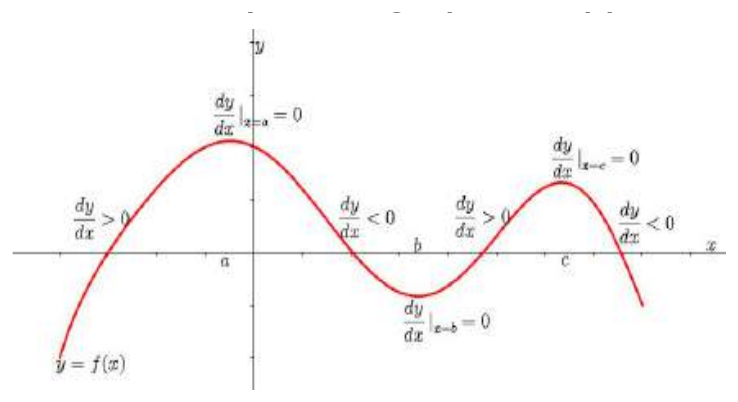
Teaching and Learning Resources:
- GeoGebra
- PhET
- Technology tools
- Mathematical sets
- Calculators
- Learners textbooks
- Graph sheets
Assessment (1.3.1.AS.6). The document marks these depth-of-knowledge levels for this indicator: Level 3 Strategic reasoning; Level 4 Extended critical thinking and reasoning.