SHS1 Additional Mathematics · Semester 2, Week 8
Principles of Calculus
Lesson notes
Learning Objectives
Indicator: 1.3.1.LI.2 - Classify left-hand and right-hand limits algebraically and with the aid of technology where available or through any creative means.
By the end of the lesson, learners can:
- Interpret the notations lim f(x), lim f(x), and lim f(x) correctly, including the meaning of the superscript - and + signs.
- Determine left-hand and right-hand limits of a function from its graph and state whether the two-sided limit exists.
- Compute one-sided limits algebraically for polynomial and rational functions using direct substitution and limit properties.
- Use tables of values and technology (GeoGebra, or a scientific calculator) to investigate how a function behaves as x approaches a value from the left and from the right.
- Distinguish between cases where a limit exists and where it does not exist, using the condition that the left-hand limit must equal the right-hand limit.
Sign in with your phone number to read the full note and download the GES plan - free.
Sign in with phone numberCurriculum details
- Strand
- Calculus (Strand 3)
- Sub-strand
- Principles of Calculus (3.1)
- Content standard
- 1.3.1.CS.1 - Demonstrate understanding of the limit of a function, investigate the behaviour of a function near a value in its domain and establish the derivative of a function. 1.3.1.LO.1 Describe graphically and algebraically the behaviour of the function about an input value and determine its derivative.
- Indicator
- 1.3.1.LI.2 - Classify left-hand and right-hand limits algebraically and with the aid of technology where available or through any creative means.
- Suggested placement
-
Semester 2, Week 8
(Week 28 of the year)
Our suggestion, laid out in curriculum order across three terms of twelve weeks. NaCCA does not fix the week, so follow your school's scheme of learning.
- Source document note
-
The official curriculum document has a fault in this entry, so the curriculum text above is transcribed exactly as printed:
- exemplars - p.185: adjacent duplicated CambriaMath characters were collapsed, but this PDF also maps some equation glyphs to the wrong letter or operator; verify every mathematical expression in this row against the rendered page
- exemplars - p.189: a stacked fraction, matrix, vector or other two-dimensional construct is flattened by the text layer; all visible parts require comparison with the rendered page
- Curriculum reference
- NaCCA curriculum document, p. 185
Exemplars (from the NaCCA curriculum)
Group discussion: Learning Experience: Learners in their mixed-ability groups are to initiate a discussion on the meaning of approaching a number on a real number line from the left or from the right of the number.
Activity 1: (left- and right-hand limits)
- Learners work in mixed groups and present across groups on left- and right-hand limits of a function and represent each of them algebraically. In addition, learners are to use graphs to distinguish the value a function approaches when an input approaches a number from the left or right.
Example 1: What is the value of 𝑔(𝑥) approaches as x approaches the number -7 from the left or from the right on the horizontal axis? (Refer to Fig. 1). Learners are to share any observations made across groups.
NB: The value 𝑔(𝑥) approaches when x approaches the number -7 from the left is 4 and from the right is 2. This means the value 𝑔(𝑥) approaches depend on the direction (left or right) x approaches -7.
Example 2 (notation of limits of a function): Write down the mathematical notation; What value will 𝑔(𝑥) approach as 𝑥 approaches −7 from the left?
Solution: 𝑔(𝑥)? Note: The negative sign on the superscript -7 means 𝑥 approaching −7 from the left. And the value 𝑔(𝑥 ) approaches is 4, so we write, 𝑔(𝑥) = 4.
- -What is the limit as 𝒙 approaches −𝟕 from the right? Solution: 𝑔(𝑥) = 2
Note: The positive sign on the superscript -7 means x approaching −7 from the right. And the value is 2.
Example 3 (Generalisation):
Type equation here.What is the meaning of 𝑓(𝑥) = 𝐿?
Solution: If 𝑓 is a function, then the 𝑓(𝑥) = 𝐿 means the value of 𝑓(𝑥) approaches 𝐿 as 𝑥 gets very close to 𝑎 from the left and right.
Example 4 (Existence of a limit): Determine whether 𝑔(𝑥) exists? Solution: From Fig. 1, Note that 𝑔(𝑥) = 𝑔(𝑥) = 2 Hence the 𝑔(𝑥) exists.
Example 5 (limit that does not exist): Verify whether 𝑔(𝑥) exists. Solution: Since 𝑔(𝑥) ≠ 𝑔(𝑥) So 𝑔(𝑥) does not exist. (Refer to Fig. 1)
Example 6 (limit of a function and function value): Find the function value f(x) approaches as x approaches 8 and the function value at x=8, thus f (8). What is the difference? (Use fig. 2)
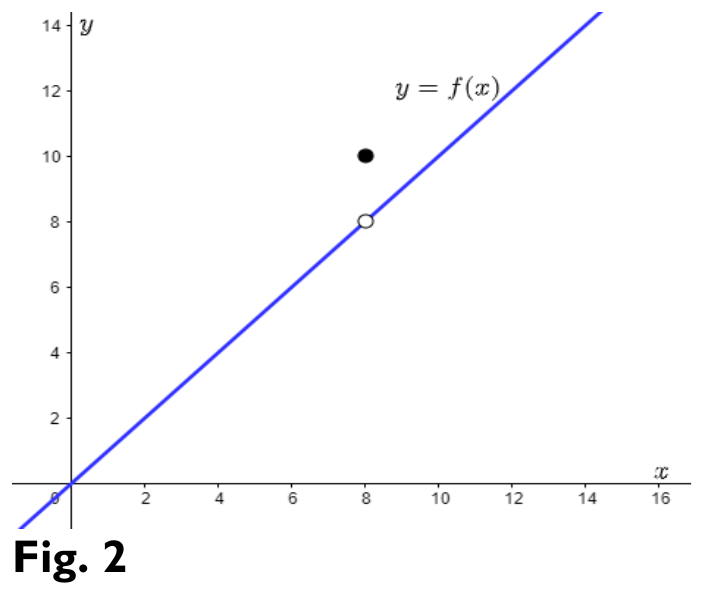
Fig. 2
Solution The function value when 𝑥 = 8, 𝑓(8) = 10; however, as 𝑥 approaches 8, the function approaches 8.
Mini project Learners are to work in groups to construct a table and graph 𝑓. Use technology or any innovative ! ways to investigate the behaviour of 𝑓(𝑥) = 0$) as 𝑥 approaches 2.
NB: 𝑥 can approach 2 from the left or right with small step sizes; hence, you may use 3 input values for each side (left and right) to undertake the investigation. Thus, approaching 2 from the left, use: 1.97, 1.988, 1.9998. And from the right use: 2.03, 2.002, 2.0001. You increase the input values.
NB: Unbounded behaviour of a limit refers to a function growing without bound (in other words, to infinity) at the limit point.
Limit Properties: Suppose that 𝑓(𝑥) 𝑎 𝑔(𝑥) both exist, then we have the following results.
- If 𝑘 is a constant, then 𝑘 ∙ 𝑓(𝑥) = 𝑘 ∙ 𝑓(𝑥)
- If 𝑟 is a positive constant, then [𝑓(𝑥)] 3 = [𝑙 𝑓(𝑥)] 3 0→&
- 𝑙 [𝑓(𝑥) + 𝑔(𝑥)] = 𝑙 𝑓(𝑥) + 𝑙 𝑔(𝑥) 0→& 0→& 0→&
- 𝑙 [𝑓(𝑥) − 𝑔(𝑥)] = 𝑙 𝑓(𝑥) − 𝑙 𝑔(𝑥) 0→& 0→& 0→&
- 𝑙 [𝑓(𝑥) ∙ 𝑔(𝑥)] = É𝑙 𝑓(𝑥)Ê ∙ [𝑙 𝑔(𝑥)] 0→& 0→& 0→& I(0) _L# I(0)
- 𝑖 𝑙 𝑔(𝑥) ≠ 0, 𝑡ℎ𝑒 𝑙 = )→- 0→& J(0) _L# J(0) 0→& )→-
Limit of a polynomial function: Let 𝑝(𝑥) be a polynomial function, 𝑎 of any number. Then 𝑙 𝑝(𝑥) = 𝑝(𝑎) 0→&
+(0) Limit of a rational function: Let 𝑟(𝑥) = `(0) be a rational function, where 𝑝(𝑥) 𝑎 𝑞(𝑥) are
polynomials. Let 𝑎 be a number such that 𝑞(𝑎) ≠ 0. Then 𝑙 𝑟(𝑥) = 𝑟(𝑎) 0→&
Example 6 Given𝑓(𝑥) = −9, 𝑔(𝑥) = 2 and ℎ(𝑥) = 4 Use the limit properties to compute each of the following limits. If it is not possible to compute any of the limits, clearly explain why not. Find a. [𝑓(𝑥) − 𝑔(𝑥) + ℎ(𝑥)]
Solution: lim [𝑓(𝑥) − 𝑔(𝑥) + ℎ(𝑥)] = 𝑙 𝑓(𝑥) − 𝑙 0→1 𝑔(𝑥) + 𝑙 0→1 ℎ(𝑥) 0→1 0→1 = −9 − 2 + 4 = −7
b. [3ℎ(𝑥) − 6]
lim [3ℎ(𝑥) − 6] = 3𝑙 ℎ(𝑥) − 𝑙 6 0→1 0→1 0→1
= 3(4) − 6 =6
Example 7 Given 𝑓(𝑥) = 1, 𝑔(𝑥) = 10 and ℎ(𝑥) = −7. Use the limit properties to compute each of the following limits. If it is not possible to compute any of the limits, clearly explain why not. a. 𝑙 [𝑓(𝑥)𝑔(𝑥)ℎ(𝑥)] 0→*, Solution: lim [𝑓(𝑥)𝑔(𝑥)ℎ(𝑥)] = É 𝑙 𝑓(𝑥)Ê É 𝑙 𝑔(𝑥)Ê É 𝑙 ℎ(𝑥)Ê 0→*, 0→*, 0→*, 0→*, = (1)(10)(−7) = −70 ! "*I(0) b. 𝑙 É W(0) + J(0)$W(0) Ê 0→*, Solution: ! "*I(0) 𝐿 0→*, É W(0) + J(0)$W(0) Ê
1 3 − 𝑓(𝑥) = 𝑙 + 𝑙 0→*, ℎ(𝑥 ) 0→*, 𝑔(𝑥 ) + ℎ(𝑥 ) _L# ! _L# ["*I(0)] = _L# )→.' + _L# )→.' W(0) [J(0)$W(0)] )→.' )→.'
_L# ! _L# "* _L# I(0) = _L# )→.' + _L# )→.' )→.' W(0) J(0)$ _L# W(0) )→.' )→.' )→.' ! "*! = *7 + !(*7
= )! !!
Example 8 Given that 𝑓(𝑥) = 3𝑥 + 4 and 𝑔(𝑥) = 7 − 4𝑥, verify the following limits properties for 𝑘 = 6, 𝑎 = 1 and = 2.
Solution:
- If 𝑘 is a constant, then 𝑘 ∙ 𝑓(𝑥) = 𝑘 ∙ 𝑓(𝑥) 𝑘 ∙ 𝑓(𝑥) = 6 ∙ (3𝑥 + 4) = (18𝑥 + 24) = 42 𝑘 ∙ 𝑓(𝑥) = 6 (3𝑥 + 4) = 6(7) = 42 Hence 𝑘 ∙ 𝑓(𝑥) = 𝑘 ∙ 𝑓(𝑥)
- If 𝑟 is a positive constant, then [𝑓(𝑥)] 3 = [𝑙 𝑓(𝑥)] 3 0→&
- 𝑙 [𝑓(𝑥) + 𝑔(𝑥)] = 𝑙 𝑓(𝑥) + 𝑙 𝑔(𝑥) 0→& 0→& 0→&
- 𝑙 [𝑓(𝑥) − 𝑔(𝑥)] = 𝑙 𝑓(𝑥) − 𝑙 𝑔(𝑥) 0→& 0→& 0→&
- 𝑙 [𝑓(𝑥) ∙ 𝑔(𝑥)] = É𝑙 𝑓(𝑥)Ê ∙ [𝑙 𝑔(𝑥)] 0→& 0→& 0→&
NB:
- Some forms of limits are called indeterminate if the limiting behaviour of individual parts of the given expression cannot determine the overall limit. Learners must be aware of such limits and how to overcome them without necessarily going through L'Hôpital's Rule.
- Determinate Forms: An undefined expression involving some operation between two quantities is called a determinate form if it evaluates to a single number value or infinity.
- Indeterminate Forms: An undefined expression involving some operation between two quantities is called an indeterminate form if it does not evaluate to a single number value or infinity.
( c - the indeterminate forms are ( , c , 0 ( , ∞ ( , ∞ − ∞, 1 c and ∞ − ∞
Example 9: Find the following √0$,*) a. 0 Solution: Note that applying the properties may yield an indeterminate form; thus,
√0$,*) = ( ( Hence, you may have to rationalise the numerator 0
√0$,*) √0$,$) (0$,)*, ∙ = 0 √0$,$) 0(√0$,$)) 0 = 0(√0$,$))
! = the as x approaches 1 √0$,$) ! ! approaches , . √0$,$)
0 " $1 b. 0 ! *, Solution 0 " $1 ( Note: 0 ! *, = ( so we have indeterminate form and their square roots, so from the remainder
theorem, there are common factors; hence 0 " $1 (0$))(0 ! *)0$,) = 0 ! *, (0*))(0$)) =0 ! *)0$,> = (0*))
Thus 𝑥 " + 8 𝑥 ) − 2𝑥 + 4 = 𝑥 ) − 4 𝑥 − 2
!) = − , = −3 Activity 2: (limit at infinity) -Learners are to work in mixed groups to discuss and present across groups to find limits at infinity.
Example 1 (limit at infinity) 𝑥 + 1 𝑥 − 1
Solution: $ _L# d!$ ) e 𝑙 )→/ $ 0→c _L# d!* e ) )→/ ! =1 ! E.g. 𝑙 (2𝑥 , − 𝑥 ) − 8𝑥) 0→c
Solution: 𝐿 0→c (2𝑥 , − 𝑥 ) − 8𝑥) = ∞
Teaching and Learning Resources:
- GeoGebra
- PhET
- Technology tools
- Mathematical sets
- Calculators
- Learners textbooks
- Graph sheets
Assessment (1.3.1.AS.2). The document marks these depth-of-knowledge levels for this indicator: Level 2 Skills of conceptual understanding; Level 3 Strategic reasoning.