JHS1 Social Studies · Term 2, Week 2
Political Institutions and Structures in Ghana
Lesson notes
Learning Objectives
Indicator: B7.3.3.1.1 - Analyse the indigenous political systems in pre-colonial Ghana and their relevance today.
By the end of the lesson, learners can:
- Identify at least four major pre-colonial Ghanaian states or kingdoms and name the type of political system each practised.
- Describe the key features of the main indigenous political systems (centralised and non-centralised) in pre-colonial Ghana.
- Compare and contrast the political systems of two pre-colonial Ghanaian states, noting at least two similarities and two differences.
- Explain the relevance of indigenous political institutions, such as chieftaincy, in contemporary Ghanaian governance.
- Discuss the role of women, particularly Queen mothers, in the chieftaincy institution both in the past and today.
Sign in with your phone number to read the full note and download the GES plan - free.
Sign in with phone numberCurriculum details
- Strand
- Law and Order in the Ghanaian Society (Strand 3)
- Sub-strand
- Political Institutions and Structures in Ghana (3.3)
- Content standard
- B7.3.3.1 - Demonstrate knowledge and understanding of pre-colonial Ghanaian political systems and their relevance in contemporary Ghana.
- Indicator
- B7.3.3.1.1 - Analyse the indigenous political systems in pre-colonial Ghana and their relevance today.
- Suggested placement
-
Term 2, Week 2
(Week 14 of the year)
Our suggestion, laid out in curriculum order across three terms of twelve weeks. NaCCA does not fix the week, so follow your school's scheme of learning.
- Curriculum reference
- NaCCA curriculum document, p. 14
Exemplars (from the NaCCA curriculum)
1. In pairs, learners create charts showing pre-colonial Ghana's major states and kingdoms and the political systems practised.
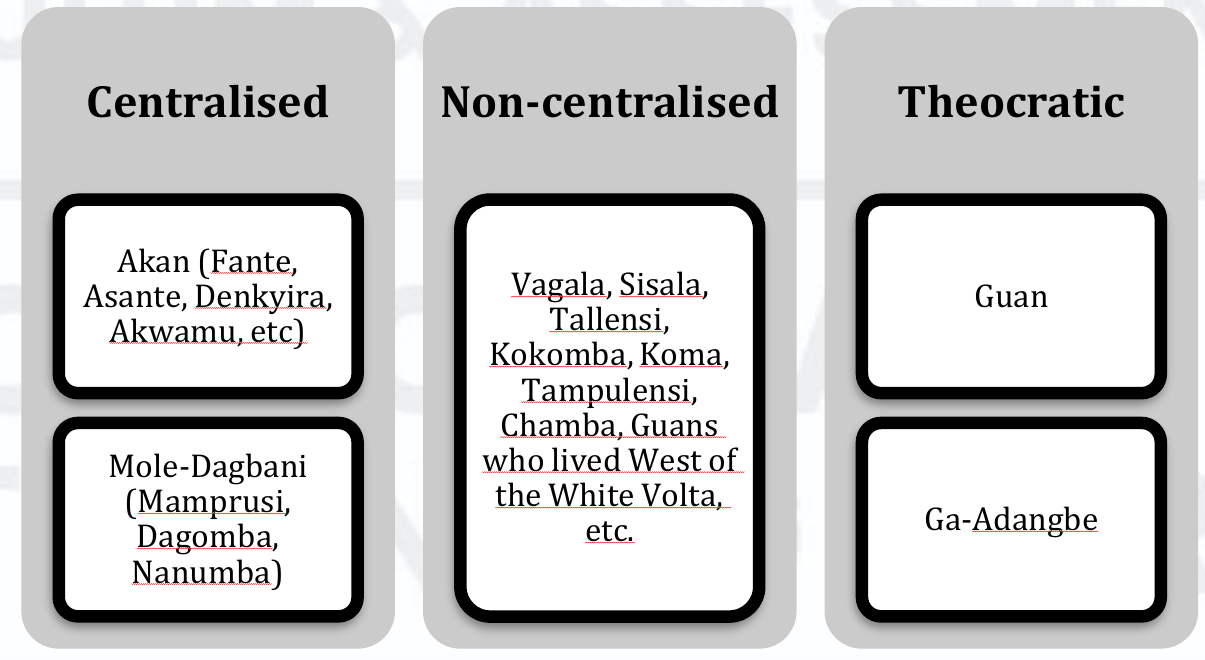
2. In mixed-ability groups, learners create posters describing the political systems in pre-colonial Ghana.
3. In small groups, learners compare and contrast the different forms of political systems in pre-colonial Ghana.
4. In mixed-ability groups, learners elaborate on the importance of Indigenous Political Institutions in contemporary Ghana.
5. Using the think-pair-share technique, learners discuss the role of women in the structure of the chieftaincy institution (e.g. Queen mother, female chiefs, etc.).