B5 English Language · Term 1, Week 2
Poems
Lesson notes
Learning Objectives
Indicator: B5.1.4.1.1 - Demonstrate understanding of lessons in stories by making relevant comments
By the end of the lesson, learners can:
- Identify the beginning, middle and ending of a story told aloud.
- Retell a story sequentially using the correct order of events.
- Answer story element questions about the main character, setting, and key events.
- Make relevant comments about the lesson or moral of a story.
- Use a story-element table to organise details from a story.
Sign in with your phone number to read the full note and download the GES plan - free.
Sign in with phone numberCurriculum details
- Strand
- Oral Language (Strand 1)
- Sub-strand
- Poems (1.4)
- Content standard
- B5.1.4.1 - Respond to stories
- Indicator
- B5.1.4.1.1 - Demonstrate understanding of lessons in stories by making relevant comments
- Suggested placement
-
Term 1, Week 2
(Week 2 of the year)
Our suggestion, laid out in curriculum order across three terms of twelve weeks. NaCCA does not fix the week, so follow your school's scheme of learning.
- Source document note
-
The official curriculum document has a fault in this entry, so the curriculum text above is transcribed exactly as printed:
- exemplars - p.74
- Curriculum reference
-
English Language Curriculum (Basic 4-6), 2019, p. 74
Transcribed from the official NaCCA publication. Check this page against the source.
Exemplars (from the NaCCA curriculum)
- Tell a story using the appropriate procedure or stages. With examples, guide learners to identify the beginning, middle and ending.
- Invite learners to retell story sequentially. Story Element: What are the key details about this story?
Who is the main character? What is the setting? What event(s) happened at the beginning of the story? What event(s) happened at the middle of the story? What event(s) happened at the end of the story?
- Have learners take turns to comment on the story.
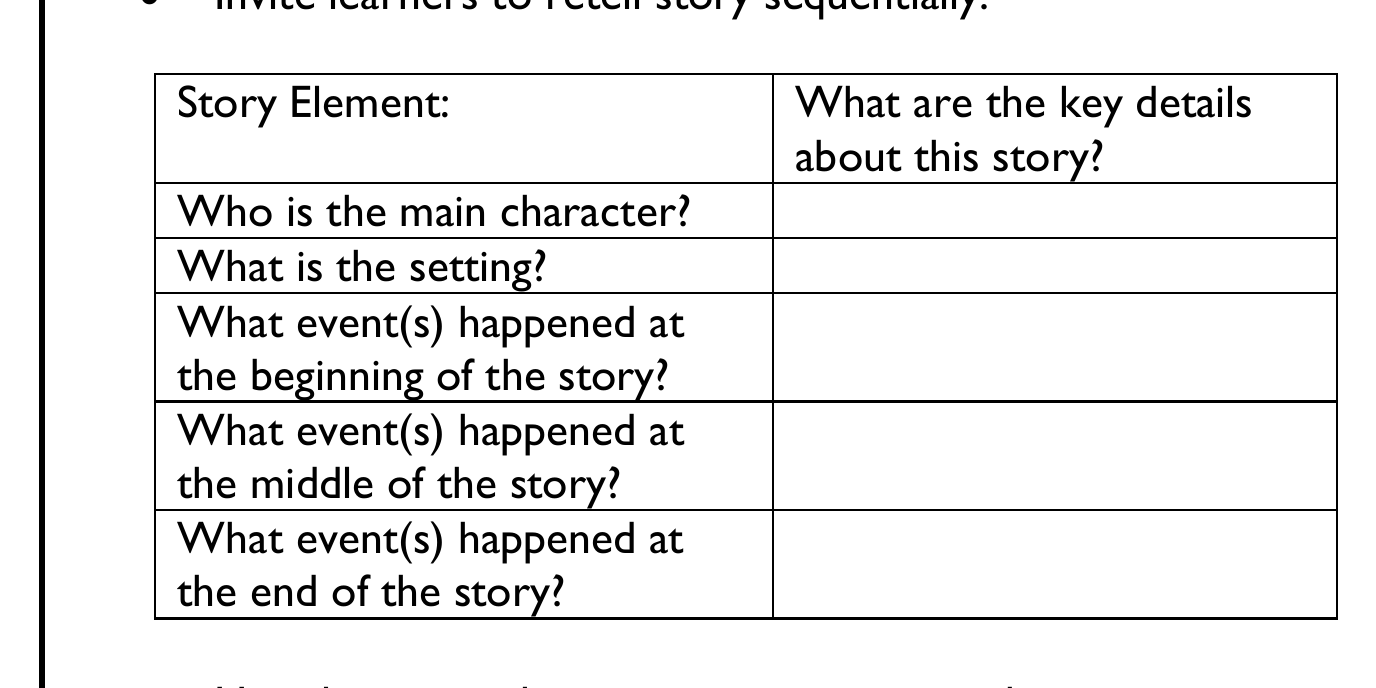
The story-element table is drawn, and its cells arrive in the text layer as one run of words. Its columns are "Story Element:" and "What are the key details about this story?", with rows for the main character, the setting and the events at the beginning, middle and end; the figure shows it.